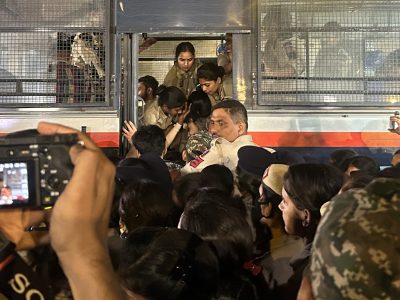
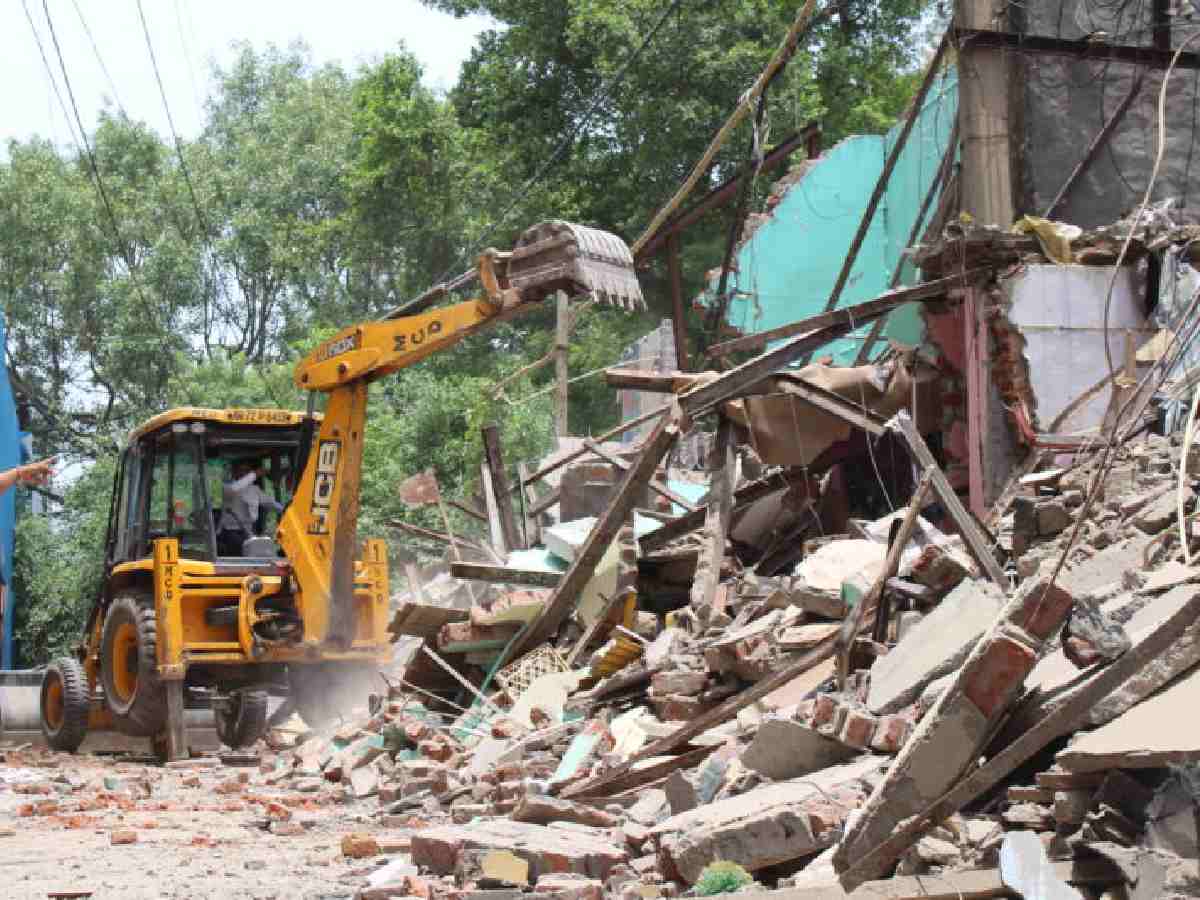
Their boats lay moored along the river bank as bulldozers rolled into Yamuna Bazar on Thursday. With their meagre settlements razed, families, who have for generations depended on the ebb and flow of the Yamuna for livelihood, stared out at the murky waters — perhaps finding in it a likeness of their bleak futures.
The Delhi Development Authority (DDA) carried out a demolition drive in Delhi’s Yamuna Bazar area after issuing notices asking residents inhabiting settlements between Ghat No. 2 and 32 to vacate the protected Yamuna floodplain.
Carrying their little possessions on their backs as they marched towards looming uncertainty, and nearby shelter homes, the now-homeless population could only whimper, “The court has asked the authorities to listen to us, but they are not listening…” — a roaring bulldozer trampled over end the sentence.
“I have been sitting here since six in the morning, just watching,” said Sudhakar Kumar Nishadraj.
Nishadraj operates a boat near Ghat No. 9, ferrying people and pilgrims across the Yamuna, and bringing families to immerse the ashes of their loved ones in the holy river.
“Two days ago, officials came and told us that everything must be removed by June 25. We had seen it coming,” he said, resignation in his voice. “Where do we go now,” he asked, staring at the Yamuna.
Nishadraj said around 100 families whose lives depended on ferry services and religious rites on the Yamuna have been affected by the demolition, including eight or nine families who have for generations looked at the river for a living.
“My family has been doing this since my grandfather’s grandfather. We have documents showing we go back nearly 150 years. We belong to the Nishad community. In the Ramayana, Nishadraj helped Lord Ram, Sita and Lakshman cross the river. We consider ourselves descendants of that lineage, and this river has been our life,” he said.
Besides ferry and ritual services, Nishadraj said he had cultivated on a small patch of land along the Yamuna bank to supplement his income.
“Now I have nothing. I have three children. My daughter and elder son are in first year of college, and my younger son is in Class 12. I don’t know how I will pay their fees, or even support my family. We may have to move to Wazirabad, but rents are high and I don’t even have an income anymore,” he said.
Pointing towards his boat, he said it is all that remains. “If debris from the demolition falls into the river, my boat could be damaged too. That boat is everything I own.”
Another boatman, who did not wish to be named, said his family had lived and worked along the Yamuna for nearly 200 years.
He recalled how, not long ago, a young girl jumped into the Yamuna in an attempt to end her life and local boatmen jumped into the river and rescued her.
“This river is our livelihood. Whether taking people for boat rides, helping families perform last rites of their loved ones or rescuing someone in distress, this is what we have done all our lives. Today, we are being removed from the very place where we have known as our life,” he said.
“We are not asking for luxury. We only want a place where we can pursue our livelihood. I have two kids and I need to send them to school, I also take care of my elderly parents’ medical bills, what do I do now?”
Another resident, Rajesh, also said the demolition has left his family without any means of income.
“My grandfather did this work, my father too, and now I do the same. Our family has lived here for more than 150 years. We know no other work,” he said.
“We were told to vacate, but no one told us how we are to survive. If we move away from the river, how will we operate our boats? This is not just about losing a home. We have lost the only livelihood our family has ever known,” he lamented.
Rajesh said arranging rent would be a major hassle. The expenses of finding a new home, shifting, and simply daily sustenance would crush their family.
The DDA carried out the demolition drive in the Yamuna Bazar area a day after issuing fresh notices on June 23 asking residents to vacate ‘illegal’ settlements voluntarily, failing which the ‘encroachments’ would be removed.
The authorities have identified the area as part of the Yamuna’s O-Zone, a protected no-construction floodplain under the management of the DDA.
Residents have been asked to move to nearby shelter homes.
For many residents, however, the uncertainty extends beyond finding another place to live. They say moving away from the river would mean leaving behind an occupation that has defined their families for generations.
“The river is our life. Without it, we don’t know how to begin again,” Nishadraj said.