
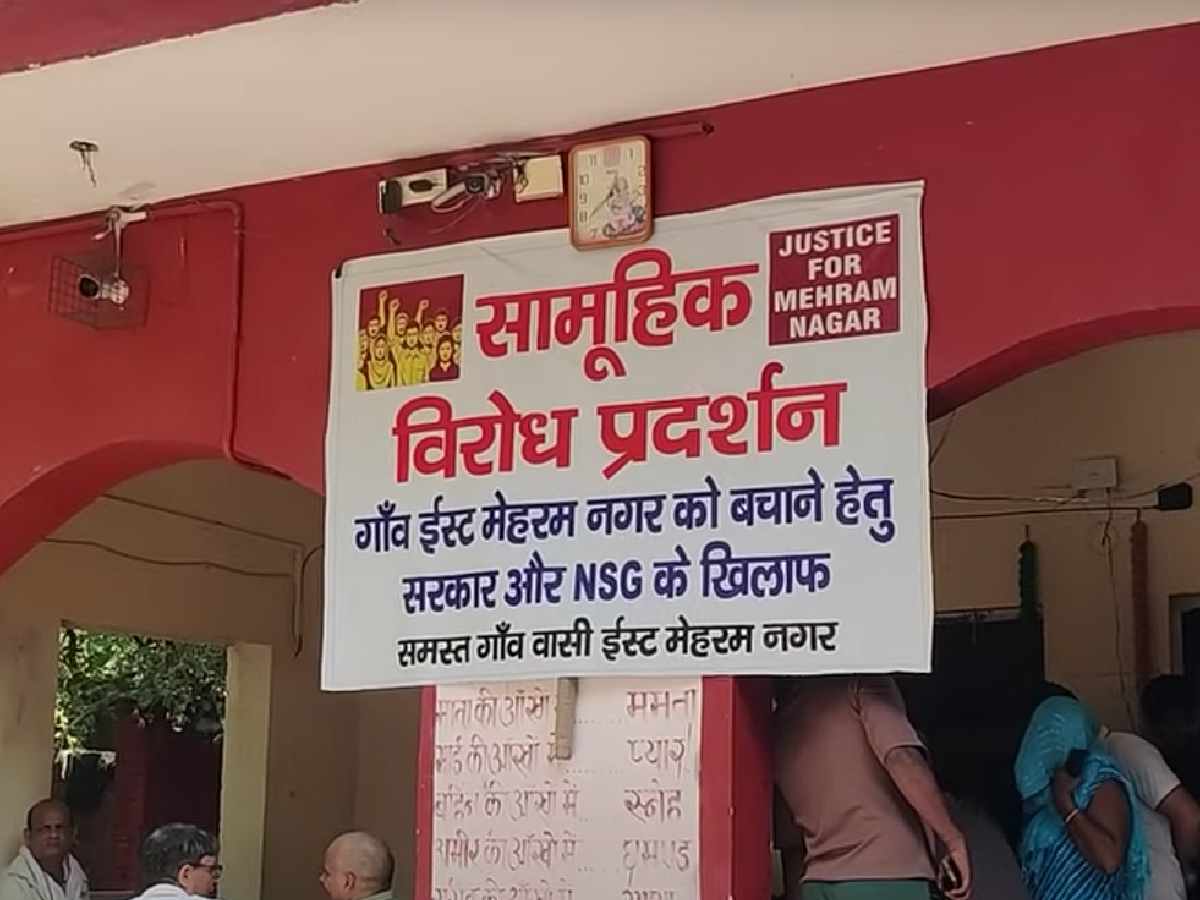
Under the shadow of Delhi’s bustling Indira Gandhi International Airport, the centuries-old village of Mehram Nagar is caught in a struggle for survival and identity. Once a quiet settlement known for its close-knit community and old temple, it is now the centre of a confrontation between residents and the National Security Guard (NSG).
What began as a government notice has grown into a full-scale resistance. Families who say they have lived here for generations are refusing to vacate their homes. For them, this is not just a dispute over land but a fight to protect their history, dignity and the only home they have ever known.
Savita, 50, sits clutching bundles of documents — voter IDs, ration cards and faded property papers. She says these prove her family’s right to live here. Around her, dozens of residents are seen poring over stacks of files, their faces lined with worry.
The village temple has turned into a makeshift command centre, where residents meet to exchange updates, sign petitions and discuss the next course of action.
A settlement rooted in history
Mehram Nagar’s history stretches back nearly 300 years, long before the airport or the NSG came into existence. In 1962, the Delhi Cantonment Board (DCB) allotted 60 houses to families displaced during the expansion of the airport.
Over the decades, the settlement grew to accommodate thousands of people, mostly from Scheduled Castes and Other Backward Classes, who built permanent homes and established livelihoods in the area. Today, between 10,000 and 15,000 people are estimated to live here. More than 5,000 houses have electricity, water supply and other civic amenities.
Residents argue that these provisions — voter IDs, water connections and electricity metres — prove their legitimacy. “If our homes were illegal, why did the authorities allow us to build them, and why did they collect taxes and provide us with services?” asked Savita.
For her, the eviction feels like a betrayal by the very system that once recognised her community. “The government that promised gareebi hatao now seems interested only in garib hatao. This government thinks that only wealthy people have the right to live in the national capital, while the others should leave the city,” she said.
Voices of protest and pain
The NSG issued eviction notices alleging illegal encroachment and unauthorised occupation of land allotted to it by the Ministry of Defence. The move has triggered widespread anger.
In recent weeks, residents have organised protest marches and mahapanchayats, seeking support from political and social groups. “We have lived here for generations. My family’s history is in every brick of this house. I will choose to die instead of relocating. If the authorities are ready to take the blame of a mass genocide just to snatch our land, then only they should think of bringing their bulldozers,” said Kamla Devi, 90.
“I was married here, raised my children here, and buried my husband here. They want me to leave all this behind as if none of it matters,” she said, her wrinkled hands trembling but her voice steady. “I would rather die under the rubble of my home than be forced out.”
Pinki, 45, shared the same resolve. “We have been living here for more than 300 years. Our forefathers built this village. Now suddenly, the NSG is calling it illegal. How is this justice?” she asked.
“We are the poor, not the criminals”
According to residents, most families belong to marginalised communities, including Dalits and Muslims. Many work as labourers, drivers, domestic helpers or small shopkeepers, with limited means to start over.
“This eviction has caused sleepless nights for all of us,” said Naseebh Singh, 55. “We are poor, but not criminals. The authorities treat us like trespassers on our own land. If they throw us out, we have nowhere to go.”
Singh added that the eviction notice threatens both homes and livelihoods. “We don’t have the income to rent houses elsewhere. For us, this village is our life. Losing it would destroy us completely,” he said.
Residents claim that three people have already died from stress and heart attacks since the notices were issued. “Our elderly are breaking down, our children are scared, and our youth are angry,” said Ramesh Chauhan, 66, a community representative. “This pressure is unbearable.”
Also read: 10 years in hiding: Rohini ashram’s self-styled godman, accused of rape, found dead
Legal relief but lingering fear
Amid growing protests, the villagers moved the Delhi High Court, which granted a temporary stay on demolition. The relief, however, has brought little comfort.
Posters and banners with the slogan Purvi Mehram Nagar Bachao Andolan now line the streets. Graffiti on the walls reads, NSG ki tanashahi nahi chalegi and Purkho ki yahi hai nishani, nahi karenge iski kurbani.
For residents, the NSG’s move feels like an attack on their identity. “Why did the government stay silent when we built our homes decades ago? Why did they give us voter cards and ration cards if this was illegal?” asked Chauhan. “Now that the area has developed, they want to push us out.”
The NSG has said that the eviction drive targets only unauthorised encroachments on land officially handed over to it by the Ministry of Defence. Officials have met village representatives, asking them to submit legal documents for review.
Political support and public outrage
As the protests continue, opposition parties have joined the residents. Both the Aam Aadmi Party (AAP) and the Congress have condemned the eviction order, accusing the BJP-led government of targeting the poor and marginalised.
AAP leaders Saurabh Bharadwaj and Rajya Sabha MP Sanjay Singh took part in the Mehram Nagar Bachao protest, expressing solidarity with the residents. “No one will be allowed to demolish this historic village,” Bharadwaj said at the rally.
Delhi Congress president Devender Yadav also addressed the gathering, warning that the party would not allow even a single house to be demolished. “This government is anti-poor and anti-Dalit. It is working for corporate interests, not the people,” he said. “We will stand shoulder to shoulder with the villagers.”
Between past and present
Mehram Nagar is not just another locality in Delhi; it is a living piece of history. Founded during the Mughal era and named after Mehram Khan, a courtier of Emperor Shah Jahan, the village has survived centuries of change, from colonial rule to rapid urbanisation.
Today, it faces the threat of being wiped off the map. While some residents are willing to discuss compensation and relocation within a five-kilometre radius, most refuse to move. “We were here before the NSG, before the airport, before all of this,” said Chauhan. “How can we become outsiders in our own land?”
A struggle beyond boundaries
The conflict in Mehram Nagar highlights a larger issue of urban displacement and the rights of traditional villages caught in Delhi’s development drive. Similar struggles have erupted in other parts of the city, where expansion projects clash with long-established settlements.
For the people of Mehram Nagar, the battle is personal. “We may be poor, but we are not powerless,” said Savita, holding her documents close. “We will not leave the land of our ancestors. If they demolish our houses, they will have to demolish us too.”