Laid on a foot-long bed that Pinky Devi, 36, had bought when she had just been married, her son keeps squirming in pain as fresh bruises send sharp jolts through his body. A large lump has formed on his foot, making even the slightest movement almost impossible.
Fending for the family on her own, the sight of her son’s condition only deepens her anguish. Devi divorced her husband owing to marital differences, and now lives with three of her children beside the Okhla Phase 1 industrial estate at Lohar Basti. The injury has pushed her to consider running from pillar to post to gather enough money for treatment.
“Metro officials have said that they will help out with whatever amount is required for his treatment. Thankfully, the doctors told us that the wounds are mostly external and it has not ruptured or broken anything in the body. I hope that the situation will not turn worse for wear,” Devi said.
Excavation triggers collapse
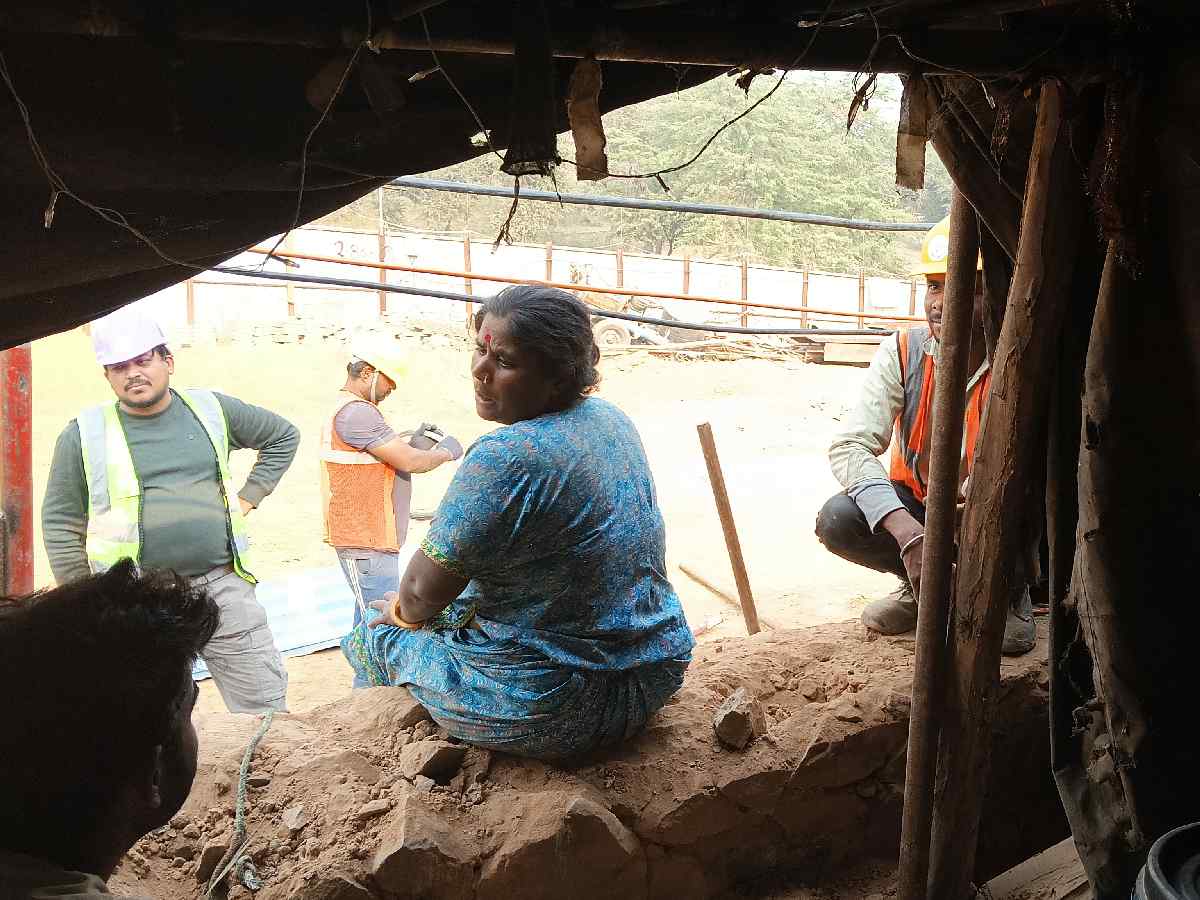
Incessant digging along the Delhi Metro Rail Corporation’s new Golden Line connecting Tughlakabad to Aerocity has caused upheaval in the settlement of Lohar Basti. On November 2, at around 10:00 am, deep excavation pits were being dug along Anandmayi Marg for the project. This caused a wall of Devi’s makeshift tenement to collapse. Her 12-year-old son had been lying on a mattress beneath it, fiddling with her phone. The wall came down without warning, and he was fortunate to escape with injuries rather than losing his life.
The DMRC has long been in conflict with the residents since the land was acquired for the new line. With families having lived here for 25 years, acquisition has been difficult. Continuous construction has also become an everyday hazard, with several jhuggi walls collapsing due to drilling and ground vibration.
“It has been happening for the past month that the drilling has got to such a degree that it has become exceedingly difficult to rest our head even for a single moment. Just a month ago, the drilling caused significant damage to our jhuggi. We have only been able to patch it through with a small amount of cement — anything more means financial ruin,” said Kaushalia Devi, 45.
High Court stay offers temporary protection
The dispute concerning the jhuggi-jhopri cluster at Prem Nagar is currently pending before the Delhi High Court, where a case on rehabilitation allotment is being heard. A stay order by the court has protected the settlement for now. Residents say the protection has come at the cost of their safety and dignity.
Also Read: Only one in three disabled in Delhi eligible for workplace compensation
‘No compensation, no resettlement’
Residents say they have repeatedly asked the DMRC for compensation or resettlement but have received no assurance.
“We have been trying to tell them that there needs to be a middle ground for us since we do not have any other place to go to,” said Asha Kumari, 22. She added that she had grown up in the area with many others. “If we had any plot of land, or a village to go back to, we would do that without any issue, but that is not really an option for us.”
The case has been adjourned to March 2026.
Residents allege that the construction work itself has become a method of pushing them out. Sita Devi, 72, said the police and other authorities visit frequently and tell them to leave. “We still do not have any place to go to so they want us to be without a place to call home,” she said. She added that the harassment continues despite their petition before the court, and many residents remain without work for entire seasons. “Where do they go if the government does not care?” she said.
Poverty deepens the crisis
A large part of the Lohar Basti community survives on handicraft work. Many families migrated from Rajasthan and are skilled artisans making idols, clay tablets and other wares. Much of the year, however, they remain without work, watching moths eat away at unsold stock.
Jagdish Kumar, 60, sits on the pavement with his wares, aware that demand is low. “If there are no new buildings being inaugurated, or housewarming ceremonies being conducted then it’s a given that there will be no sale on my end,” he said with a dry smile.
For the past month, he and his wife Kaushalini have survived on their savings and whatever their eldest son can provide. He said they would move if provided compensation or resettlement, but the lack of either makes relocation impossible. “With sales being low either way, it does not make any sense for us to move since that would mean the end to our livelihoods,” he said.
The Mazdoor Awas Sangharsh Samiti has been advocating for housing rights for the labourer families.
Convenor Nirmal Gorana said the group had taken the fight from the Delhi Urban Shelter Improvement Board to the Delhi High Court. He said they had been campaigning tirelessly for the families’ rights but the Delhi Government had not allocated a single house. “At the same time, the DMRC remains intent on pushing ahead with the metro route, which would involve demolishing the settlement and evicting residents without rehabilitation,” he said. A stay order from the High Court, he added, continued to protect the families. “We demand that the Delhi Government immediately provide housing to all these families, rehabilitate them without further delay, and ensure free medical treatment for the injured child.”
Demolitions across Delhi
According to a Rajya Sabha response in July, 5,185 homes were demolished in Delhi over the past three years in operations by the Delhi Development Authority. Of these, 3,043 households — affecting approximately 17,015 individuals — received alternative accommodation in Ashok Vihar, Kalkaji and Narela.
The DDA spent Rs 766 crore (excluding land cost) on constructing rehabilitation housing. Based on an average household size of five, around 25,000 people have been displaced due to these demolitions.
Slum rehabilitation in Delhi is governed by the Delhi Slum and Jhuggi-Jhopri Rehabilitation and Relocation Policy, 2015 (approved by the Cabinet in 2016). The policy prioritises in-situ rehabilitation, offering alternative flats on-site or within 5 km.
Eligibility is limited: clusters must have at least 50 households, must have existed before 2006 and residents must prove they lived in the slum before 2015.
According to the Delhi Urban Shelter Improvement Board, there are 675 jhuggi-jhopri clusters in Delhi. Of these, 376 are on Central government land under the Delhi Development Authority. Responsibility for rehabilitating the remaining 299 clusters on Delhi government land lies with the DUSIB.