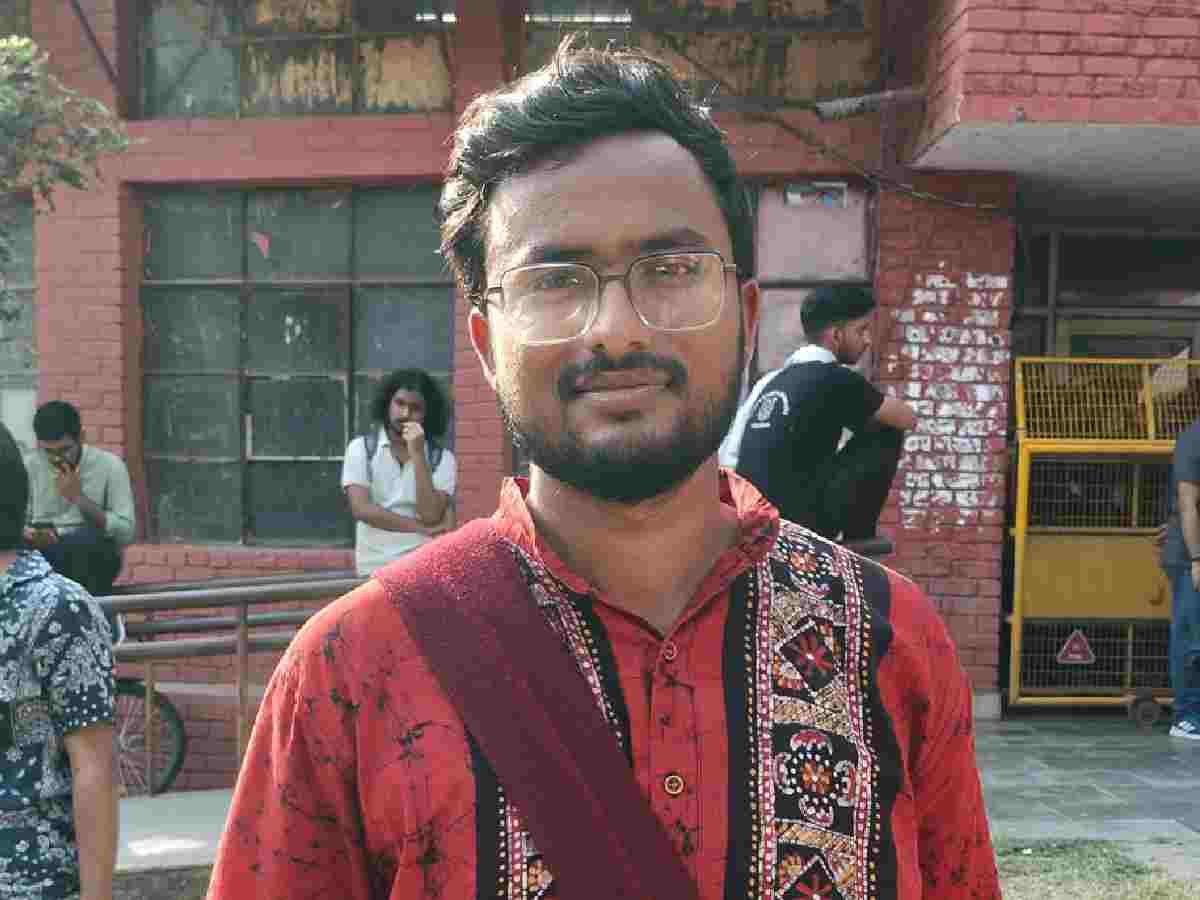
Nitish Kumar
As Jawaharlal Nehru University (JNU) gears up for its student union elections, campus politics is once again in the spotlight. At the centre of this year’s contest is Nitish Kumar, the presidential candidate from the All India Students’ Association (AISA), a Left-wing student organisation with a long history at JNU.
Recently, AISA has claimed credit for a major student victory—the disbursement of government funding for the Barak hostel, which they say was the direct result of sustained protests. The issue gained momentum after students from the Northeast, many of whom faced acute accommodation shortages, led widespread demonstrations on campus.
In an in-depth interview with Patriot, Kumar speaks about what drew him to student politics, how he intends to make the campus more inclusive, and why JNU’s battle for public education is inseparable from the political realities of the country.
What motivated you to contest the Jawaharlal Nehru University Students’ Union (JNUSU) elections for the post of president?
I enrolled in JNU during the Covid pandemic. At the time, everything was reopening—metros, malls—but universities like JNU remained shut. We launched an online movement demanding that the campus reopen. During this period, I came into contact with members of AISA and eventually became a part of the organisation. We staged a 21-day protest at the Dean of Students’ office to push for the reopening.
Through this journey, I realised the value of organised student politics. In a time when education is being increasingly commercialised, student intervention becomes crucial—to resist privatisation and to ensure that education remains accessible for students from poor, marginalised, and remote communities. That’s what JNU has historically stood for, and AISA has always upheld those values.
What do you see as the top three challenges facing students at JNU today?
The first and most important issue is faculty recruitment. Students come here with the desire to study, but that motivation often dies when there’s no proper guidance or passionate teaching. Recruitment needs to be democratic and based on academic merit, not ideology.
Second is infrastructure. We need better hostels, libraries, laboratories, and basic amenities—functioning fans, water coolers, proper sanitation facilities.
Third is policy-level resistance. We must stand against the National Education Policy (NEP) and its long-term effects on public education. The funding mechanism should be fair. No student should suffer because of political bias or a lack of resources in labs or classrooms.
Do you believe there is a hostel shortage at JNU? How is this affecting students’ access to accommodation?
Yes, hostel accommodation is definitely an issue. As the number of students at JNU increased, there was no corresponding focus on expanding infrastructure. That led to a shortage of rooms and overcrowding.
Now that the Barak hostel has finally opened, the pressure on other hostels has eased a bit. We can say it was AISA’s sustained effort that led to this. In 2014–15, we won all four union posts and led a hunger strike. It took ten years, but we achieved the goal. We even received funding from the donor ministry after our protest. That long struggle culminated in a real, material victory.
AISA has long been central to JNU student politics. If elected, how will your leadership differ, and what fresh initiatives do you hope to introduce?
I wouldn’t say I’ll be entirely different—the previous leaders were experienced and committed. But yes, I want to bring a sharper focus on certain things.
Also Read: Broken promises and crumbling buildings: JNU students voice grievances ahead of union elections
For instance, there are schools like the School of Language, Literature and Culture Studies (SLSI) and School of Translation and Philosophy of Language Studies (STPLS) where the Left has a strong presence and cadre, and we will continue strengthening that. But now, the School of Engineering has also opened in JNU. It’s going to become a major centre in the university, so we must give special attention to its infrastructure and student needs.
I also want to improve communication, particularly with students in the science schools. They’re facing serious problems—especially the lack of laboratories. We study science, but we don’t even get to enter a lab. JNU is awarding degrees without the necessary lab infrastructure, and that needs to change. Strengthening communication with students will help us address these gaps more effectively.
JNU is home to a diverse student body, including minorities, LGBTQIA+ students, and women. How do you plan to ensure the campus is inclusive and safe for all?
Back in 2016, the Gender Sensitisation Committee Against Sexual Harassment (GSCASH) was dismantled and replaced with the Internal Complaints Committee (ICC), which is a far less democratic structure. GSCASH had elected student, faculty, and staff representatives, and its removal was deeply undemocratic. We’ve been fighting to restore it ever since.
On inclusivity, our union pushed for gender-neutral washrooms, and the first one was established at the School of Arts and Aesthetics. We want these in every school and every hostel. We also advocate for proper implementation of reservations for the transgender community.
But structural changes alone are not enough. Sensitisation is essential. These issues won’t be solved overnight. They require continuous dialogue, training, and a cultural shift across campus.
Critics, particularly from the Akhil Bharatiya Vidyarthi Parishad (ABVP), argue that the Left prioritises ideology over ground-level student concerns. How do you respond to that perception?
In our last union, we sat on a 16-day hunger strike. That wasn’t about international politics—it was about core issues in JNU. Our Charter of Demands included infrastructure problems, the entrance exam model, the need for a caste census, reopening Barak hostel, and reducing viva voce weightage, which was causing discrimination.
Also Read: Admin stripping students of their basic rights: NSUI’s Pradeep Dhaka
Eventually, Barak hostel was opened. That wasn’t just symbolic—it was a real, tangible outcome. But at the same time, we believe JNU doesn’t exist in a vacuum. If the government is trying to undermine the institution, or if JNU is being demonised in Parliament, we can’t ignore that. We can’t just sit quietly and ask for water coolers—we also have to stand up on the bigger issues.
So yes, we raise our voices for Palestine. But we also fight for fans, water, and better infrastructure.
How would you describe the political mood on campus ahead of the elections? Do you believe your alliance can govern effectively?
We will completely defeat ABVP. The students of this campus are aware. They know who they must support, which forces they must vote for, to push back against ABVP. The campus is going to choose an anti-ABVP front.
Were there any challenges in forming the Left alliance with the Students’ Federation of India (SFI), Democratic Students’ Federation (DSF), and others? What were the main points of disagreement?
Naturally, everyone comes from different political backgrounds and has their own perspectives, priorities, and interpretations.
We didn’t fight over seats. The disagreement was ideological. We were consistently talking about the larger political climate and how parties like SFI and the Communist Party of India (Marxist), or CPI(M), interpret the current situation. For us, what’s happening in the country—the new laws, systemic discrimination against minorities—is clear evidence of fascism. But CPI(M) called it “neo-fascist tendencies”.
That’s where the debate really started: If there’s going to be a Left alliance, who will lead it? Those who believe that fascism is already here? Or those who don’t?
What message would you share with students who feel disillusioned or disengaged from student politics?
There is always hope in politics.
The regime in power will always try to break your spirit. But we must never give up. We have to keep learning and keep struggling.
We must walk the path of resistance. We must go to school, get educated, and have the courage to study. And most importantly, we must organise ourselves. Like Ambedkar said: Educate, Agitate, Organise
An AI tool flagged 18,377 Delhi slum residents for TB testing after analyzing chest X-rays,…
Delhi Police reiterated that Jantar Mantar protests require 10 days' advance permission and caps attendance…
SC slammed civic bodies over poor maintenance of Delhi's heritage monuments, ordering top officials to…
Delhi HC directed the Centre to consider a plea for SOPs mandating 'always-on' body-worn cameras…
A portion of a building collapsed in northeast Delhi's Seemapuri on Wednesday. Rescue operations are…
Delhi HC judge Justice Prateek Jalan recused himself from hearing a plea against the Centre's…
