As 2025 draws to a close, Delhi’s Yamuna River remains a study in scrutiny without recovery. Despite sustained judicial pressure, expanded budgets and repeated clean-up drives, the river’s water quality stayed critically degraded through the year, exposing the limits of policy ambition when confronted with decades of systemic neglect.
From recurring froth and bacterial spikes to contested claims of improvement during festival seasons, the Yamuna’s condition continued to rank among the Capital’s most visible environmental crises, fuelling political debate and public frustration alike.
Pollution levels remain alarmingly high
Throughout the year, official assessments confirmed that the Yamuna remained heavily polluted along its Delhi stretch. The Delhi Pollution Control Committee repeatedly warned that key indicators such as biochemical oxygen demand and faecal coliform levels continued to breach permissible limits, reflecting the dominance of untreated sewage and domestic waste in the river system.
At Wazirabad, where the Yamuna enters Delhi, pollution levels remained elevated. Faecal coliform counts were recorded at thousands of units above Central Pollution Control Board norms, indicating widespread contamination. Environmental activist Varun Gulati attributed these figures to a combination of reduced river flow and the unabated discharge of wastewater from urban and industrial sources.
Conditions deteriorated further downstream. Monitoring stations near ITO Bridge, ISBT and Nizamuddin reported water quality far outside limits considered safe for bathing or ritual use, including during peak festive periods.
A disproportionate Delhi burden
The Yamuna’s pollution problem remains heavily concentrated within the national capital. While Delhi accounts for roughly two % of the river’s total length, it contributes about 76 % of the overall pollution load, highlighting the outsized impact of urban wastewater and inadequate treatment infrastructure.
According to environmental ministry data, Delhi generates approximately 792 million gallons per day of sewage, while its treatment capacity stands at about 667 million gallons per day. The gap leaves hundreds of millions of gallons of untreated waste flowing into stormwater drains that ultimately discharge into the Yamuna.
Major drains such as Najafgarh, Shahdara and Barapullah continue to carry untreated domestic sewage and industrial effluents into the river. Several sewage treatment plants operate below capacity or fail to consistently meet pollution norms, weakening efforts to control contamination at source.
Ecological stress and visible fallout
The ecological consequences of pollution were stark in 2025. Reports documented the death of thousands of fish along riverbanks, pointing to oxygen depletion and toxic water conditions.
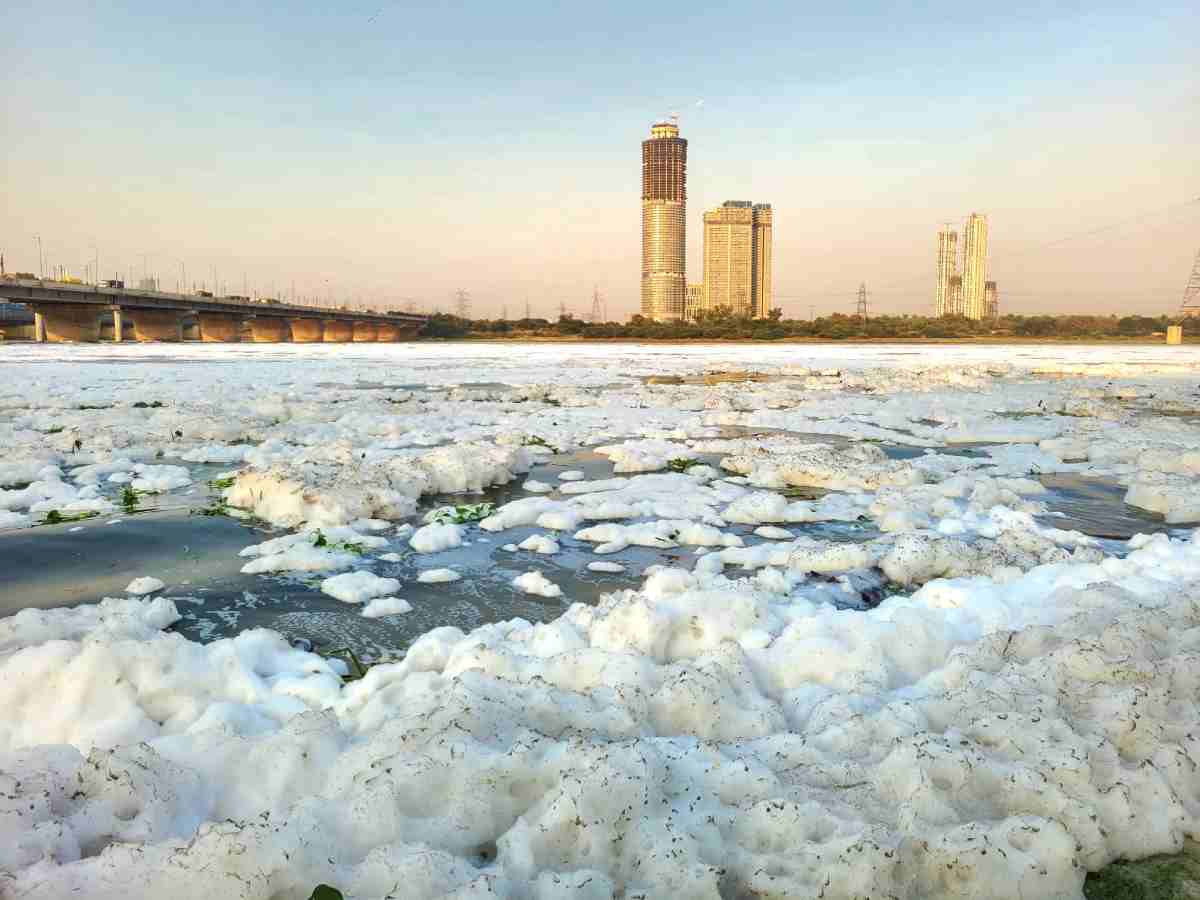
Foam formation, caused by surfactants from detergents and cleaning agents, also re-emerged repeatedly during dry spells following rainfall. Thick layers of froth were recorded at locations such as Kalindi Kunj, often accompanied by foul odours. Despite periodic clean-up efforts, the foam returned within weeks, reinforcing concerns that surface-level interventions were failing to address underlying pollution drivers.
Courts intervene, politics intensifies
Judicial scrutiny remained a defining feature of the year. The Delhi High Court repeatedly reprimanded authorities for their failure to curb pollution and ordered the formation of inquiry committees to examine persistent violations and systemic lapses.
At the same time, Yamuna pollution became a flashpoint in Delhi’s political discourse. During the Assembly election season, political parties traded accusations of neglect, while environmental groups argued that repeated promises had delivered little lasting improvement.
Budgets and projects under scrutiny
In the 2025 Delhi Budget, the city government allocated Rs 500 crore specifically for the Yamuna’s cleanup, describing it as a core environmental priority. An additional Rs 250 crore was earmarked for replacing ageing sewer lines, along with funding to upgrade sewage infrastructure in unauthorised colonies lacking proper connectivity.
In August, the Delhi Jal Board approved Rs 917 crore for sewage treatment projects, which officials said would add around 51.5 million gallons per day to the city’s treatment capacity.
These investments coincided with renewed official claims of improved water quality ahead of major festivals such as Chhath, when authorities undertook high-visibility cleaning drives and related measures.
Claims versus ground reality
Independent assessments and ground reports, however, questioned the durability of such improvements. Viral images and field investigations showed that polluted and frothy conditions often returned within weeks of ceremonial clean-up exercises.
For several weeks after festival rituals, sections of the river continued to exhibit thick foam, chemical odours and visibly degraded water quality, underscoring the gap between short-term cosmetic interventions and long-term environmental recovery.
Emerging threats beyond sewage
Beyond conventional municipal waste, newer forms of pollution drew attention in 2025. A TERI-led study commissioned by the Delhi Government identified significant microplastic contamination in water and soil along stretches of the Yamuna, expanding concerns beyond organic pollution.
Chemical profiling of the river also revealed the presence of ammonia, surfactants and heavy metals entering the system from industrial zones, complicating rehabilitation efforts and heightening ecological risks.
Infrastructure gaps remain unresolved
Despite incremental expansion, Delhi’s sewage infrastructure continued to lag behind wastewater generation. Analysts estimated that around 414 million litres per day of sewage was still flowing untreated into river drains by mid-2025.
Industrial effluent management also remained uneven. Several industrial areas in and around Delhi lacked robust effluent treatment facilities, allowing toxic residues from processes such as dyeing and electroplating to enter waterways.
Long-standing gaps in sewer connectivity in unauthorised colonies and informal settlements further contributed to the steady inflow of untreated waste into the Yamuna.
A river entwined with public life
The Yamuna’s condition intersected repeatedly with Delhi’s public health and cultural calendar. During periods of severe air pollution, concerns grew over the combined health burden of contaminated air and water.
Festivals such as Diwali and Chhath brought renewed administrative focus on the river, but the contrast between festival-time interventions and post-event conditions highlighted the episodic nature of official responses.
Looking ahead to 2026
As Delhi enters 2026, the challenge of reviving the Yamuna remains formidable. Pollution stems from a convergence of chronic sewage mismanagement, industrial discharge, chemical contamination and fragmented governance across state boundaries.
Judicial oversight, increased funding and expanded treatment capacity provide a framework for progress. However, sustained political will, inter-state coordination and long-term infrastructure reform will be critical to achieving meaningful recovery.
A mirror of governance failures
In 2025, the Yamuna stood as more than a polluted river. It became a reflection of Delhi’s environmental contradictions, bearing the weight of public expectation, political rhetoric and ecological stress.
By year-end, despite heightened scrutiny and significant financial commitments, the river’s water quality and ecological health continued to fall short of regulatory benchmarks and civic aspirations. The year reaffirmed a difficult truth: without enduring structural reform, the promise of a cleaner Yamuna will remain unfulfilled.