
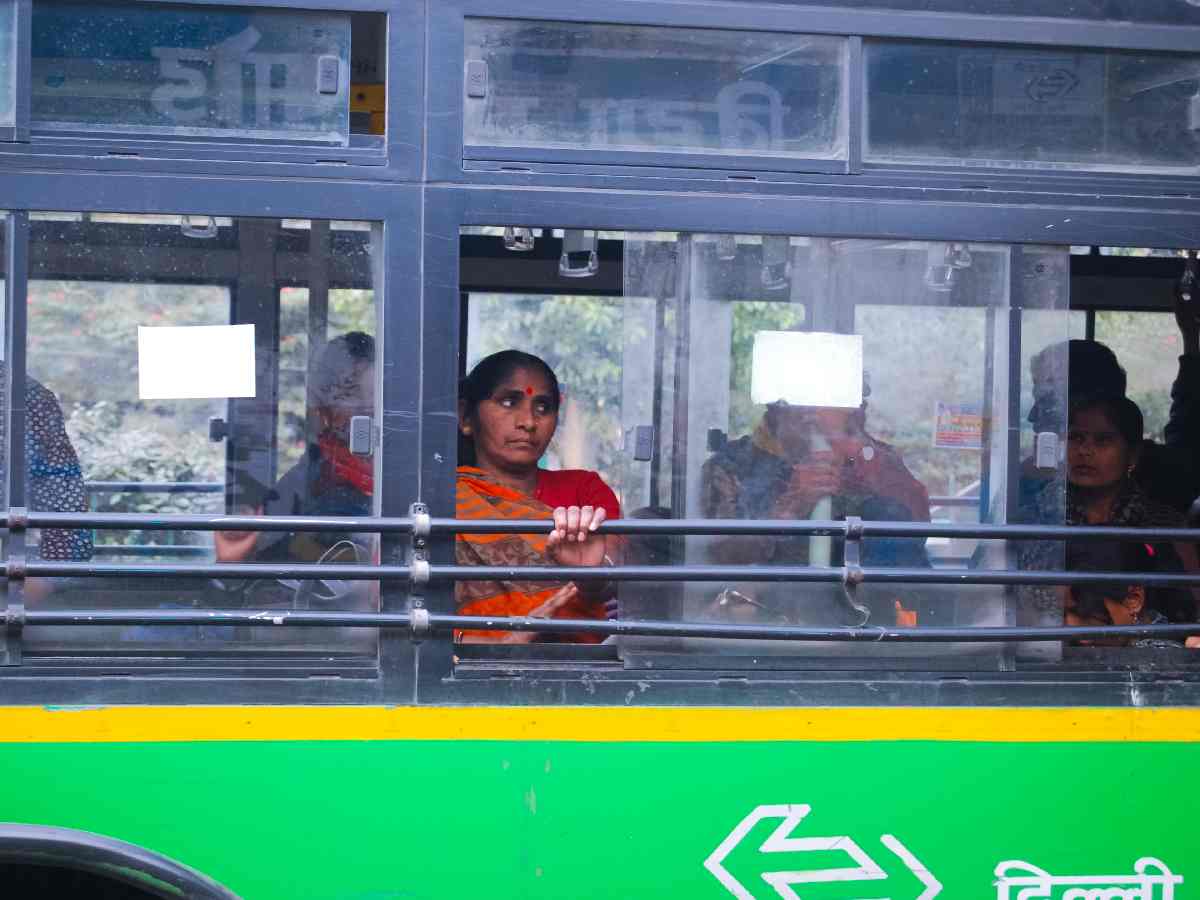
At a Chhatarpur bus stop on a humid July morning, 36-year-old Rani Devi clutches her shopping bags, waiting for a cluster bus to Lajpat Nagar. A domestic worker and daily commuter, Rani has relied on Delhi’s pink ticket scheme to save Rs 10–20 each day.
“It adds up to Rs 500–600 every month. That’s my electricity bill or half my ration,” she says. But with the pink ticket being replaced by the new Saheli Smart Card, she fears being left behind. “They say I have to go to a bank. When will I do that? I leave for work by 8 AM and come back after dark.”
The Saheli Smart Card, recently announced by the Delhi government, is a personalised digital mobility card offering free bus travel to women and transgender persons on Delhi Transport Corporation (DTC) and Cluster buses. It replaces the paper-based pink ticket system introduced in 2019.
Officials say the card is designed to prevent misuse and improve transparency in fare subsidies, aligning with the city’s larger push to integrate transit infrastructure under an Automated Fare Collection (AFC) system.
Transport Minister Pankaj Singh said the change would not impact revenue significantly. “Of the 4.8 million daily DTC commuters, just about 20% are women, and making their travel free does not impact revenue much,” he said. “The smart cards have been kept for residents only to streamline registration and ensure accountability. It is a Delhi service, for the people of Delhi.”
A digital shift with analogue barriers
Only Delhi residents aged 12 and above are eligible for the Saheli Smart Card. Applicants must register online, complete full KYC verification at a partner bank, and wait for delivery by post. The card, issued under the National Common Mobility Card (NCMC) framework, features the user’s name and photograph.
Aman Dev Chhikara, Deputy Chief General Manager (Security, PR & RSC) at DTC, confirmed: “We are going to issue green cards to women and transgender persons to enable them to avail the free bus service.”
When asked about non-resident women, Chhikara said, “This is a decision taken at a higher level. As the implementing authority, our role is to carry out the directive as issued.”
The card enables free travel only on DTC and Cluster buses, although it can be recharged for other transport services. This restriction has raised concerns among commuters.
Digital divide on wheels
Sunita, a domestic worker from Sunder Nagri who travels daily to Civil Lines, said: “The introduction of Saheli Smart Cards will further limit access. We’re already struggling with frequency and overcrowding. Now, instead of fixing those issues, they are adding new hurdles.”
She pointed out that women in the informal sector often work all week and don’t have the time to visit banks or deal with digital formalities.
Bus conductors, too, are wary of the change. “The pink ticket system was smooth—hand out the slip, move on,” said Ramesh (name changed), a conductor on Route 465. “If they bring a smart card, we’ll have to scan or verify it. That may slow things down, especially if people don’t know how it works.”
A joint statement by Greenpeace India and Public Transport Forum India (PTFI) echoed the concern: “This proposed shift, while ostensibly aimed at reducing leakages, threatens to exclude lakhs of women—especially those from economically weaker sections, migrants, and students—from a scheme that has significantly improved mobility, financial independence, and access to education.”
The groups cited a study showing 75% of women surveyed saved on transport under the pink ticket scheme, allowing them to spend more on food, healthcare, and their children’s education.
“Our survey findings also suggest the same. 54% of the surveyed women report that they save this money for future use and spend on household items. Half of the women are keeping the savings aside as savings or emergency funds. One in three women use the savings to purchase personal items that they could not have otherwise bought. About 15% of women using buses can spend more on health and education,” Aakiz Farooq, Campaigner at Greenpeace India, told Patriot.
Farooq added that savings from fare-free travel were used for personal essentials, leisure, alternative transportation options, or savings. “Middle-class women, who generally use other modes of transportation, also reported benefiting from this scheme when they choose to travel by bus,” he said.
He warned that the smart card’s digital requirements could alienate the very women it intends to serve. “This amounts to digital exclusion and defeats the very intent of an accessible, inclusive mobility programme.”
Young women, old concerns
Amisha Patel, a young woman from Bihar who has lived in Delhi for five years, explained: “My mother gives me Rs 50 daily for travel. I save Rs 30 almost every day. This way, I save around Rs 150 a week. So, I have some money in hand. If I want to buy anything, I can. I can save for earrings, lipsticks and other things. On days I’m hungry, I can eat something. But when I don’t get a bus, I end up spending Rs 50 just on a one-way commute.”
Namrata, a 35-year-old factory worker from Neb Sarai and mother of three, said small savings made a big difference. “When my children insist on travelling by auto, I tell them that if we go by bus, we can have juice or snacks with the money we save. Sometimes I buy them colours or give them the saved money. They are happy to travel by bus then. These small savings bring big joys.”
Students face hurdles
Students commuting across Delhi and the NCR say the new requirement feels exclusionary.
“My Aadhaar is linked to my home in Kashmir. I live in a rented flat here. How will I prove I’m a Delhi resident?” asked Saba, a postgraduate student in social work. “We already pay for everything else—this was the only benefit that acknowledged our economic situation.”
Fiza Bhat, a third-year undergraduate, added: “We attend late evening classes and rehearsals. Bus travel is safer at night because the conductors and drivers are there. If the new card takes that away because of some technicality, it’s not just unfair—it’s unsafe.”
Many said the pink ticket system worked well, especially for those juggling jobs and studies. “They could have introduced the card gradually. But forcing it as the only option will definitely affect our attendance and mobility,” said Rashi, a final-year education student.
Ritu Pandey, a 19-year-old nursing student from Badarpur, said she does not have an Aadhaar-linked bank account. “I’ll try to apply, but if it takes too long, I’ll be forced to pay or stop attending my classes. It’s already a daily struggle.”
All India Students Association national president Neha raised concerns about the implementation of the Saheli Smart Card, particularly for women and trans persons without formal documentation.
“The pink slip issued to women in DTC buses had gone a long way in encouraging their participation in public life by making mobility easier,” Neha told Patriot. “Earlier, women could board a DTC bus and receive a pink slip — no questions asked. Now, they must prove they are bona fide residents of Delhi.”
She added, “Delhi thrives on the labour of people who come from all over the country. Does this scheme expect women, girls, and trans persons from other states to give up their home-state residency just to travel in the city?”
Highlighting documentation hurdles, she said, “The DTC is a lifeline for the working class. Women and girls from modest backgrounds rely on these buses. But how many have rent agreements, ration cards, or PAN cards in their names?”
Neha questioned the need to overhaul the previous system. “The pink slip scheme was functioning effectively. In fact, its usage had increased significantly since its introduction in 2019,” she said.
Policy shift lacks transparency
Despite the overhaul, the government has not shared data on misuse that prompted the shift. Civil society groups have demanded that pink tickets be continued as a parallel option during the transition.
While the Saheli Smart Card offers security and personalisation, critics say it undermines the universal accessibility of the earlier system. “Retaining the pink ticket as a parallel, accessible alternative is critical,” said PTFI.
They also called for the inclusion of migrant women and girl students—many of whom lack Delhi address proof—as equal beneficiaries of the scheme.
Mobility, employment and safety
A report titled Beyond Free Rides, by the Sustainable Mobility Network and Nikore Associates, supports this view. Based on data from 10 cities across five states, it found full fare subsidy schemes help women save 30–50% on transport costs.
“For many women in low-income jobs, daily bus fares stood in the way of work and opportunity. Removing that cost does more than improve access—it enables economic participation and affirms dignity,” said Mitali Nikore, the organisation’s founder and chief economist.
In cities with full subsidy schemes like Delhi, Bengaluru, and Hubballi, more than one in four women shifted to bus travel. However, outcomes varied based on service quality.
In Bengaluru, where bus service is robust, women reported employment improvement rates five times higher than in infrastructure-deficient cities like Mumbai.
Safety remains a concern. In full subsidy cities, only 42–46% of women felt safe on public buses. The figure drops to 35–42% in partial subsidy cities, and to 31.5% in cities with no subsidy.
A question of access
Chief Minister Rekha Gupta hailed the digital shift in her March budget speech, calling the pink ticket system “a source of corruption.” But critics say the plan lacks public consultation.
DTC operates 3,266 buses—including 1,950 electric vehicles—and serves millions daily. While the Saheli Smart Card is designed to simplify commutes for eligible users, it may complicate them for those without digital access.
As the system rolls out, one question lingers: will a drive for digital efficiency erode hard-won mobility for Delhi’s most vulnerable women?