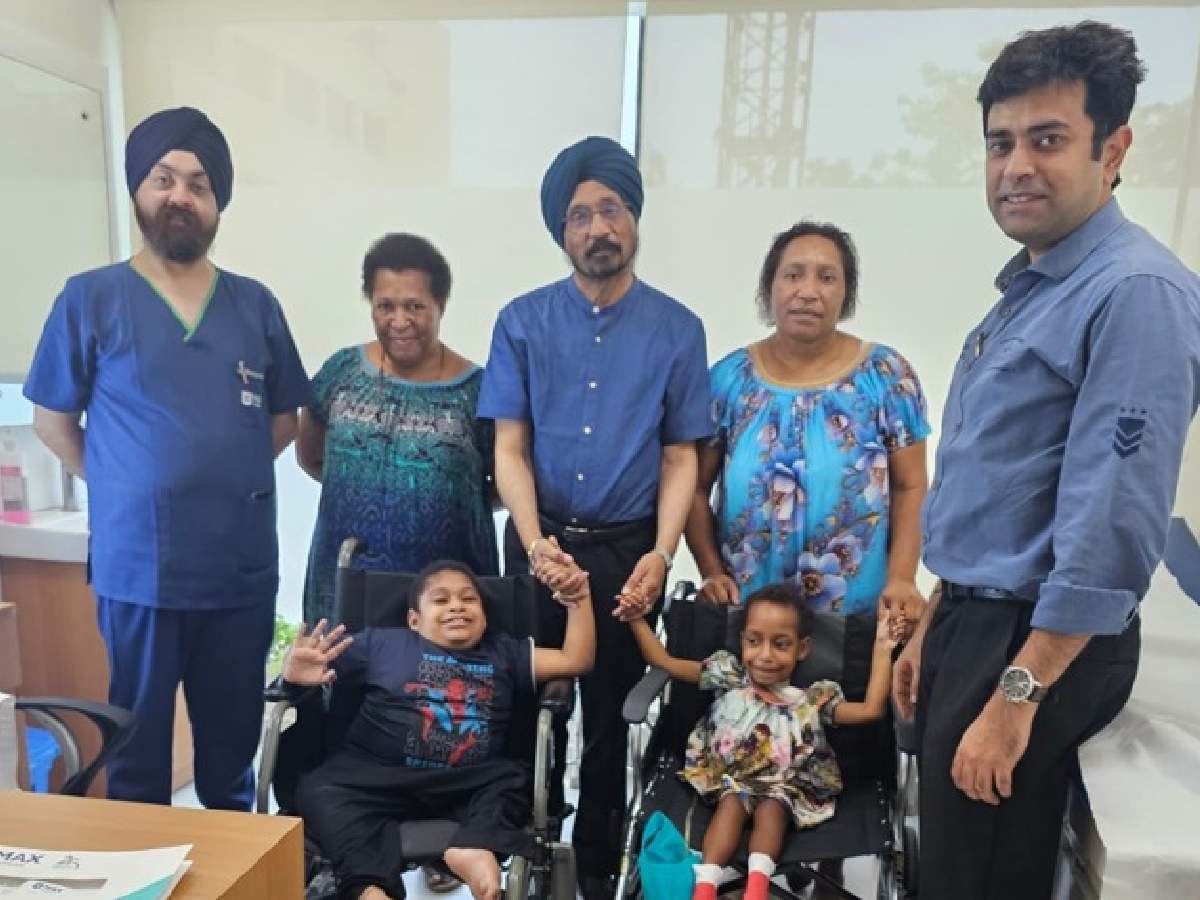
In a significant medical achievement, doctors at Max Smart Super Speciality Hospital in Saket, New Delhi, have successfully treated two children from Papua New Guinea suffering from complex Neural Tube Defects (NTDs), rare congenital conditions that affect the development of the brain and spinal cord.
A five-year-old girl Hensley, and her seven-year-old cousin Francisco, had been living with paralysis of their lower limbs and loss of bladder control since birth. With limited treatment options available in their home country, their families travelled to India seeking specialised neurosurgical care.
The surgeries were performed by the hospital’s neurosurgery team led by Dr Daljit Singh, Vice Chairman and head of Neurosurgery and unit head – Neuro Intervention, along with Dr Simranjeet Singh, consultant – Neurosurgery. Following detailed evaluations, doctors decided to operate on both children on the same day despite the complexity of their conditions.
Hensley had a watermelon-sized swelling measuring nearly 10×12 cm on her lower back, making it impossible for her to sleep on her back throughout her life. She also suffered from scoliosis and had completely lost sensation in her lower limbs.
Her cousin presented with an equally challenging condition, including a spinal swelling, severe curvature of the spine, clubfoot affecting both feet, a left-sided inguinal hernia, and loss of bladder control. He had previously undergone corrective surgery in another country, after which he lost movement in both legs, and later received a ventriculoperitoneal (VP) shunt procedure to drain excess fluid from the brain.
Doctors performed microscopic excision and repair of the spinal defect in the older child, followed by flap rotation surgery to reconstruct the large skin defect. The younger patient underwent excision and repair of the spinal lesion, with surgeons carefully managing excessive cerebrospinal fluid loss during the procedure.
“These cases highlight the complexity and varied presentation of Neural Tube Defects. Although both children had similar symptoms of paralysis and bladder dysfunction, the embryological basis of their conditions was entirely different,” said Dr Daljit.
He said successful treatment required meticulous surgical planning, advanced microsurgical techniques, and comprehensive post-operative rehabilitation, adding that early diagnosis and timely intervention could significantly improve the quality of life of patients with such congenital disorders.
Following surgery, both children underwent intensive post-operative care and physiotherapy. Hensley was able to lie comfortably on her back for the first time in her life and was discharged on the eighth day after surgery. Francisco required additional wound care for a small non-healing flap site before making a satisfactory recovery and was discharged on the tenth day.
Singh also stressed the importance of preventive maternal healthcare, noting that neural tube defects are among the most common congenital anomalies and can often be prevented through adequate folic acid supplementation before conception and during early pregnancy.
“In these cases, both mothers had not received folic acid supplementation, and the defects were not detected during routine prenatal ultrasound examinations. Strengthening awareness, antenatal counselling, and early screening can play a critical role in reducing the burden of these congenital disorders,” he said.
According to the hospital, the successful treatment was made possible through the coordinated efforts of its neurosurgery, anaesthesia, rehabilitation, and nursing teams, reflecting the growing capability of Indian hospitals to manage highly complex congenital neurological disorders for patients from across the world.
Supreme Court advocate Abhishek Pawar alleges women were denied washroom access for seven to eight…
Each day of closure costs shops in Khan Market and Connaught Place between Rs 60,000…
Delhi generates nearly 15,000 tonnes of waste daily, prompting the government to deploy 1,000 mechanical…
Delhi Police has issued an NOC for the Congress rally at Ramlila Maidan on November…
CJP chief Abhijeet Dipke received conditional bail following his arrest for participating in a Connaught…
The DPCC has floated ₹104 crore tenders to test pilot pollution-control technologies across 40 key…
