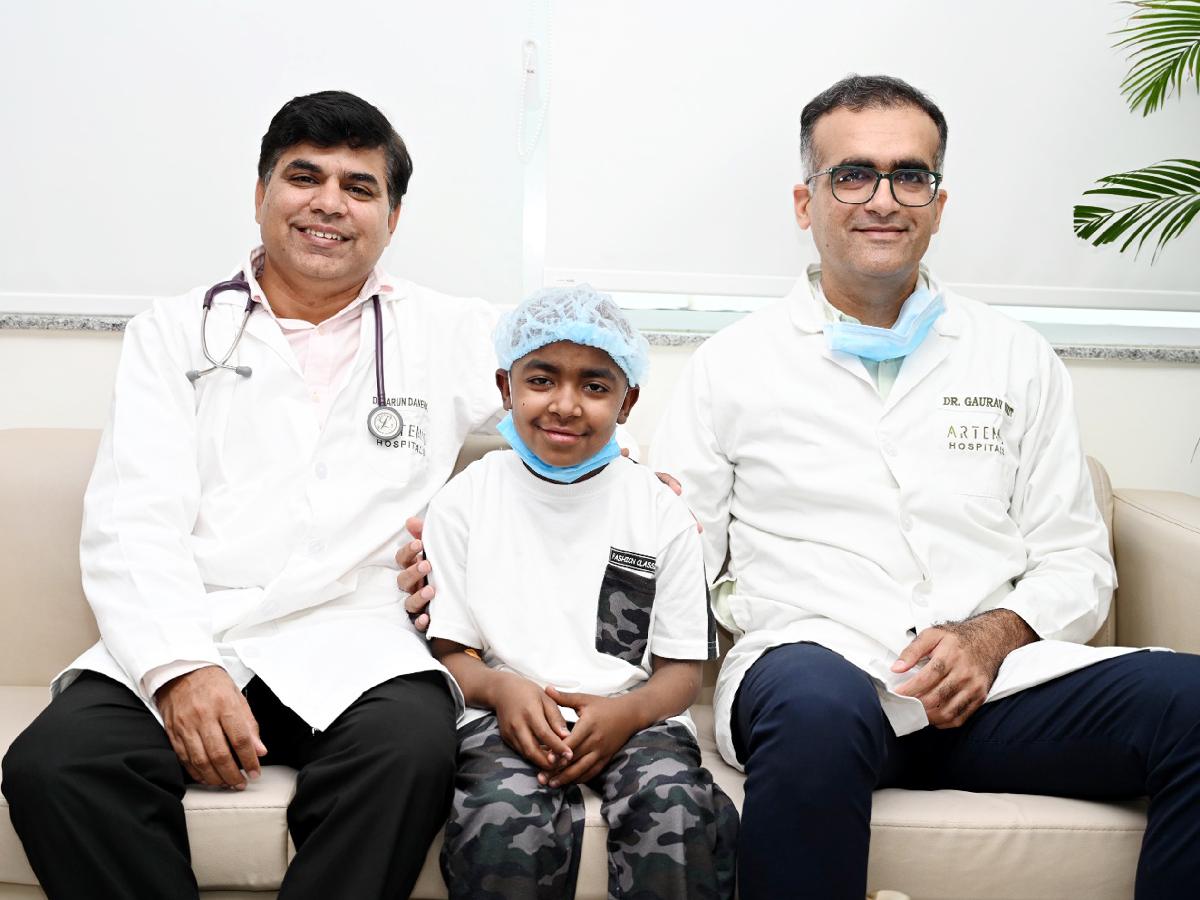
Delhi: In a significant medical breakthrough, Artemis Hospitals in Gurugram has successfully treated what is believed to be India’s first known case of MYSM1-related bone marrow failure syndrome (BMFS4), an ultra-rare genetic disorder affecting blood cell production.
The patient, a 12-year-old boy from war-affected Sudan, had been battling severe, transfusion-dependent anaemia since infancy. Initially suspected to have Diamond–Blackfan anaemia, his condition worsened over time, with falling platelet counts and increasing fatigue, prompting further investigation.
“I had no strength most days. Even walking a short distance made me tired,” said the child, who travelled over 3,500 km to India in search of advanced treatment.
Doctors identified the underlying condition as a mutation in the MYSM1 gene, which plays a crucial role in regulating the function of haematopoietic stem cells responsible for producing red cells, white cells and platelets. Fewer than 20 such cases have been reported globally, making both diagnosis and treatment particularly challenging.
Explaining the complexity, Dr Arun Singh Danewa, Senior Consultant – Paediatric Hemato-Oncology & Bone Marrow Transplant at Artemis Hospitals, said: “In simple terms, the MYSM1 gene acts like a master controller for blood production. When it fails, the bone marrow gradually shuts down. This was an exceptionally rare and challenging case, requiring us to move beyond standard treatment protocols.”
With no fully matched donor available, the medical team opted for a haploidentical (half-matched) stem cell transplant, using the child’s father as the donor. The procedure, performed on January 31, 2026, involved a carefully customised reduced-intensity conditioning regimen, with radiation deliberately avoided to minimise long-term toxicity.
“The rarity of the condition meant there were no established guidelines. We had to rely on limited global literature and tailor every step—from conditioning to transplant—to ensure both safety and effectiveness,” Dr Danewa added.
The transplant was successful, with blood cell recovery beginning within 12 to 14 days. By day 30, the patient achieved 100 per cent donor chimerism, indicating full acceptance of the donor cells. The child required a three-week stay in a high-tech sterile isolation unit and has since transitioned to outpatient follow-ups, showing steady recovery.
Also Read: Heatwave pushes surge in illness as doctors warn against ignoring early symptoms
“For years we saw him suffer. Now seeing him recover gives us hope again,” said his father, who also served as the stem cell donor.
Doctors noted that the case highlights the potential of haploidentical transplantation, particularly when combined with post-transplant cyclophosphamide, as a viable option for patients lacking matched donors.
While long-term follow-up and broader clinical data will be necessary to fully assess outcomes, the successful treatment marks an important step in managing ultra-rare genetic blood disorders—and underscores India’s growing capabilities in advanced, personalised medical care.