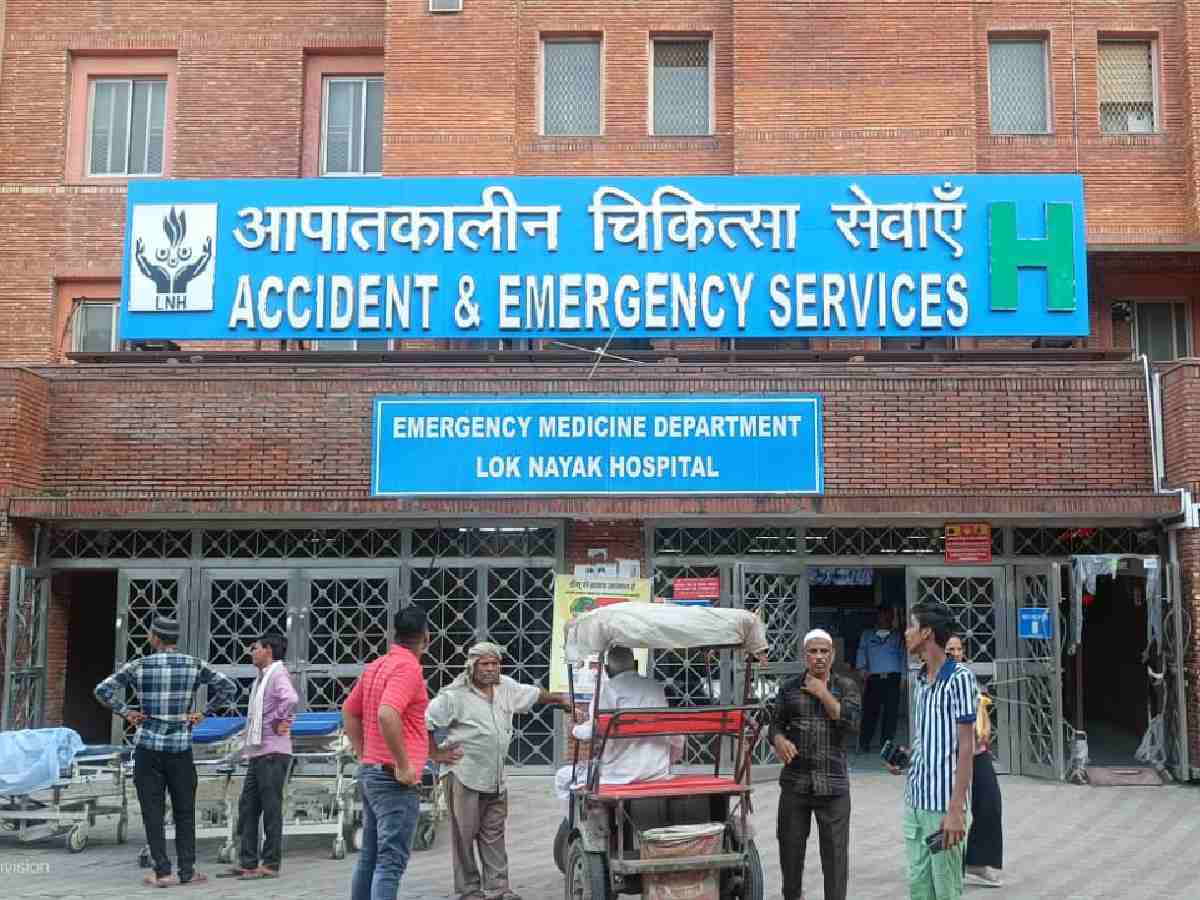
Inside the largest Delhi government-run medical facility, the Lok Nayak Jai Prakash (LNJP) Hospital, the hum of crowded corridors is interrupted by a growing murmur of despair. From the emergency ward to general medicine, patients and attendants whisper the same line — “There are no medicines.”
According to the patients, the shortages range from basic consumables, such as sterile lotion, ECG gel, leuco plaster, and disposable bed sheets, to critical injections, including Amikacin, Lasix, Dopamine, and Adrenaline. Even the most routine items — bandages, xylocaine jelly, and hydrogen peroxide — are missing.
For thousands of patients who depend on free government care, this shortage has turned treatment into a daily struggle.
When contacted, the hospital’s administration refused to comment on the matter.
‘Running for everything’
In the medicine ward, Kamla Devi, a 54-year-old patient admitted with a severe urinary infection, lay waiting for her nurse to return. “The doctor wrote five medicines,” she said softly, clutching a prescription slip. “When I went to the counter, they said none were in stock. My son had to run outside and buy all of them. We already spent Rs 2,500 in three days.”
She points to a brown paper bag filled with medicines bought from a shop across the road. “I came here because I can’t afford private treatment. But now I’m paying the same as a private hospital — just without the comfort.”
‘Missing injections’
In the emergency unit, a young nurse whispered while arranging IV sets. “We’ve run out of adrenaline, scolin, and even dopamine. We borrow from other departments when needed,” she said.
“Sometimes, patients’ families bring injections themselves. It’s unsafe, but what can we do?”
A junior doctor nearby nodded in frustration. “Even the ECG gel is out of stock. We’ve been writing requisitions for weeks,” he said. “We’re treating trauma and cardiac cases with half the equipment we need.”
‘Buy saline yourself’
For Ravi Kumar, a 28-year-old daily wage worker from Seemapuri, the ordeal began after a road accident. “I was admitted to the orthopaedic ward with fractures,” he said, his leg wrapped in an old bandage. “The doctor told my brother to buy bandages, saline bottles, and antiseptics from outside. The hospital had nothing.”
His brother showed a handwritten list given by the nurse — the same items appearing on the hospital’s internal shortage note. “We borrowed money from our relatives to buy these things,” he said. “What kind of free treatment is this?”
Chronic patients
Long-term patients are among the worst affected. Sangeeta Sharma, who visits the LNJP Hospital every month for asthma treatment, said she has been unable to get her inhalers from the pharmacy for nearly a month. “They told me to buy Budecort Respules from outside. It costs nearly Rs 400 a pack. I’ve been skipping doses because I can’t afford it,” she said.
Her father, Mohan Lal, said even the cough syrups prescribed by the doctor were unavailable. “Every counter says ‘NA’ — Not Available. We come here early in the morning, stand in line, and still return empty-handed,” he said.
Inside the wards
A walk through the hospital reveals the scale of the problem. In the medicine dispensary, a small crowd of attendants argue with a pharmacist who keeps repeating, “Yeh sab bahar se lena padega” [you’ll have to get these from outside]. The pharmacist’s register has the same list pasted on its cover — the “NA List” — handwritten and dated early September.
Near the gynaecology wing, a pregnant woman waits for her turn. Her husband, Arif, said they were told to bring sterile gloves, gauze, and antiseptic solution before delivery. “We spent more on buying things than on the treatment,” he said. “They even asked us to get the Dynaplast tape from the market.”
Procurement delays
Several nurses and resident doctors confirmed that the shortages have persisted for over a month. “The supply stopped coming properly in mid-September,” said a senior nurse.
“We keep requesting replenishment, but the central store says tenders are pending.”
According to her, even N95 masks, disposable sheets, and glucose drips are being rationed.
Families question accountability
Families of patients are now questioning the administration. Rajesh Gupta, whose elderly mother is admitted to the cardiac ward, said the hospital’s reputation has deteriorated sharply. “Doctors are good, but what can they do without medicines?” he asked. “The system has collapsed. If the hospital can’t provide basics like glucose drips or antibiotics, then where does the budget go?”
Another attendant, Farida Begum, waiting outside the pharmacy counter, said she had spent her entire week’s savings buying injections and gloves. “We came here for free treatment. Now we pay for everything — medicines, bandages, even syringes,” she said, shaking her head. “We poor people have no other place to go.”
The human cost
Hospital insiders admit that the situation has become both a logistical and moral crisis. “Doctors are exhausted explaining to families why nothing is available,” said one senior resident doctor.
“Patients shout at us, but the problem is procurement. Files move slowly. By the time medicines arrive, patients are already discharged.”
The ripple effect is visible across departments — operations are postponed, diagnostics are delayed, and attendants spend hours running between wards and outside chemist shops.
By evening, the pharmacy shutters roll down for the day, but the line of attendants remains. Many carry prescriptions in hand, hoping the stock will arrive the following day.
A young mother, Pooja, whose child is admitted with pneumonia, sat crying outside the paediatric ward. “They told me to buy every injection from the market,” she said. “I borrowed Rs 1,800 already. I don’t know how long I can manage.”
A nurse passing by summed up the crisis in one tired sentence — “The shelves are empty — and so are our hands.”
A month of silence
Despite repeated complaints and requisitions, no fresh stock has reached the wards. The handwritten “NA List” continues to grow longer by the week — a silent record of a system that has stalled.
For now, the patients of LNJP Hospital wait — for medicine, relief, and someone in authority to notice their pain.