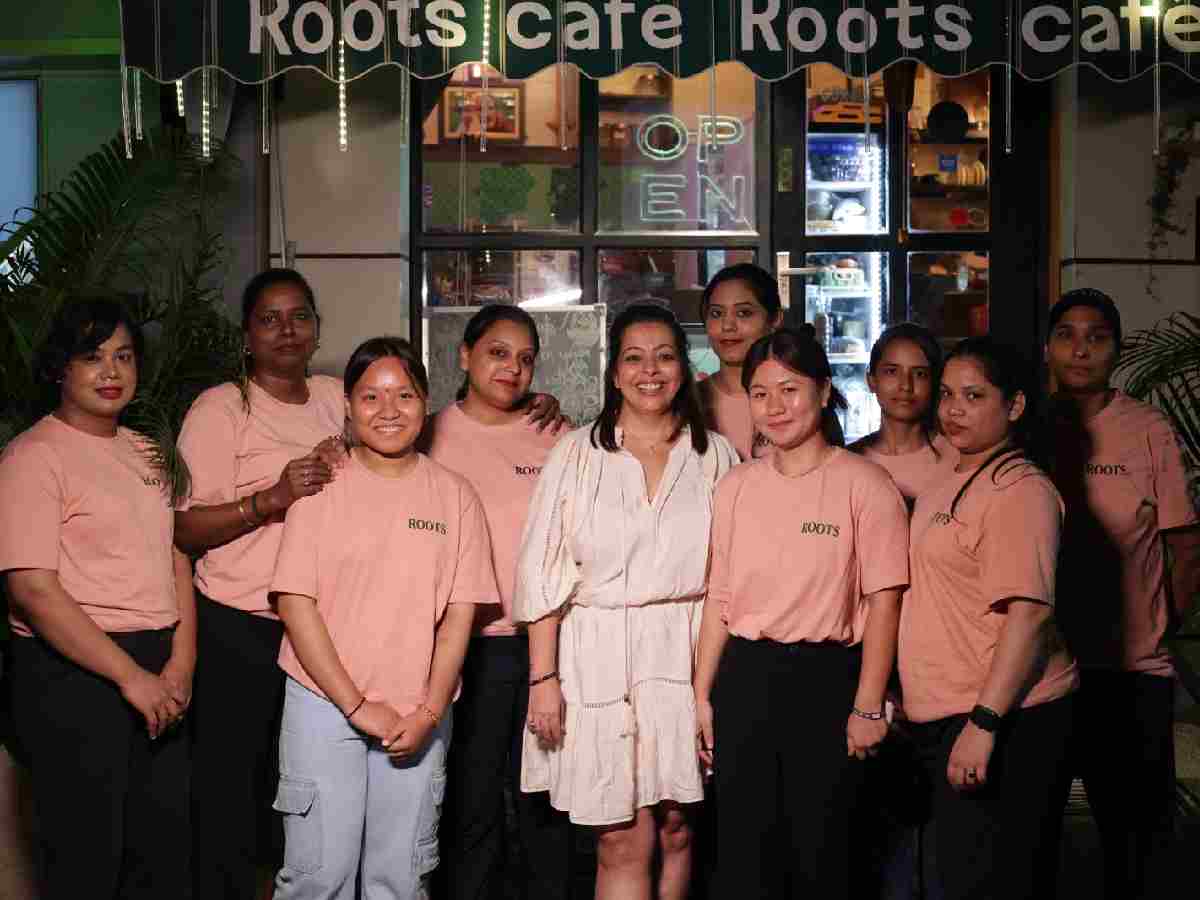
Meenakshi Kumar with her team
Meenakshi Kumar: Tucked away in a quiet lane in Delhi’s Greater Kailash market—surrounded by trendy cafés and eateries—Roots feels like a secret. Where other places chase fads and photo ops, Roots offers warmth, honesty, and depth. Its menu is chalked onto a board, its dishes made from scratch, and its ethos rooted in sustainability and community.
The food is inventive yet comforting: pho made with rasam, almond milk lattes, house-made red curry paste and chilli oil. There are no packaged shortcuts—just honest, soulful cooking.
At the heart of it is Meenakshi Kumar, 45, a chef, trained lawyer, and first-generation food entrepreneur. After two years in Thailand’s culinary world, she returned to India and opened Roots Café just seven months ago.
“I never thought I’d settle back here,” she says. “But now I can’t imagine being anywhere else. Coming back felt like coming full circle—to my roots.”
From the courtroom to the kitchen
Before stepping into hospitality, Meenakshi practised criminal law for nearly seven years alongside her father. After a master’s in corporate law from London, she decided to take a sabbatical.
“I told my father I needed a break,” she recalls. “During that time, I joined a dormitory kitchen, started cooking, and eventually met Chef Gaggan Anand. He gave me my first restaurant job without even asking for a résumé. That changed the course of my life.”
She later trained at Le Cordon Bleu, worked with acclaimed chefs, and rose to become General Manager at Gaggan Anand’s restaurant. But eventually, she walked away to build something of her own.
“I don’t miss law anymore,” she says. “Though it still helps. I know what clauses apply if something goes wrong. I can’t be fooled easily.”
Also read: A living museum of threads and tradition
A farm in Noida, a café in Delhi
Returning to Delhi during COVID-19 lockdowns shifted Meenakshi’s relationship with food.
“I moved here during COVID. I was not meant to stay long, but I have a piece of land in Noida and couldn’t find the kind of vegetables I wanted,” she says. “So I began learning organic farming and started growing them myself.”
She began working closely with local farmers—one of whom has stayed with her for 14 years.
“Earlier, they used chemical fertilisers. I told him, ‘We’re not doing that anymore—let’s go organic.’”
What started as a plan for a vegetable shop evolved into something more.
“This was supposed to be a sabzi (vegetables) shop,” she says. “But once I started designing the space, I knew I wanted to return to cooking.”
Cooking as therapy
For Meenakshi, food is emotional grounding.
“Cooking calms me. If I’m anxious, I make something. I don’t use recipes—just fresh produce and instinct.”
She began bringing produce from her farm into the city, creating a menu built on freshness and global influences.
“I would say we have a global menu, but it all comes from organic things,” she says.
“Because I’ve travelled so much, I like to cook all sorts of things. I also want to do conscious living, but it can’t be boring—it’s not just salads.”
Roots is part restaurant, part café.
“You can call it either—the service and menu are that of a restaurant, but the feel is of a café. A place where people come to chill.”
All-women team, all-heart kitchen
Roots Café is run entirely by women, from the kitchen to the counter.
“I think women don’t get that much opportunity,” Meenakshi says. “None of my staff has worked in a restaurant before. They were housewives or came from unrelated fields.”
“I hire freshers on purpose. I want to train them. Women multitask—they understand food and service with love and care.”
But for Meenakshi, this is more than a hiring policy.
“I want to create opportunities, not just jobs. We’re building confidence, skills, and a space where women lead. We work hard, and we laugh hard.”
Legacy and reinvention
Meenakshi’s father, a respected Supreme Court lawyer known for his sherwani and fierce sense of identity, shaped much of her journey.
“My father’s roots are in pre-Partition Pakistan—Shahabad and Lahore. His passport still says ‘Undivided India’,” she says proudly. “Now, every morning, he gets his coffee and muffin from here.”
Though he once hoped she would continue the family’s legal legacy, he encouraged her to stay.
“After I returned during COVID, he told me, ‘Don’t go back. Stay here and do what you want.’”
World flavours, local produce
The Roots menu reflects Meenakshi’s travels and her farm: vibrant, organic, and deeply personal. Rasam pho, coconut curry khao suey, Mango Avocado Apple Granola Smoothie Bowl, Spiced Vietnamese Bhel, Tofu Chilli Khichdi, and Sticky Soya Tofu with Brown Rice are among the highlights.
There are also cold-pressed juices—Jamun Glow, Flat Tummy Juice, and Anti-inflammatory Juice—made fresh daily.
“Whatever you see here—we make it in front of you. If you want, I’ll go to the coffee counter and make it for you. There’s absolute transparency.”
“Our pho is made with rasam, not stock,” she adds. “We use masala Thumbs Up for a drink base. The almond milk, the sauces—everything’s made here.”
“I love Japanese, Lebanese, Indian—whatever tastes good. Food is food.”
Gully Gully Café and beyond
Meenakshi also runs Gully Gully Café, a more casual, affordable space built around India’s nostalgic favourite—Maggi.
“We do Thai-style Maggi, butter masala Maggi, shakarkandi chaat—all made in-house, no premixes,” she says. “It’s for people who might not feel comfortable in a formal café. They should feel welcome too.”
In 2026, she plans to launch her dream space in Padampuri, near her farm.
“It’ll be a larger community café where we can grow food, host events, and build something long-term and sustainable.”
Organic growth, by design
Roots has grown through word of mouth—not marketing.
“All sorts of people come here. Once they enter and eat the food, they come back,” says Meenakshi. “I’m not aggressive with marketing—it’s more organic growth.”
With an open kitchen and a focus on personalisation, the café offers a different kind of hospitality.
“We always ask customers what they like, what spice level they prefer, if they’re allergic to anything—we adjust recipes accordingly.”
“We remember customers and what they like. I think that’s why they remember us.”
No shortcuts, no compromises
Running a café based on organic values comes with challenges.
“Changing mindsets isn’t easy. People say they want organic food but don’t want to pay for it. For them, anything green is ‘organic’—which isn’t true. It’s mostly chemical.”
“I know what I grow. I know what I serve. It’s hard to convince people, and I’m not trying to.”
Still, the commitment remains unwavering.
“We make our own coffees, masala chai, turmeric shots. Whatever you see—we make it right in front of you.”
Also read: Lucknow Food Festival: A Celebration Of Royal Awadhi Cuisine
No investors, just intuition
Roots Café began without investors or a business plan.
“I didn’t know if I’d last three months,” Meenakshi says. “I picked a quiet spot with low rent and built it one dish at a time.”
Seven months in, the café is thriving.
Though trained in law, Meenakshi has no regrets. “My father once hoped I’d carry on his legal legacy. Now he sees I’ve built something with purpose. And that matters too.”
She smiles. “I just come here every day and cook. And that feels enough.”
DMRC says zero reduction in train trips, attributes decline to security measures and public apprehension…
A Delhi court denied bail to a former DU professor accused of raping a student,…
Delhi Police charged seven dhaba workers in the fatal beating of a Manipuri musician who…
Seven Delhi STPs failed DPCC standards in September, dumping high levels of faecal coliform and…
AISA chief Neha Bora petitioned the Delhi HC against a police notice requiring a peace…
Average AQI of 171 in the first week of this month; falling temperatures and stubble…

