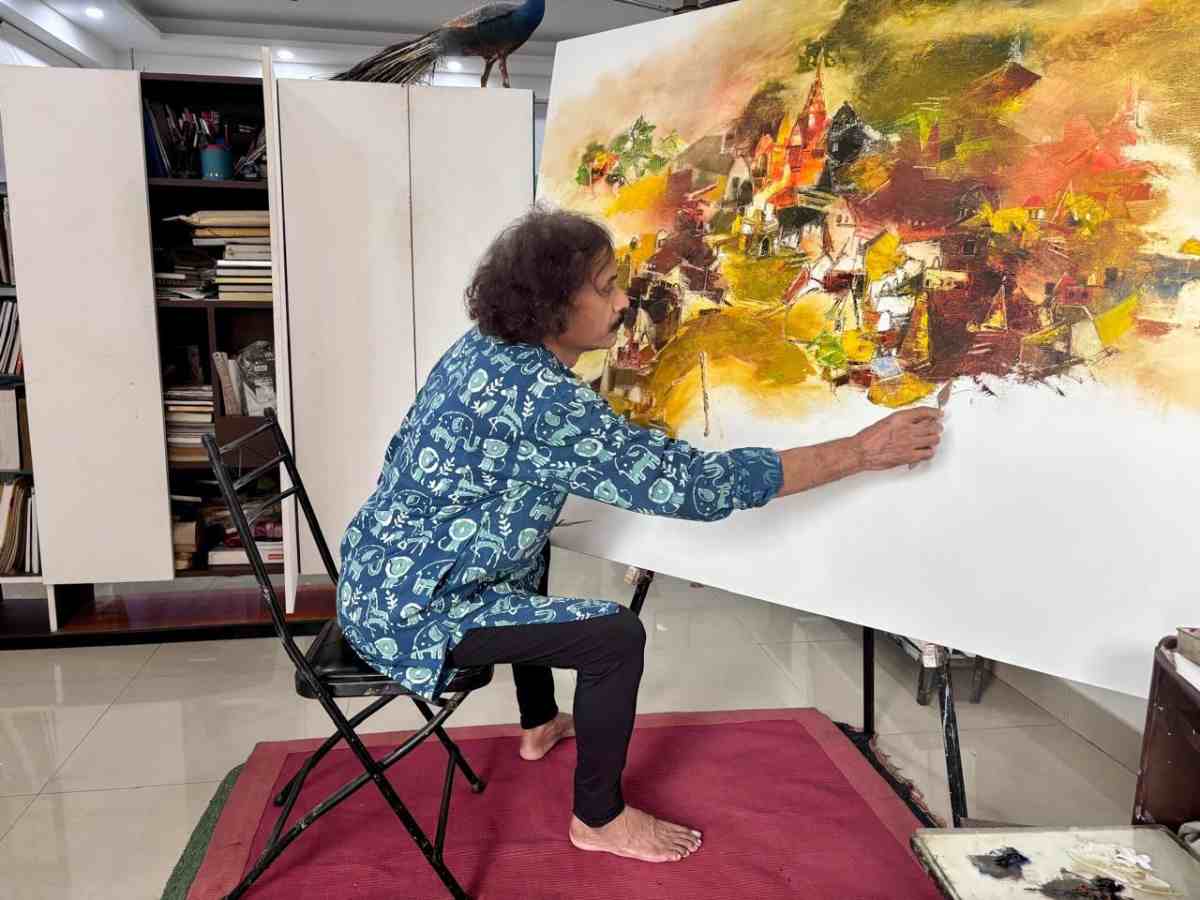
For more than four decades, painter Anand Narain has built his world on canvas—fields stretching across the Indian plains, riverbanks heavy with memory, the timeless ghats of Banaras, and the spiritual resonance of Ayodhya. His paintings, often described as poetry in colour, are rooted in cultural symbols yet alive with personal vision.
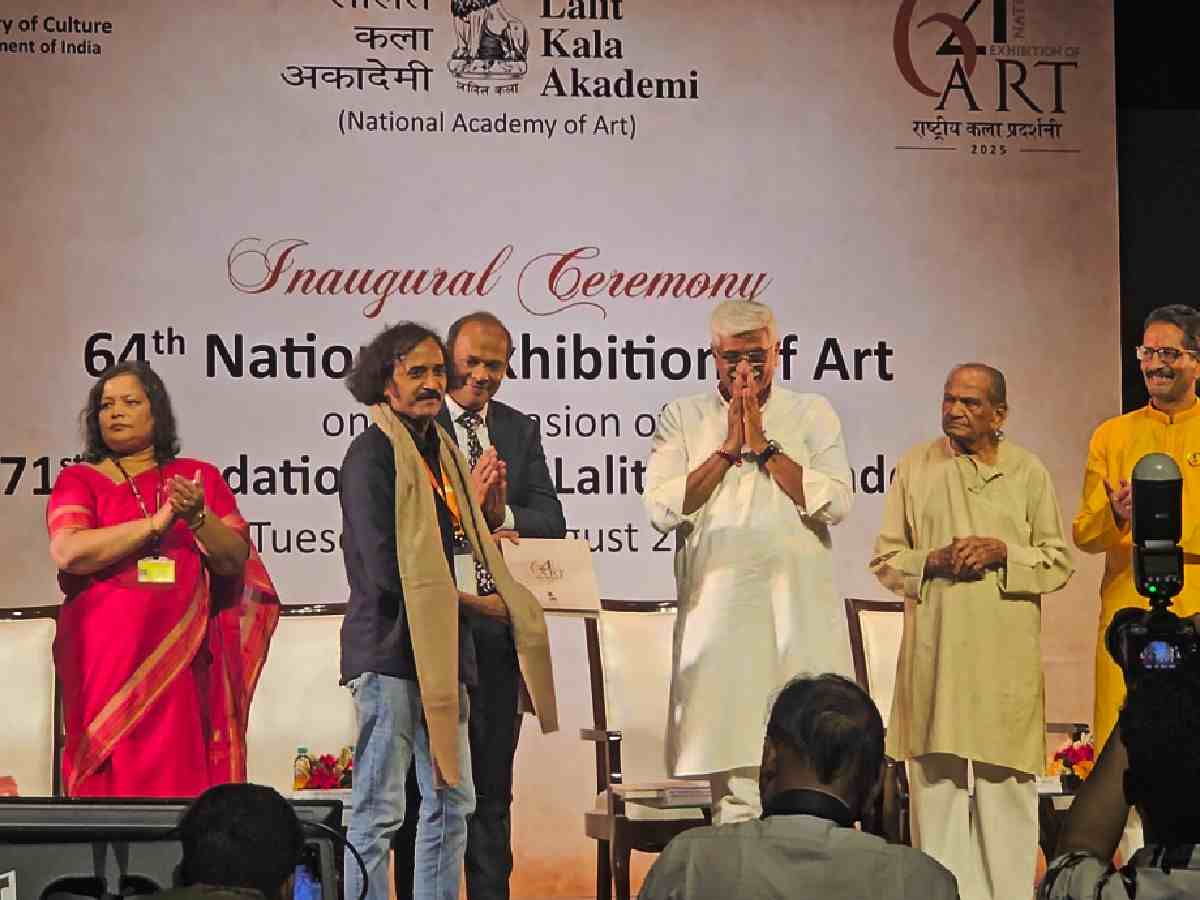
This August, that lifelong journey reached a milestone when Narain was awarded the National Award at the 64th National Art Exhibition in Delhi for his evocative work Kan-Kan Mein Hain Ram.
“In 2024, when I was asked to submit a work, the whole environment was filled with Ram,” Narain recalls. “The temple was being built, there were programmes everywhere, and people were excited. And as a contemplative artist, how could I remain untouched? It came to me—Ram is everywhere, in every particle. That thought became Kan-Kan Mein Hain Ram.”
Reflecting on the recognition, Narain added that he was grateful to the Lalit Kala Akademi (LKA) for continuing to organise the exhibition each year, which, he said, opens ample opportunities for artists across the country to showcase their talent.
A painter of poetry
Narain is unusual among his contemporaries for the way literature flows into his brushwork. He often writes verses that mirror his canvases, with colour and word feeding into one another.
“I use both words and pictures. They are simple, they flow like poetry. And in that sense, painting itself becomes poetry,” he says.
Critics note how his paintings seem to hold within them the rhythm of verses. To him, words and colour are not separate languages but parallel streams converging on the canvas.
Also Read: Delhi’s Old Secretariat: a witness to India’s political journey
The making of an artist
Narain’s artistic journey began in 1982 at the College of Art, Lucknow, before he completed his MFA at Jamia Millia Islamia, Delhi. “Our degree course was detailed. We studied every medium—watercolour, tempera, acrylic, oil. That education built the foundation for everything I do today,” he says.
Since then, his career has spanned more than 50 group exhibitions in India and abroad, along with 14 solo shows in major galleries. He has also been recognised with the Uttar Pradesh State Lalit Kala Akademi Award, among other honours. But for Narain, consistency matters more than accolades.
“I paint regularly. That is why my works are in so many collections, in India and abroad. Good people like them because they feel connected,” he says.
Landscapes of memory
Much of Narain’s oeuvre centres on expansive landscapes that carry cultural and spiritual resonance. His series Untouched Nature reflects the vast plains of India—the view from a train window, golden crops, the colours of soil untouched by human interference.
“These places attract me because they are not man-made. I don’t need references. Once I have seen a glimpse, I visualise it, and then paint like I’m speaking to the canvas,” he says.
Similarly, his celebrated Banaras series captures the timelessness of the city’s ghats, temples, and riverbanks. “Banaras is spiritual heritage,” he reflects. “When I see the Ganga, the old city from above, its spaces and forms connect like a rhythm. That becomes painting. My Banaras is of happiness, prosperity, beauty—it is my way of carrying home the spiritual atmosphere.”
Like Kan-Kan Mein Hain Ram, these works are not mere depictions of place but explorations of what Narain calls “India in its self.” He draws deeply from myth, heritage, and cultural symbols. “It has become rare today for an artist to be in his time and still express himself with cultural metaphors,” he notes. “But my vision is to preserve Indian symbols, to keep them alive in contemporary art.”
Between realism and abstraction
Stylistically, Narain resists neat categorisation. “I am not an illustrator. I am an abstract painter. You can call me semi-realistic,” he says. His forms are often simplified, his palette rooted in earthy tones. “Simplification allows people to understand quickly. The colours I use are Indian colours—they feel familiar, like something people have seen before.”
Yet his work is not about reproducing what exists. “Painting is imagination plus expression. And since I am aware of society, country, and humanity, all these things are within me,” he says.
A voice of caution
Even as he celebrates his National Award, Narain is candid about what troubles him in today’s art world. He worries about shortcuts.
“Many young artists stick papers, cloth, even hammer on the canvas,” he observes. He explained that material itself carries feeling and, without understanding this, expression weakens.
For him, the danger lies not in experimentation but in neglecting rigour. “There is no shortcut to success. Hard work is essential. Our study was detailed, with dedication. Today, that seriousness is missing,” he says.
Galleries, he adds, often encourage what sells quickly. “To make anything cannot be considered art. First of all, it must be beautiful, with powerful expressions.”
Carrying responsibility
For Narain, the National Award is both recognition and reminder. “After doing a lot of work, when something like this comes, it brings happiness. But more importantly, an artist must consolidate, must take responsibility. That is what I tried to do with Kan-Kan Mein Hain Ram,” he says.
The award, he adds, is not just for him. “It is respect for the vision of India that I carry. The process of losing and winning has been constant in my life. But whenever I fell, my courage kept increasing.”
Beyond borders
Narain’s paintings have found homes far beyond India. At an exhibition abroad, he recalls, a couple bought his painting of the Ganga because they wanted to worship it at home in London. “Moments like this make me feel that Indian art and culture travel far, reaching people emotionally, spiritually,” he says.
Message to the young
As the National Art Exhibition continues, Narain hopes young artists visiting will reflect on art’s deeper role. “My message is simple: avoid shortcuts. Study deeply. Respect material. And remember, art carries responsibility—it is not just about self-expression but about connecting with society, culture, humanity.”
In the end, Narain’s art—whether in the ghats of Banaras, the fields of India, or the spirit of Ayodhya—reminds viewers of something essential: that faith, culture, and imagination are interwoven. And in every brushstroke, he makes visible a truth he holds dear—that Ram, and with him India’s cultural soul, lives in every particle.