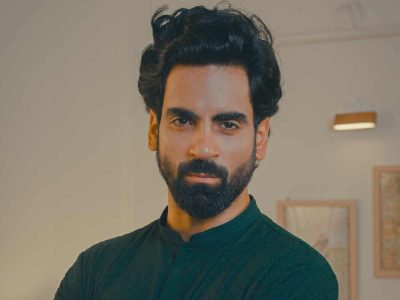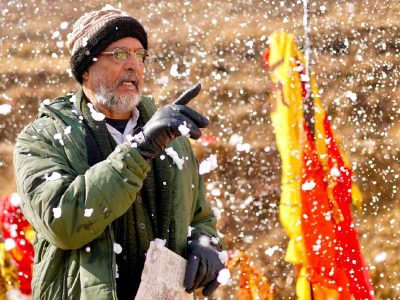

On stage, Ricky Kej has conducted orchestras, collaborated with legends, and won three Grammys. Off stage, he is a committed environmentalist, UN Goodwill Ambassador, and advocate for sustainable living. Yet despite global acclaim, he remains grounded, choosing projects that speak to history, culture, and conscience.
That balance between recognition and humility defines Kej’s career: a musician whose melodies traverse continents, yet whose purpose is larger than awards. “Music is not just sound,” he says. “It’s a story, a message, a bridge between worlds.”
Bangalore beginnings
Born Ram Gyan Kej in North Carolina, United States, in 1981, Kej’s family relocated to Bangalore when he was eight. Raised in a Punjabi-Marwari household, he was encouraged to pursue a conventional career. He initially studied dentistry at Oxford Dental College but soon realised his true calling lay in music.
“I don’t remember a time when I was not a musician,” he recalls. “For the first six years of my life I was in America… My father had a massive music collection… he had a guitar, he had a piano… I used to play on that and I was self-taught in the earlier stages of my career.”
Kej began his musical journey as a keyboardist with the progressive rock band Angel Dust before founding his own studio, Raveolution, in 2003. Since then, he has composed over 3,500 jingles, film scores, and albums, drawing inspiration from Hindustani and Carnatic classical traditions, world music, and environmental sounds.
“From the beginning, it has always been me trying to create my own music and expressing myself through my music,” he says. “That is why you never see me go on stage playing a cover version of another song. It has always been me trying to express myself through my music.”
Also read: PVR INOX expects strong festive season, clocks 50 pc occupancy during Dussehra
Grammy milestones and international acclaim
Kej’s global recognition began with Winds of Samsara (2014), a collaboration with South African flautist Wouter Kellerman, which debuted at No. 1 on the US Billboard New Age Albums Chart and won him his first Grammy. Subsequent albums, including Divine Tides with Stewart Copeland, garnered his second Grammy in 2022 and a third in 2023 for Best Immersive Audio Album.
“My first Grammy award was for an album called Winds of Samsara,” he says. “The second and third Grammy awards were for this album called As Divine Lines. They are very Indian in essence — basically Hindustani and Carnatic classical music vision albums.”
His music often carries a message beyond melody. Shanti Samsara, launched at COP21 by Prime Minister Narendra Modi and French President François Hollande, and My Earth Songs, a series of environmental songs for children incorporated in over five million school textbooks worldwide, reflect his commitment to social causes.
“We are currently in more than 20 million textbooks across India and in a couple of other English-speaking nations of the world,” he says. “Each song is very positive, very entertaining, very energetic. Children love it, and children love singing. That is the kind of impact I would like to have, changing people’s behaviours and lives through music.”
Kej’s philosophy is simple: “Obviously, when I am creating music for social impact or musical impact or whatever, it is very important that the art form itself has to be good, the art has to be fantastic. If the art is not good, then nobody is going to listen to the message in the first place. You cannot have an excuse not to do that — it has to be absolutely spectacular. Only if it is spectacular, people are going to watch it, and only if people watch it, they will get the message.”
Papa Buka and the Oscars
Kej’s latest project, Papa Buka, marks another first: composing the score for Papua New Guinea’s official Oscar entry. Directed by three-time National Film Award winner Dr Biju, the film traces the story of Indian historians searching for an indigenous World War II veteran. Kej immersed himself in local tribal music and natural rhythms, ensuring the score resonates authentically with the film’s narrative.
“It’s an honour to contribute to a story that connects cultures and histories,” he says. “This project is about music serving a purpose beyond itself.”
Music, film, and social conscience
Despite opportunities in Bollywood, Kej remains selective. “I’ve done soundtracks in the past but I’ve not done mainstream movies because I would not want to create an item song. Many composers in Bollywood are making item songs that objectify women. I feel that is extremely wrong. I want my art to define me. That is what art is all about.”
He has composed for natural history films such as Sir David Attenborough’s Wild Karnataka and the upcoming Wild Tamil Nadu, as well as socially conscious films like the Malayalam anti-war film Atrisha Jala Thangal. “These are the kind of subjects I would love to do — talks about social causes, about something that needs to be addressed, but at the same time, it’s beautiful and artistic,” he explains.
Awards, recognition, and legacy
Kej’s work has been recognised globally, but 2025 brought a milestone of national pride. He was conferred with the Padma Shri by the President of India, Droupadi Murmu, for his contributions to the Arts.
“I’ve won lots of awards all over the world, but all of those have been for a project or a song. I feel the Padma award is for my entire career, and it is a huge validation of all the decisions I’ve made, a lot of them against the grain, by the highest authority in my country. There is no greater feeling,” he says.
An adjunct professor at the National Institute of Applied Studies, Kej continues to explore music as therapy. “Last year I created this album called Break of Dawn… we researched heavily on what kind of music, frequencies, and sounds contribute to stress relief for as large a demographic as possible. We’ve put it into clinical trials in multiple countries, and the dream is that doctors will one day prescribe music legally to their patients for stress relief, just like medicine or physiotherapy.”
Grounded by purpose
Even with performances for world leaders and global audiences, Kej remains rooted in simplicity. “I measure success not by awards, but by impact. If a piece of music can make someone pause, reflect, or feel connected to the planet, that is my reward,” he says.
From his early days in Bangalore to Grammy stages and the Oscars, Ricky Kej’s journey reflects a rare fusion of talent, conscience, and humility. His story is a reminder that music can transcend entertainment — it can heal, educate, and inspire change.
As he prepares for upcoming projects such as Wild Tamil Nadu and the international releases of his environmental albums, Kej continues to follow a guiding principle: “Create with purpose, and the world will listen.”