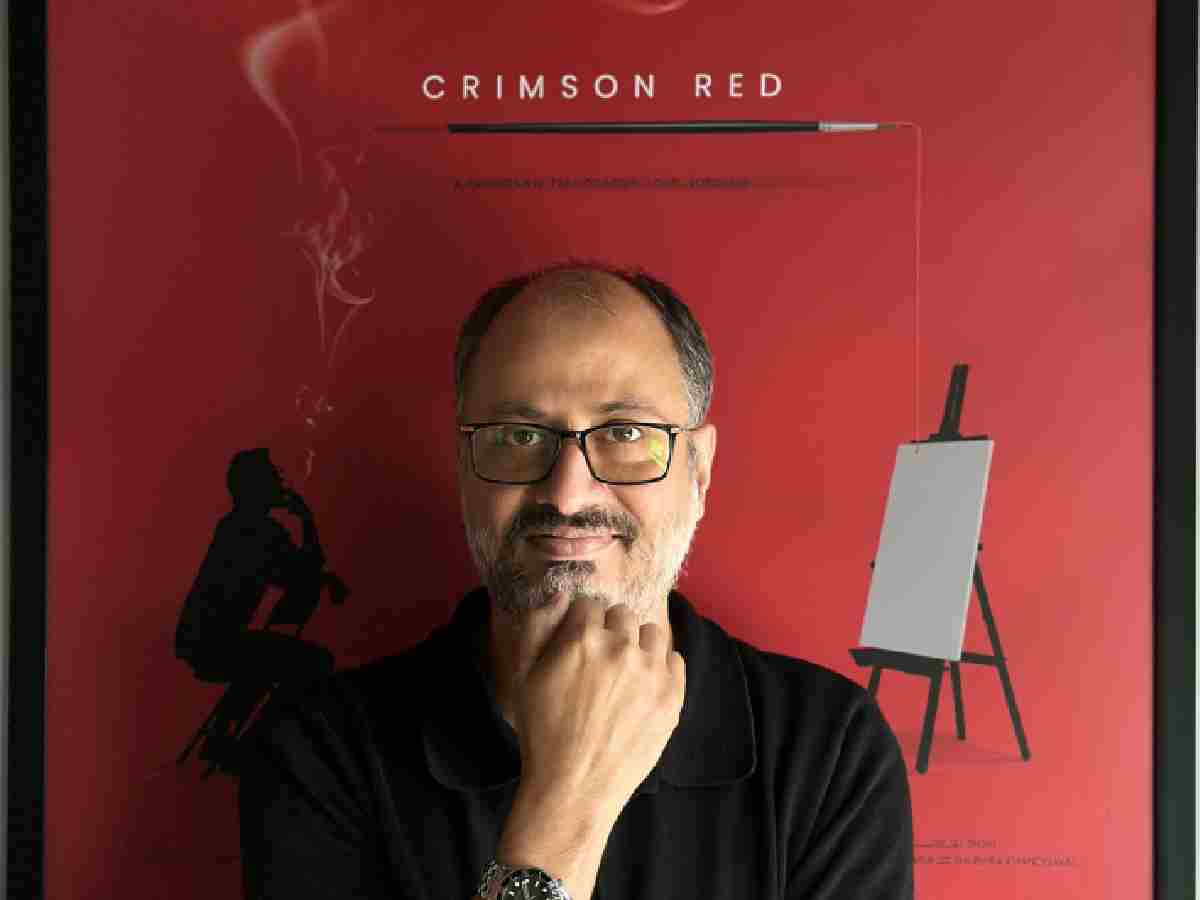
For over 40 years, Cunal Ranjan quietly nurtured one dream—to make films.
“There hasn’t been a single day that I haven’t thought about cinema,” he says. “Especially the kind I wanted to make.”
That vision takes form in Crimson Red, a debut rooted in memory, love, and obsession. A painter, event manager, photographer and production designer, Ranjan says the film wasn’t planned. “It chose me.”
“As a child, I was always telling stories—too elaborate, too detailed. I was laughed at for them,” he recalls. “But I kept at it. I’ve lived many lives, and those chapters inspired me to tell a story that comes from a colour I am deeply drawn to—red.”
One such chapter was marked by the loss of actor Major Bikramjeet Kanwarpal during the second wave of Covid-19. “He dreamt of becoming a filmmaker but couldn’t finish his journey. That left a scar.”
A conversation with cinematographer Sejal Shah soon after sparked the idea for Crimson Red. “We were casually discussing me directing a film, and in that moment, it chose me. It splattered all over me like paint.”
A stain that lingers
The film’s title and metaphor come from the crimson dye once extracted from the insect Kermes vermilio, which clings to the bark of the Kermes oak.
“It’s like Romeo and Juliet,” Ranjan says. “The insect clings to the tree, and in its release, we find transformation, pain, and beauty. That image became the spine of the script.”
The film is dedicated “to every muse who quietly shapes an artist’s vision.” For Ranjan, that includes “my mother, first and foremost, and many extraordinary women I’ve met—each left a Pandora’s box of memories.”
“I wanted the stains of those moments to stay—intact, vivid, and alive.”
At the centre is Basudev Bhargav, a creative alter ego. “He’s like the Kermes oak. Seeking the purest hue in every woman he meets. It’s obsessive, sometimes narcissistic. He undergoes transformations that are irreversible.”
But the film, he insists, is not dark. “It’s deep. Every frame reveals a new layer, like a painting you keep returning to.”
A shared vision
Though deeply personal, Crimson Red was built through collaboration.
At the forefront of this creative team was Violette Ghosh, the film’s producer, who helped shape the project from concept to completion. “With someone like Violette on board, a monumental task starts to feel achievable,” Ranjan notes.
Sejal Shah was behind the camera, with music by Sidhant Mathur and Annabelle Lombard, vocals by Vasundhara V, and performances from Sarah Jane Dias, Siddhant Karnick, Sanya Sagar, and Pooja Bhamrrah.
“As a director, my job was to stay honest to my vision. But I was lucky to work with people who got it,” says Ranjan. “Sejal understands images with class and detail. Sidhant paints with sound the way I paint with visuals.”
The symbolic aesthetic was completed by Shalini Jaikaria’s costumes and Shubhra Khandelwal’s makeup.
Returning to where it began
Crimson Red premiered in Delhi, where Ranjan began his creative journey.
“This city gave me my identity. I started here as a painter, accessory designer, and photographer. And Sunil Sethi, my mentor and friend, helped shape this journey. Delhi was always the right place for the film’s unveiling.”
He sees the Capital as India’s “home of art and design”—a place that still embraces slow, symbolic storytelling. “Of course the bar has to be high. Crimson Red is my humble attempt to meet that bar.”
Ranjan welcomes the rise of independent cinema but warns against formula. “The tools are cheaper, the platforms are open. But we must keep experimenting. Independent cinema should not become its own cliché.”
From Talkies to trilogies
Ranjan’s cinematic influences are eclectic.
Growing up in Marhowra, Bihar, he found his love for cinema in Vijay Talkies. “Amitabh Bachchan, Jeetendra, Rajinikanth, Dharmendra… I watched them all.”
Later, after studying at the College of Arts and Crafts in Patna, then Delhi, and at NIFT, his sensibilities expanded. “Satyajit Ray and John Woo both speak to me. That duality still exists in me. I want to craft films with both style and soul.”
He acknowledges the comparisons to Kieślowski’s Three Colours trilogy but adds, “The answer is both yes and no. My stories are different, but I loved the idea of colours as emotional landscapes.”
Also Read: Siddhant Karnick is in no rush to be seen or liked
Even as he leans into stylised storytelling, Ranjan dreams of reaching the masses.
“I want to hear the whistles, the applause. I want my characters to live in people’s hearts. But before I get there, I have to honour the world I’ve lived in—the sounds, the stains, the stories.”
The Delhi High Court stayed an order requiring public prosecutors to mark daily attendance via…
Railways cancelled select trains to New Delhi and Nizamuddin on Oct 10, citing road traffic…
Delhi Police registered 25 FIRs regarding SIR protests, naming Rahul and Priyanka Gandhi Vadra over…
Around 200 LHJP protesters gathered in Delhi to condemn abusive language against PM Modi and…
Delhi Police denied permission for the Cockroach Janta Party's Oct 10 protest at Jantar Mantar,…
CTI has urged PM Modi to ban large protests in central Delhi from Navratri to…

