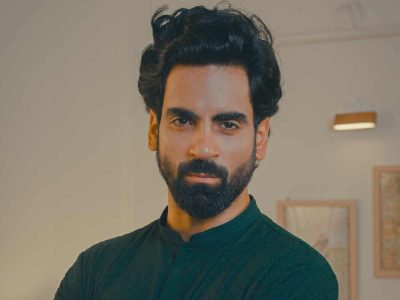

Siddhant Karnick is not in a hurry. Not to be seen, not to be liked, and certainly not to fit in.
“Every character I’ve done—good, bad, aristocratic, bloody—has found me when I was ready,” he says with quiet conviction, sipping coffee ahead of his upcoming Delhi theatre show. From the charming teen in Remix to the tormented Basu in the psychological thriller Crimson Red, Karnick’s two-decade-long journey in front of the camera has been anything but linear.
Best known for his regal turn as Rana Indravadhan Singh Deo in the period drama Ek Tha Raja Ek Thi Rani (2015–2016), Karnick has straddled television, indie films, web series, and now stage performances. But it is in Crimson Red—a disturbing film drenched in metaphorical and literal blood—that he says he truly surrendered to the art.
“The script felt normal on paper,” he recalls. “But when I saw what Cunal Ranjan [the director] had done with the visuals—the red, the tension, the visceral violence—I was stunned. That’s when I realised, this wasn’t just a film. This was an excavation.”
The discomfort of truth
In Crimson Red, Karnick plays Basu, a character whose intimacy with Tanya (his co-star) carries both emotional and disturbing weight.
“We had an intimacy coach on set,” he says. “And thank God for that. As actors, we’re often told to just get on with it. But those scenes needed psychological care, not just choreography.”
While performing, Karnick says he was completely immersed. The character was so well-written that nothing felt difficult during the shoot. “But it hit me later, during post-production,” he says. “Basu is that kind of man—he doesn’t leave you easily.”
The audience response has been intense. “They say it’s brilliant but uncomfortable,” he smiles. “And I think that’s exactly what art should be. It should unsettle. That’s what makes it real.”
Return to stage—and to Delhi
Karnick’s next performance will be Ladies’ Sangeet, a theatrical production scheduled to be staged in Delhi on August 30.
“It’s part of who I am now,” he says. “I do theatre because it keeps me honest. Live performance has a pulse. No matter how flashy cinema gets, theatre will never lose its relevance.”
Delhi, for Karnick, is more than just a stop on his tour calendar. “I have a lot of memories here,” he says fondly. “Especially about food. I remember going to Jama Masjid at night, eating in the lanes. That meant a lot to me.”
He adds, “I’ve got a lot of friends in the Dhaula Kuan and Tank Road areas—mostly army kids. My father was in the army too, so my Delhi connect is emotional.”
Motorcycles, memories and YouTube
Outside acting, Karnick is equally invested in travel and storytelling. He runs a YouTube channel where he vlogs about his motorcycle journeys and creative experiments.
Also Read: My father’s simplicity shaped me, says Nitin Mukesh
“Riding isn’t just an escape—it’s a way to declutter. I find stories on the road,” he says. He edits and photographs most of his own content. “It’s about expression, not algorithms.”
An actor without a formula
From Thappad to Adipurush and Animal, Karnick has taken on roles across genres and scales. “I’m also working on a thriller—One Night at McCluskey Gunn—and producing a French film, The Diggers, where I’m also in the lead,” he says.
But visibility has never been his goal. “Acting, for me, is rhythm. Sometimes the beat is fast, sometimes it’s slow. You just have to keep dancing.”
He remains optimistic about OTT platforms. “They’ve opened doors for indie creators like me. I don’t believe in the Netflix star system. I believe in stories. And OTT has made room for storytellers—writers, directors, technicians—who were otherwise ignored.”
Advice for newcomers
What would he tell the next generation of actors?
 “There is no formula,” he says. “Everyone’s journey will be different. If you’re coming in for money or fame, this industry will break you. But if you love acting, no one can stop you.”
He names Irrfan Khan as his all-time favourite actor—“a star who never chased stardom”—and says he is open to working with anyone who brings emotional honesty to the craft.