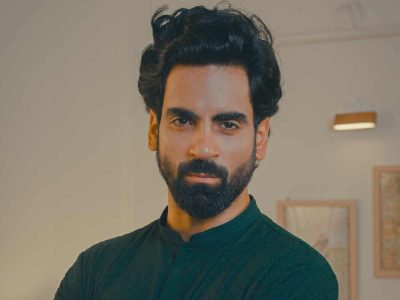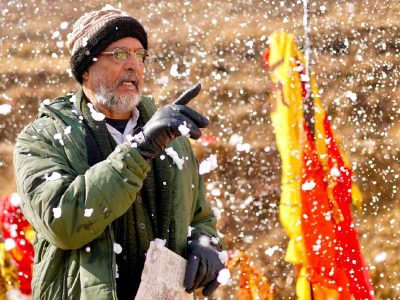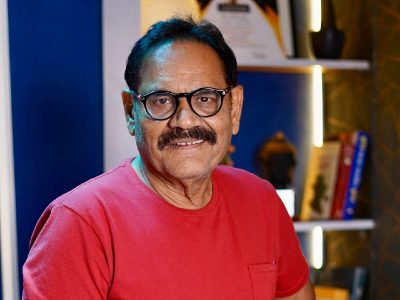
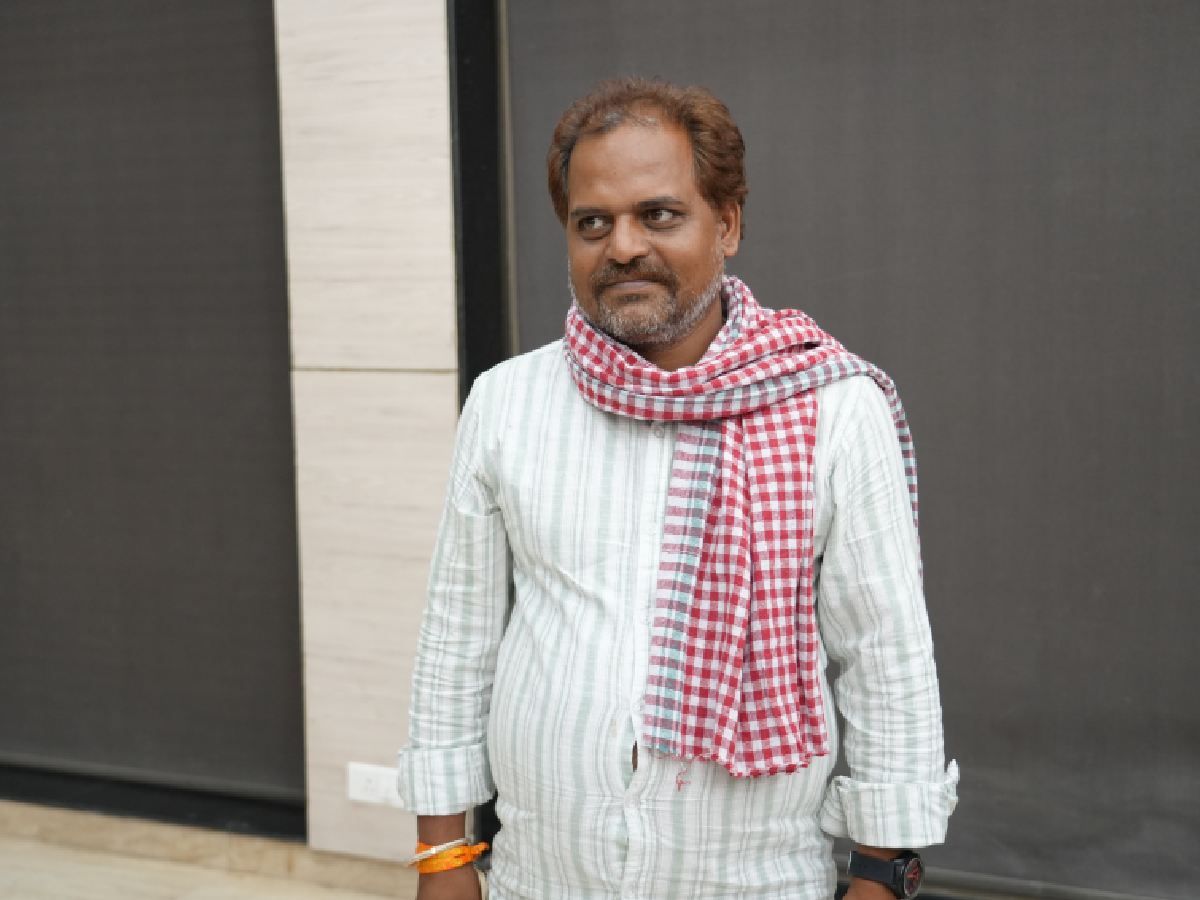
For Durgesh Kumar, the path to recognition has been long and often uncertain. The actor, best known for his viral line ‘Dekh raha hai Binod?’ in Panchayat 2, has spent over two decades quietly honing his craft—first on stage, and later on screen. Today, as one of the most familiar faces in India’s OTT space, he looks back on the years of struggle that shaped him.
“I have seen many films since childhood but never thought of becoming an actor,” he begins. “My father was a professor at CM Arts College, Darbhanga. Then Satya was released in 1998. I was very inspired by that. Manoj Bajpayee had done very good work in it. I got to know about the path.”
It was a newspaper article about Bajpayee that changed his life. “There was a newspaper called Hindustan. I read in detail that he did theatre for 10 years but not in NSD. I saw that challenge,” he says. That moment planted the seed for his journey.
From Darbhanga to Delhi
Durgesh came to Delhi in 2001, intending to appear for the IIT entrance exam. “My elder brother told me to leave it and do theatre for personality development,” he recalls. “Then I joined theatre on December 9, 2001.”
What followed was a decade-long immersion in acting—training at the Shri Ram Centre, earning a three-year diploma at the National School of Drama (NSD), and later joining its repertory.
“I did theatre continuously for 12 years,” he says with quiet pride. “I did SRC 2-year diploma, NSD 3-year diploma, 1-year fellowship in Robinson, and 1-year repertory. I did acting and nothing else.”
Years of struggle in Delhi
The early years were marked by hardship. “My father and elder brother helped me a lot to sustain myself in Delhi,” he says. “Still, I used to starve once in seven days, and once in three days.”
He moved between small rooms in Shakarpur and near Tilak Bridge, surviving on minimal means. “Theatre was the only source of income,” he adds. “I did one work, I was a salesman at a motorcycle shop for three months. And I did one work in Noida, I taught for one and a half years in Shankar Public School.”
Yet, his focus never wavered. “I did theatre for 25 years. I did acting and nothing else,” he says simply.
Also read: PVR INOX expects strong festive season, clocks 50 pc occupancy during Dussehra
A break that changed everything
Durgesh’s first screen appearance came with Imtiaz Ali’s Highway (2014). “In Delhi, I got the first chance in Highway, Alia Bhatt’s film, the one which goes to Kashmir,” he recalls.
“After Highway, I went on to star in more films. However, all the roles were small and more often than not nameless,” he recalls. He appeared in Salman Khan’s Sultan as a wrestling commentator, in Sanju as a postman alongside Ranbir Kapoor, and in Dhadak as a supporting character named Bheema.
“After that, I got less work. Then in 2020, when the lockdown came, my work started going well—and touchwood, it’s still going well.”
That year, Panchayat came calling. “I was called for an audition at Navneet Ranga Casting, Mumbai. They offered me the role of a photographer. I gave two to three takes, then they said there is another role of Bhushan Sharma,” he says. “Remember, in the first season, I did one scene—that was viral. In the second season, I didn’t know, but I got the role of Bhushan Sharma.”
The scene went viral overnight, turning him into an internet sensation. But Durgesh is grounded about the unpredictability of fame. “We only work hard to do it,” he says. “It is God’s grace that a reel goes viral. As an actor, I don’t have to impress you—I have to do it truthfully.”
He cites his inspiration from actors known for their realism. “Right now, Manoj Bajpayee, Nawazuddin Siddiqui, and Irrfan Khan inspire me,” he says. “I never think what will go viral. I just do my work honestly.”
Not chasing success
Unlike many who chase stardom, Durgesh believes in patience. “You said a good word—I am not chasing,” he smiles. “Beggars can’t be choosers. You give me a two-day role, I will do that too. This is my thing.”
Even as his popularity grows, he remains disarmingly humble. “I take it positively. I give a selfie to everyone. People talk to their parents on video calls. I like that too,” he says. “I don’t reach there by imagining it. I reach there by working hard. If I get it, it’s fine. If I don’t get it, I should go home.”
Looking ahead
At 44, Durgesh reflects on his life with a calm sense of fulfilment. “How do I see life?” he repeats the question thoughtfully. “If you work hard, you get things.”
From Darbhanga to Delhi and now Mumbai, his story is not one of overnight fame but of quiet perseverance—the kind that defines many of India’s finest actors. His journey, from doing theatre in dimly lit halls to starring in Laapata Ladies and Panchayat, reminds him every day of where he started.
As he puts it, “I reach there by working hard. If I get it, it’s fine. If I don’t, I should go home.”