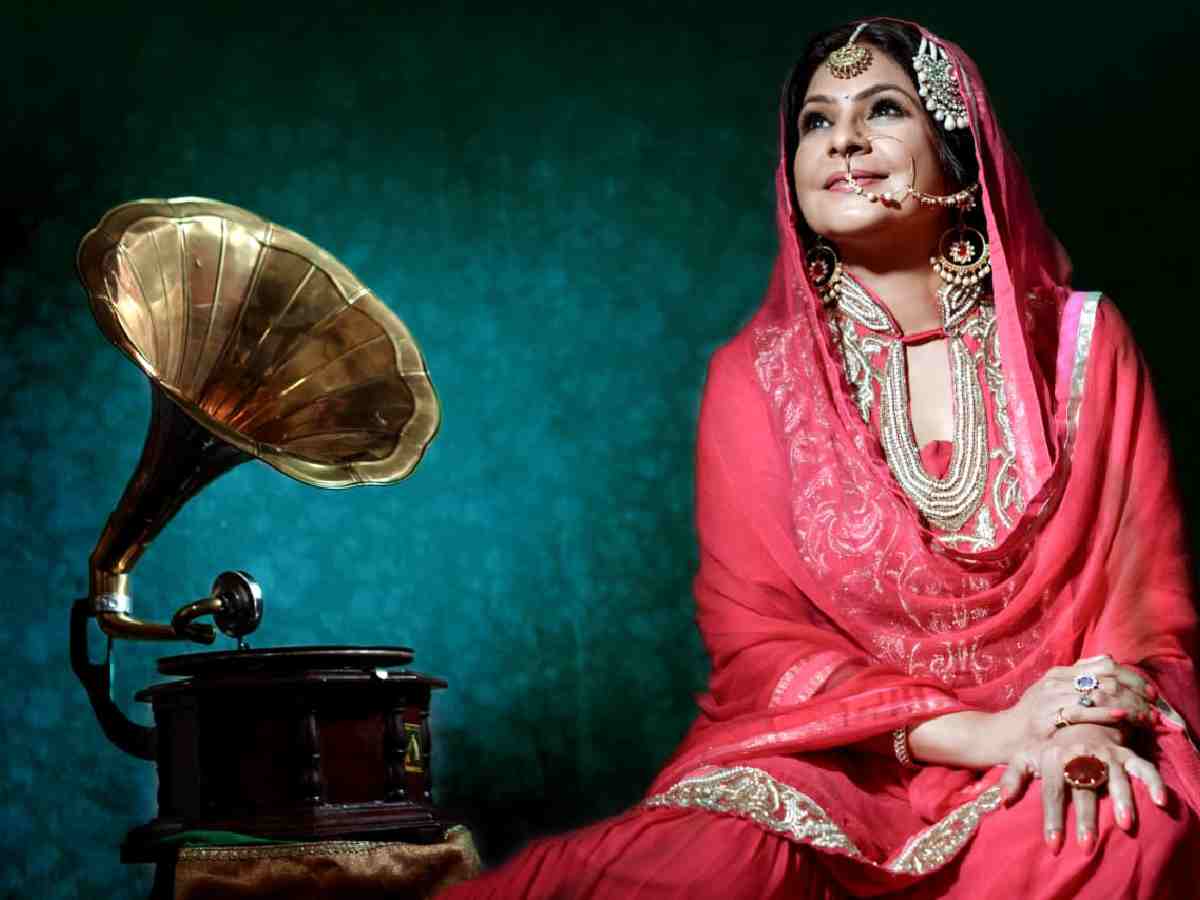
Malini Awasthi
For Malini Awasthi, folk music is a living archive of India’s collective memory — its dialects, festivals, customs, philosophies and everyday lives. Its songs carry stories passed down through generations, preserving emotions and traditions that are not always captured in written history.
For over four decades, the Padma Shri awardee has been among India’s prominent folk artistes. Yet even after international performances, film songs, national honours and countless accolades, Awasthi says her greatest ambition now is to prepare the next generation to carry the tradition forward.
Bridging musical worlds
Awasthi recently shared the stage with electronic music duo Midival Punditz at Baarish, an immersive monsoon-themed musical experience held in Delhi. The performance brought together electronic soundscapes and centuries-old folk traditions, a collaboration made possible, in her view, by years of trust between the artistes.
“I have known Midival Punditz for nearly 15 years now,” she says. “It has been a long and beautiful association built on mutual respect. Both Gaurav and Tapan have exceptionally good ears and a deep understanding of Indian music. They appreciate classical music, folk traditions and everything in between.”
That shared musical understanding, Awasthi believes, is what makes the collaboration work.
“They may be pioneers of electronic music, but whenever they blend Indian music with electronic arrangements, they never compromise its essence. They give every artist the freedom and space to remain true to themselves while creating something entirely new.”
Their journey together began in 2011 after the duo heard Awasthi perform and approached her through music composers Salim–Sulaiman. She recorded Tonic for their album Hello Hello, and the collaboration went on to include performances at major music festivals in India and abroad.
Building a legacy
Ask Awasthi about the milestones that have shaped her career, and she responds with gratitude.
“Life has been kind,” she says. “Guru kripa has always been there. I have been fortunate to receive the Padma Shri, sing for films, perform for Coke Studio, represent India on international platforms, and receive many other honours.”
But success has also brought with it a sense of responsibility. “I don’t think of it as an unfulfilled dream, but today I feel it is my moral responsibility to teach.”
Six years ago, she quietly began teaching students at her home through the traditional guru-shishya parampara. What began as a modest initiative has since grown into a much larger vision. “My disciples come home to learn, and I am already working towards establishing a proper gurukul for them in the coming years. I believe that dream will become a reality very soon.”
For Awasthi, preserving folk music does not simply mean performing it on stage. It means ensuring that knowledge, discipline and cultural understanding are passed on exactly as they were received.
Lessons from a guru
Much of that philosophy comes from her own guru, the legendary Girija Devi, whose influence continues to shape Awasthi’s life beyond music.
“I observed Girija Deviji very closely and realised she was never two different people. The person she was at home was exactly the person she became on stage.”
Watching her guru in ordinary moments — sharing meals, laughing, watching television or conducting lessons — left a lasting impression. “She carried the same spirituality, intelligence and simplicity everywhere she went. That taught me that your life and your music cannot be separated.”
Preserving a tradition
Earlier this year, Awasthi released Chandan Kiwad, her first book, offering readers a glimpse into the experiences that have shaped her musical journey. Although she prefers readers to discover its stories for themselves, she says it is deeply personal.
“As an artiste, I have shared my own experiences and how every song gradually begins to reveal deeper meanings. Every chapter carries multiple memories and contexts. You have to read the book to truly understand that journey.”
Her efforts to nurture the next generation also extend beyond the classroom. Through her organisation, Sonchiraiya, which recently celebrated its 15th anniversary, Awasthi organised workshops and folk festivals that encourage young musicians to engage with India’s traditional arts.
Contrary to the perception that younger audiences have drifted away from folk music, her experience suggests otherwise.
“The younger generation is actually far more responsible than we often imagine,” she says. “There is genuine curiosity. They want to understand what they have missed. They want to learn, appreciate and respect everything that belongs to our own culture.”
Changing perceptions
If there is one thing Awasthi wishes could change overnight, it is the society’s attitude towards folk artistes. “People judge them by their clothes, by their dialects, by the songs they sing, almost as though they belong to a different world.”
To Awasthi, that perception must change. “Our folk artistes are the greatest ambassadors of this country. They are the storytellers of our ancestors.”
Rather than seeing them as performers who appear briefly on stage before disappearing again, she hopes audiences will engage with them more personally.
“Learn your own dialect. Learn the language of your region. Invite folk artistes into your homes. They should become part of society again, not remain confined to festivals.”
As folk songs increasingly find new life through commercial remixes, Awasthi adopts a balanced view. She does not oppose experimentation. Her concern, instead, lies in careless adaptations. “The fact that people repeatedly choose old folk songs or qawwalis for remixes shows there is a shortage of original compositions.”
Universal language of folk
Despite rapid social change, Awasthi rejects the idea that folk music belongs only to the past. “Folk has always been relevant. It continues to be relevant.
“When I sing about a girl married far away from her parents, I have seen women in America and other countries crying.”
Songs celebrating women’s freedom often surprise contemporary audiences. “People have created a narrative that women in earlier generations had no freedom. Folk songs completely challenge that. They show women laughing, playing, expressing themselves and celebrating life.”
Technology and tradition
Awasthi sees significant potential in digital platforms. “Social media has done great service to Indian folk music.”
Videos allow audiences to understand traditions beyond the performance itself. “When you see how people live, why they sing certain songs and the rituals surrounding them, you understand the music much better.”
She also believes digital platforms have dismantled cultural hierarchies. “What I love most is that social media has broken the shackles of elitism.”
Today, she points out, anyone can proudly showcase their forgotten village, dialect, cuisine, ritual or local tradition.
More than music
For Awasthi, folk music ultimately represents something much larger than culture. Its songs, she says, explain the country’s philosophy more clearly than any academic text.
“In our Panchatantra, Jataka tales and folk songs, nature has a voice. Trees speak. Birds teach. Rivers become companions. That is how we have traditionally understood the world.”
Modern lifestyles, she believes, have gradually weakened those connections.
“People are working harder than ever. They earn well, but many no longer know their neighbours or spend enough time with their families.”
Singing for Delhi
Having performed in the capital for years, including her recent appearance at Baarish, Awasthi says she considers Delhi one of India’s most rewarding cities for musicians because of its diverse and appreciative audiences.
“Delhi is a great audience,” she says. “It is a mixed crowd, of course, but they are great connoisseurs and great listeners. My audience here is both young and old.”
She believes the city’s openness to different musical traditions sets it apart. “Delhi embraces every kind of music — qawwali, Sufi, Kathak, classical, thumri and folk. Everything is respected and accepted here. That is a wonderful quality because listeners come with an openness to experience different forms.”
Surprise in store
She was aware that many people attending Baarish arrived with certain expectations.
“When the posters and announcements for the show came out, many people wanted to know whether I would be singing my popular numbers,” she says.
“That is natural because once an artist becomes associated with a particular style, audiences hope to hear those familiar songs.”
Instead, she wanted to present a different side of her music.
“I think many people were in for a pleasant surprise,” she says. “Our music is like water — it should be allowed to flow and be experimented with. It takes the shape of whatever vessel you place it in.”
When rain arrives
The monsoon theme of the event resonated deeply with her lifelong engagement with folk traditions.
“Rain has inspired generations. Human beings have always drawn inspiration from nature, and that is how music itself came into existence,” she says. “India is blessed with six seasons, and after months of scorching heat, the arrival of rain is seen as a blessing.”
That relationship between nature and music, she explains, runs through India’s folk traditions. It was one of the reasons why she immediately embraced the idea of Baarish. “When Minhal Hassan, proposed the concept, I loved the name itself. It is so musical. We performed on World Music Day, around the time the monsoon arrived, so everything felt beautifully connected.”
DMRC says zero reduction in train trips, attributes decline to security measures and public apprehension…
A Delhi court denied bail to a former DU professor accused of raping a student,…
Delhi Police charged seven dhaba workers in the fatal beating of a Manipuri musician who…
Seven Delhi STPs failed DPCC standards in September, dumping high levels of faecal coliform and…
AISA chief Neha Bora petitioned the Delhi HC against a police notice requiring a peace…
Average AQI of 171 in the first week of this month; falling temperatures and stubble…
