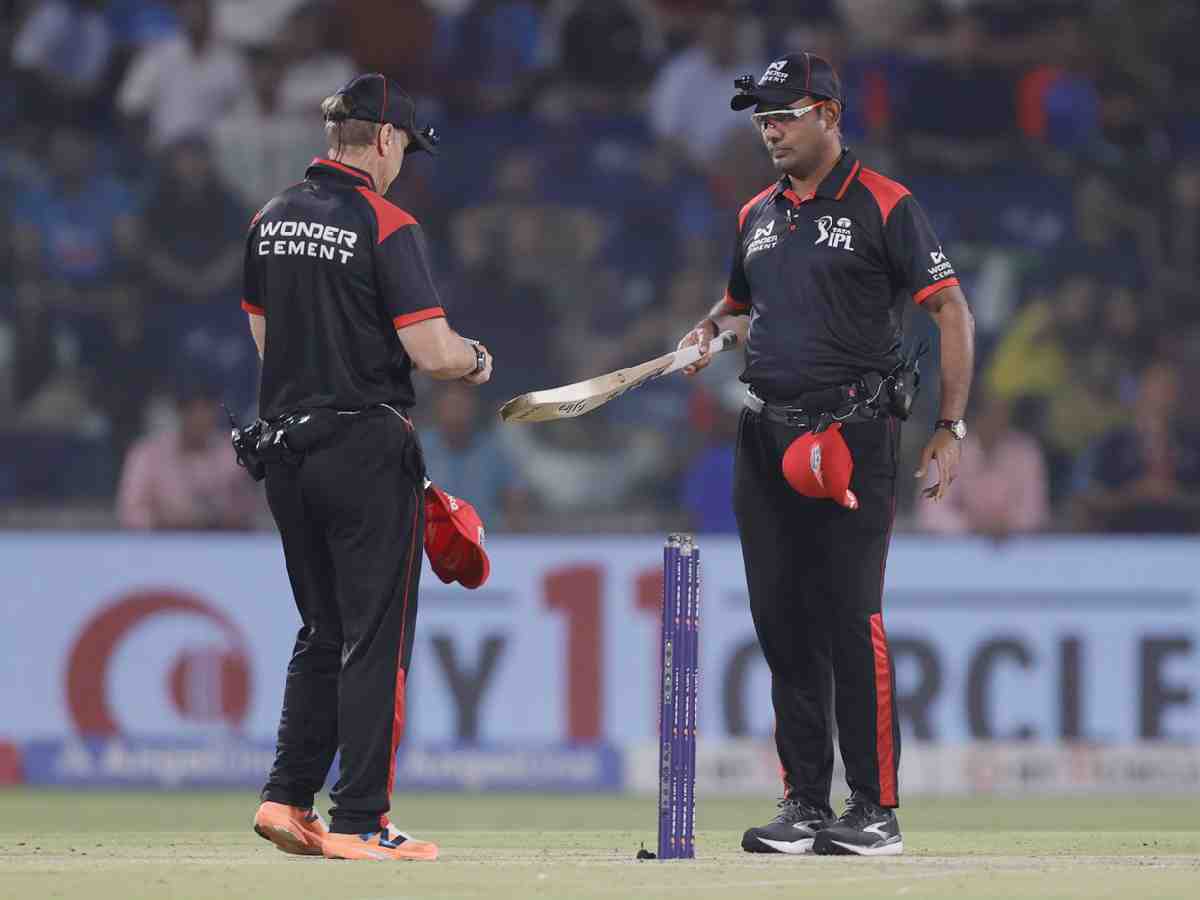
In the high-octane Mumbai Indians-Chennai Super Kings derby at the Wankhede Stadium on April 20, Rohit Sharma stepped onto the field as an impact substitute. As he reached the crease, senior umpire Virender Sharma pulled out a hut-shaped gauge from his pocket and checked Rohit’s bat for size compliance. Rohit smiled, walked a few steps towards the former first-class cricketer-turned-umpire, passed the test—and went on to score his first fifty of the 2025 Indian Premier League: an unbeaten 76 off 45 balls that helped Mumbai Indians secure a much-needed win and climb the points table.
This was not an isolated incident. Umpires in the 18th edition of the IPL have been checking bats of all players in every match to maintain balance between bat and ball. But what has triggered this sudden stringency?
Pushp Kohli of Beat All Sports (BAS)-Vampire, a leading bat manufacturing company based in Jalandhar, can only speculate. He suggested that the move could have been prompted by complaints made by players about oversized bats used by some of their opponents. He compared it to typical workplace grievances: “Players, just like employees, could object to anything on the field,” he said.
A senior umpire, speaking on condition of anonymity, confirmed that concerns raised by some senior cricketers and coaches about certain batsmen using oversized bats during the IPL and the recent domestic season led to the BCCI’s decision. He explained that these complaints resulted in mandatory bat checks to ensure a level playing field.
According to reports, two players’ bats have failed the gauge test so far: West Indies all-rounder Sunil Narine and South African pacer Anrich Nortje, both representing Kolkata Knight Riders. They were asked to change their bats during their April 15 match against Punjab Kings in Mullanpur. As of now, there is no official word from the Board of Control for Cricket in India (BCCI) on any fines or penalties for the transgression.
Under the specifications set by the Marylebone Cricket Club (MCC) and accepted by the International Cricket Council (ICC), a bat’s length must not exceed 96.52 cm, its face must be 10.8 cm or less, the blade thickness capped at 6.7 cm, and edge width restricted to 4.0 cm. These rules apply to all international and first-class matches, besides the IPL.
New protocol for a level playing field
The process now involves checking the two opening batsmen’s bats in the dugout by the fourth umpire before they enter the field. The on-field umpires then check the bats of subsequent batsmen as they walk out to bat.
Previously, until the 2024 IPL and domestic season, the practice was random. “The fourth umpire would visit team dressing rooms and check five to six bats at random. But from this year, we’ve been instructed by the BCCI to check all bats, due to size-related concerns,” the senior umpire explained.
There was also no guarantee that players were using the checked bats. He pointed out that it was difficult to track how many bats a player was carrying or whether all of them had been verified. He gave examples of top players like Virat Kohli, who carries up to ten bats, and Shubman Gill, who also carries several. “Some team managers were also reluctant about the checking process,” he told Patriot.
He further noted that pinch-hitters like Narine were more frequently checked, while bowlers were often spared. He explained, “Bowlers usually borrow bats and don’t use customised ones. Most bats made for contracted players pass the gauge test.”
A BCCI match referee revealed that a few bats failed the gauge test during the 2024-25 domestic season. The referee stated that the BCCI had specifically instructed referees to check the top five batsmen in each team, and some players failed the test with oversized bats. However, this information was kept confidential.
What the bat makers say
Pushp Kohli, while defending players, welcomed the move. He explained that players often don’t know if their bats meet the required dimensions because they don’t carry a gauge. “Players often use bats from different companies, so it’s good that checks are being done. When we make bats for first-class or international players, we ensure they meet the specifications,” Kohli told Patriot.
Also Read: IPL diary: Kohli’s milestone century of T20 fifties sparks IPL charge
Rakesh Mahajan, Managing Director of BD Mahajan and Sons, a prominent Meerut-based bat maker, said that top-level cricketers are very particular about the dimensions of their bats. He explained that when cricketers visit factories, they ensure their bats are made to their specific requirements. “Factory owners don’t sit with them while the bats are being made,” Mahajan noted.
Jatin Sareen of Sareen Sports (SS), another well-known manufacturer based in Meerut, suggested that the bats which failed the test might have slipped through due diligence. He remarked, “We make bats for professional players following ICC specifications. It’s rare for a bat to fail the test — those two may have been overlooked by mistake.” He also clarified that most bats they manufacture are sold for school or club cricket, where ICC rules don’t apply.
Mahajan also shared insights on custom-made bats. He stated that since the advent of six-a-side and T20 formats, cricket has become a more aggressive, high-impact sport, and players now prefer bats with thicker edges. “When players insist on thicker bats, we get it in writing that they won’t use them in international matches,” he said.
With the IPL in full swing and bat checks now routine, it seems the BCCI is taking no chances in ensuring a level playing field — even if it means measuring every inch of the willow.