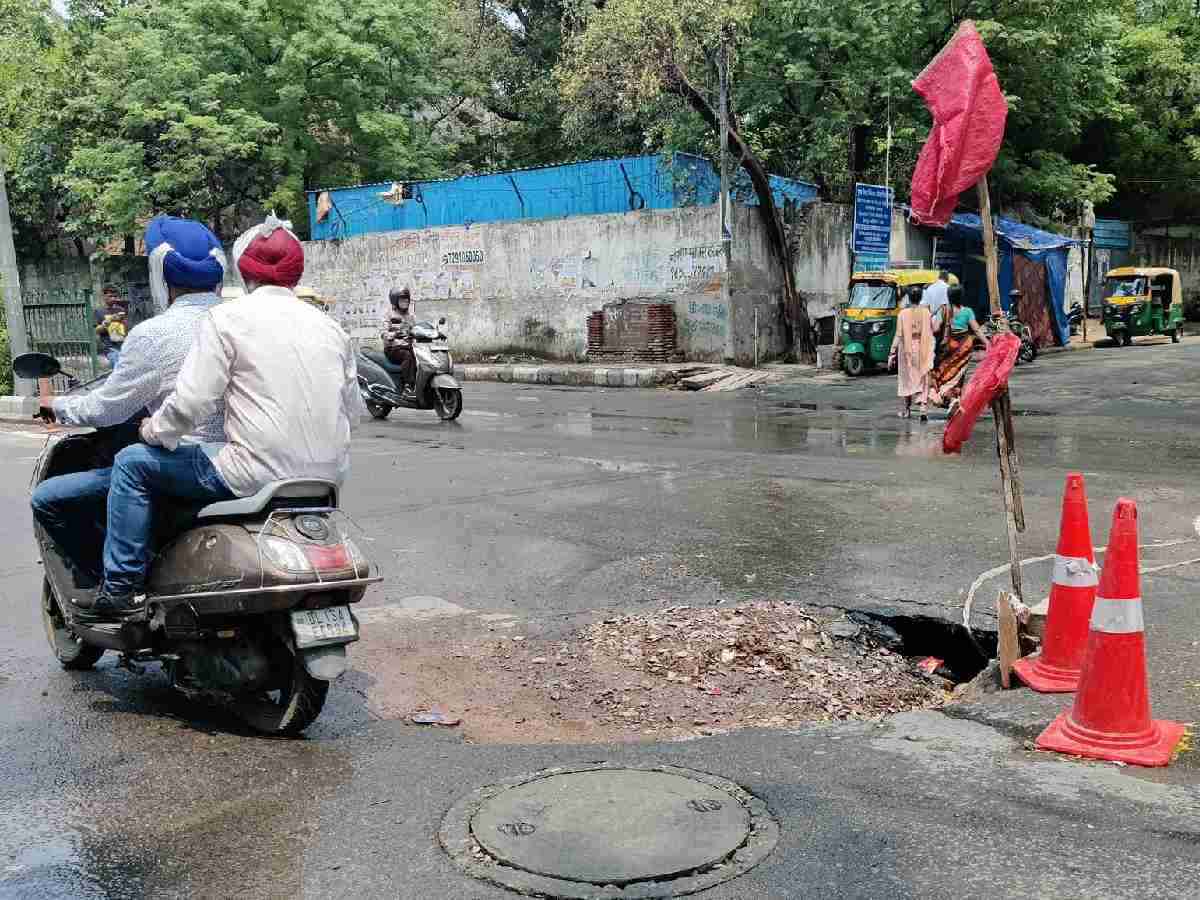
The monsoon has brought Delhi’s already ailing civic infrastructure to its knees. Overflowing drains, waterlogged streets, and pothole-riddled roads have created extended traffic chokepoints and a sharp rise in accidents across the city.
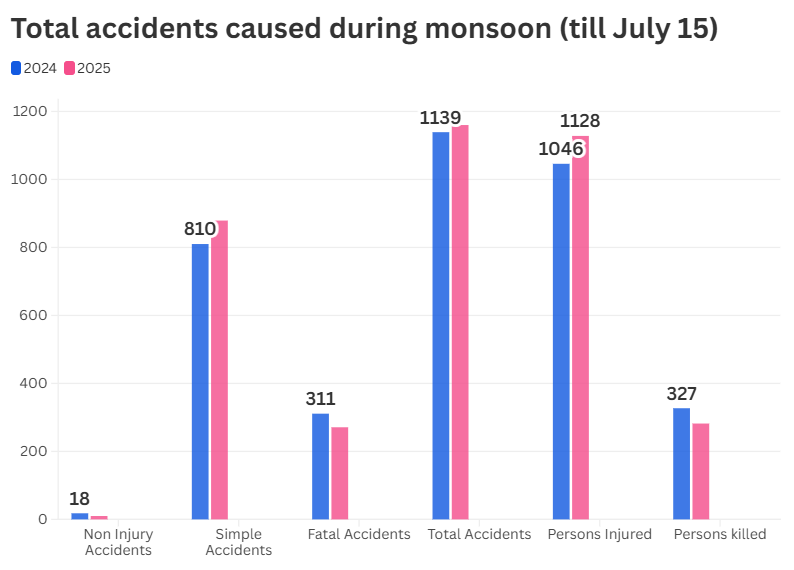
Data from the Delhi Traffic Police show a marginal increase in overall accidents during the current monsoon season. Between May 1 and July 15, 2025, the city recorded 1,160 accidents—21 more than the 1,128 incidents during the same period in 2024. The number of people injured rose from 1,046 in 2024 to 1,128 this year—a 7.1% increase.
Interestingly, while injury-related accidents rose, non-injury accidents dropped from 18 in 2024 to 10 this year, suggesting a higher severity of accidents. However, there is one silver lining—fatal accidents decreased from 311 in 2024 to 271 in 2025.
Joint Commissioner of Police (Traffic) Kime Kaming attributed the rise in accidents to Delhi’s poor road conditions. “We have been trying to push through the civic bodies and ask them to improve the civic infrastructure. However, there has been no response from them. Moreover, most of these accidents are caused due to waterlogging as well, where most of these instances happen to motorcyclists and pedestrians,” Kaming told Patriot.
Young lives lost to pothole-riddled roads
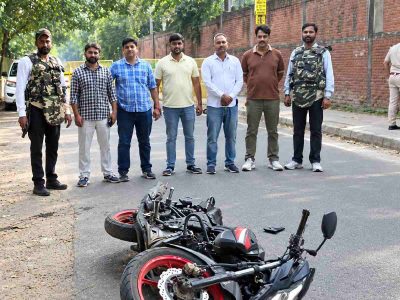
On July 26, two students died when their motorcycle collided with a lorry near Pusa Chambery in central Delhi’s Paharganj. According to police, the deceased were identified as Ayush, from Gorakhpur, Uttar Pradesh, and his cousin Anubhav—both in their twenties.
Deputy Commissioner of Police (Central) Nidhin Valsan said a passing bus driver alerted them around 6:30 AM. “We have registered a case and are searching for the lorry and its driver,” Valsan said. The victims were declared dead on arrival at the hospital.
In a separate road incident, a 40-year-old e-rickshaw driver, Jamaluddin, sustained serious injuries after being hit by a car near Dwarka Metro station on Friday morning. A case has been registered at the Dwarka North police station.
Thousands of complaints, few resolutions
Between April 1 and 30, the Public Works Department (PWD) received 1,574 complaints regarding road safety hazards—including potholes, damaged roads, waterlogging, and broken footpaths. Of these, 255 complaints remain unresolved.
The situation deteriorated in May. From May 1 to 12 alone, 855 complaints were received—of which 503 remain pending. That means 58.83% of complaints in that period were unresolved. Additionally, 107 complaints from March and 38 from February are still pending.
A large number of complaints are concentrated in West and North West Delhi. Damaged footpaths continue to force pedestrians onto traffic-heavy roads, increasing the risk of accidents. One complainant flagged the deteriorating condition of Najafgarh Chowk, worsened by digging activities by the Delhi Jal Board. Another pointed to the poor condition of the road near Mayapuri Flyover, which has reportedly remained damaged for over a year.
“During peak hours, traffic jams last over two hours daily. It’s largely due to the damaged roads, which slow vehicles to a crawl,” said Vaibhav Bansal, a resident of the area.
One unresolved complaint about encroachments turned violent. “We went to clear the encroachments of shops and makeshift stalls, but they charged at us. Even the police did not intervene,” said a PWD official.
Rashid Khan’s death was the first of the year
Neglect proved fatal on March 10, when 37-year-old motorcyclist Rashid Khan died after skidding on a six-inch-deep pothole near Hamdard Hospital in South Delhi’s Tigri area.
Khan was found unconscious at the scene with severe head injuries. His helmet, discovered in his hand rather than on his head, offered no protection. Witnesses said he lost control navigating the waterlogged pothole. Though rushed to AIIMS Trauma Centre, Khan was declared dead on arrival.
Police are awaiting post-mortem results to confirm whether he died of trauma or possible drowning. They are also investigating whether another vehicle may have been involved. A case has been registered for reckless driving and causing death by negligence.
2023 crash report reveals persistent dangers
According to the Delhi Traffic Police’s 2023 crash report, road conditions continue to pose significant threats. Fatal accidents rose 4.7% in 2024, with 1,504 deaths compared to 1,432 in 2023.
Pedestrians comprised 43% of fatalities in 2023, while two-wheeler riders made up 38%. Ten “black spots” with high accident frequencies were identified, including ISBT Kashmere Gate, Mukarba Chowk, Libaspur bus stand, and Burari Chowk. Roads such as NH-8, Kanjhawala Road, and NH-24 each recorded more than 10 deaths in 2023.
Overspeeding, drink-driving, and general non-compliance with traffic rules remain top causes of fatal crashes.
“Our aim is to ensure commuters reach their destinations safely. Despite extensive awareness campaigns, many drivers remain reckless. You cannot force compliance on those unwilling to learn,” Kaming said.
He added that most fatal two-wheeler crashes involve riders not wearing helmets. Many drivers of large vehicles also speed, ignore road humps, or drive under the influence—putting pedestrians at heightened risk. For car passengers, not wearing seatbelts continues to be a major issue.
Kaming acknowledged that potholes contribute to accidents, but said they are not the leading cause. “Data and comprehensive studies confirm that pothole-related accidents are far fewer,” he said. Yet the mounting backlog of complaints tells another story.
Traffic Police alerts repeatedly ignored
The Delhi Traffic Police have consistently flagged dangerous road conditions—only to be ignored by the PWD. On March 20, they requested urgent repairs to Janakpuri District Centre Road, which remain unaddressed. A similar plea was made a day earlier for a broken footpath near Peeragarhi’s pillar 263. Potholes at Peeragarhi Chowk were also reported but never repaired.
Between February and May, ten complaints filed by the Traffic Police were left unresolved. One such complaint involved an illegal passageway in Sarita Vihar that facilitates wrong-way traffic.
Also Read: Delhi: Saheli Smart Card roll-out raises concerns of digital exclusion
Officials allege that the PWD typically acts only upon receiving direct government orders, often sidelining the Traffic Police’s requests. The result is a delayed response that endangers daily commuters.
New tech, slow rollout
The PWD Engineer-in-Chief declined to comment on the backlog. However, efforts are under way to fix potholes ahead of the monsoon.
On April 5, the department tested a new pothole repair technology called ECOFIX on Delhi Secretariat Road. Developed by CSIR-CRRI in collaboration with startup Ramuka Global Services, the steel slag-based mix can repair both dry and waterlogged potholes without requiring dewatering. Roads can reopen within 15–20 minutes, potentially minimising commuter disruption.
The highest number of potholes were reported in the East Zone (3,213), followed by the North Zone (2,310) and South Zone (2,155).
Uneven safety trends across districts
Despite overall grim numbers, there are signs of improvement in some areas. In the first half of 2025, fatal accidents dropped from 764 in 2024 to 677. Fatalities declined by 10%, from 778 to 700.
Central Delhi recorded the most notable improvement, with fatal crashes and deaths halving due to stricter enforcement and road redesigns like protective grilles. New Delhi district remained relatively safe but was overtaken by Central Delhi as the least fatal zone.
 However, Outer North remains the deadliest region, with fatal accidents rising to 97 and deaths to 103. High-speed lorries and disregard for road rules continue to plague the area. Districts like South West and West Delhi saw modest gains, while North West, Dwarka, and East Delhi experienced sharper drops in fatality rates. In contrast, Outer districts and South Delhi saw a rise in fatal crashes.
Injuries across the city rose from 2,566 in 2024 to 2,617 in 2025, highlighting the growing vulnerability of road users.
Delhi’s decaying roads—riddled with potholes, broken footpaths, and systemic apathy—are proving lethal. The death toll keeps climbing while agencies fail to coordinate. Until urgent infrastructure reforms and bureaucratic accountability are enforced, the capital’s roads will remain as dangerous as they are essential.