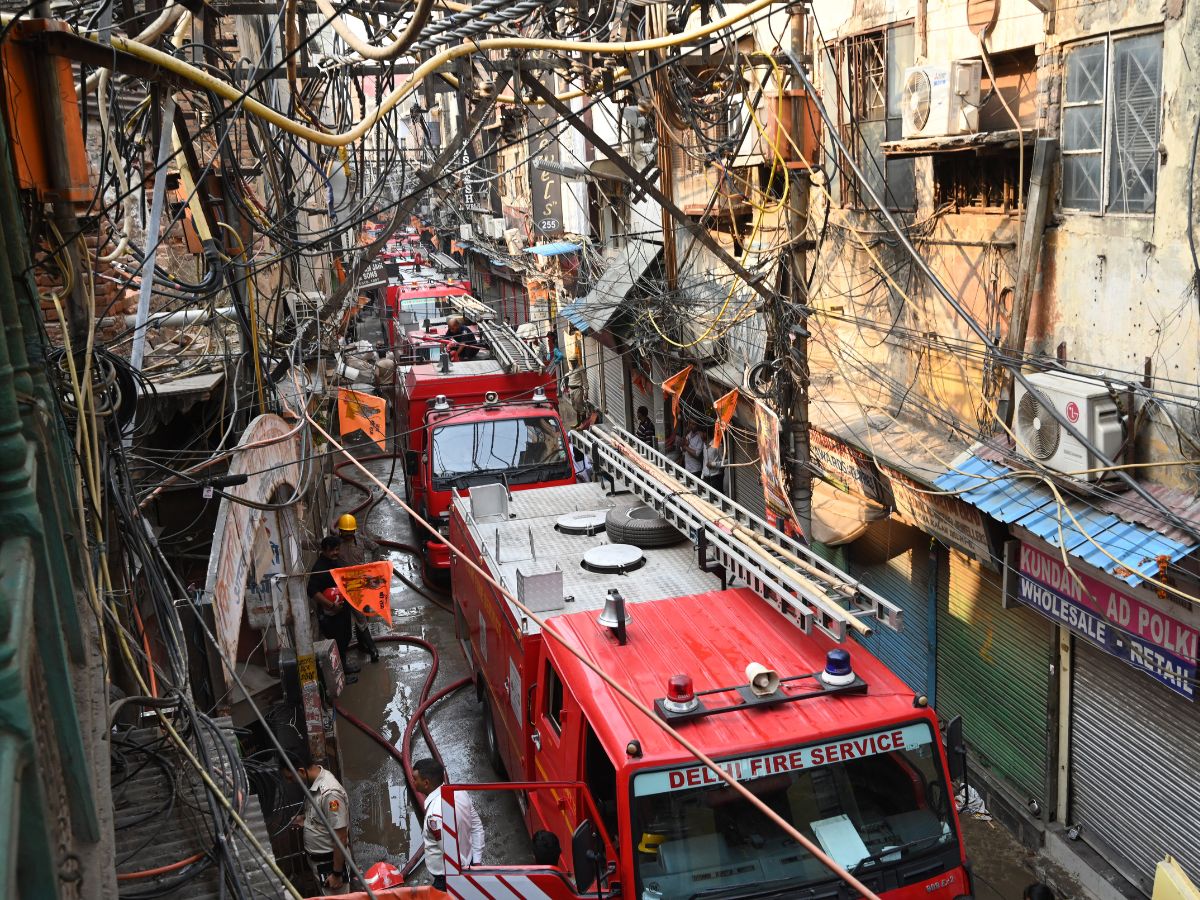
The Delhi government has identified 24 vulnerable locations that have reported repeated fire incidents, citing congestion and high population density as key barriers to firefighting operations. To tackle the issue, 24 Quick Response Vehicles (QRVs) will be deployed at fire stations in the identified areas to ensure faster emergency response, officials confirmed.
“The high population density, particularly in slum areas and densely populated or closely built parts of the city, makes it difficult for large fire tenders to navigate and access the affected locations. Due to these challenges, the average response time increases and small fires turn into big ones, which demand more personnel and equipment, significantly increasing the risk of property damage and loss of life,” a government official said.
The vulnerable locations include Hastal Village in Janakpuri, Vishal Garden in Najafgarh, Vikaspuri, Mehrauli, IGNOU Maidan Garhi, Ghitorni Metro Station, Badli Industrial Area, Sant Nagar in Burari, Lajpat Nagar Market, Sonia Vihar, Gandhi Nagar, Paharganj Main Bazaar, Bawana, Rani Bagh Market, Palam Gol Chakkar in Dwarka, and Guru Gobind Singh Government Hospital in Raghubir Nagar, among others.
Fire incidents on the rise
Fire emergencies remain a persistent problem across Delhi. The Janakpuri fire station recorded the highest number of incidents in its vicinity, at 2,211 between April 1, 2024, and March 31, 2025. Nehru Place followed with 2,021 incidents during the same period.
From April 1 to September 17 this year alone, the city has already reported 17,905 fire-related calls. For comparison, 36,568 calls were registered across the entire 2024–25 financial year.
Janakpuri’s fire hazards
The areas demarcated as potential tinderboxes remain cramped, congested, and unsafe. Janakpuri has been among the worst affected, logging the highest number of fire-related calls, largely due to dense residential neighbourhoods.
However, officials point out that the Janakpuri Institutional Area has also emerged as a hub of incidents. Many educational and government institutions there operate with outdated safety standards. Hostels located on their fringes have similarly been flagged as fire hazards.
On June 8, the A-2 Block of Janakpuri witnessed panic when an air conditioner exploded in a residential flat near Arya Samaj Mandir. The blast was so powerful it sparked a fire that engulfed the entire house. The Delhi Fire Services (DFS) received the alert in the afternoon and rushed eight fire tenders to the spot.
“There was a deafening explosion. When we rushed over, we saw the AC had burst and the house was ablaze,” a local resident said.
Fire horrors in Burari
Burari’s Sant Nagar, already infamous for the alleged ritual mass suicide case, has been battling repeated fires in recent years. Factories have sprung up in precarious conditions, despite being located on the fringes of North Delhi.
Without a fire station of its own, Burari relies on Rohini’s Sector 16 fire station, compounding delays in response times.
On December 22, 2024, a devastating fire broke out in A Block of Pradhan Enclave. One man sustained 100% burns, while three others were injured. Deputy Commissioner of Police Raja Banthia (North Delhi) said police received a PCR call about a blaze and trapped residents. Five fire tenders, PCR staff, and local police were deployed.
The victims were identified as Anand Gupta, 24, Ravi Prakash Morya, 22, Vijay Pandey, 20, and Himanshu Gupta, who sustained the worst burns. All four were initially taken to Burari Government Hospital but later shifted to LNJP Hospital due to inadequate burn facilities. A DFS officer confirmed that Gupta and Morya each suffered 25% burns, while Pandey suffered 40%.
The fire was reportedly caused by materials stored by an event management firm, including electric cold pyrotechnics. The flames spread rapidly through the supplies. Investigations continue, but none of the victims have yet been deemed fit to record statements.
A DFS officer, Devender Sandhu, also sustained a hand injury in an on-site explosion and received treatment from CATS personnel. Another DFS officer claimed the premises housed a cracker factory on the ground floor, with residential rooms above. Despite the tragedy, such factories continue to operate in Burari.
Industrial failings of Jwalapuri
The Jwalapuri area has also seen a spate of incidents. Between April 1, 2024, and March 31, 2025, it reported 1,319 fires. Its proximity to the Udyog Nagar Industrial Area has made the situation more precarious.
The locality is crowded with cloth factories and small manufacturing units, many lacking fire exits or ventilation. Once a hub of development, the area now reflects neglect and poor safety enforcement.
On August 21 this year, a fire erupted at a factory in Udyog Nagar, requiring eight fire tenders. Earlier, on February 19, a blaze broke out in a residential block of Jwalapuri at around 9:45 PM. Domestic items stored on the upper floors caught fire, forcing six residents to leap from the second floor to save themselves.
The injured were identified as Pranjal (19), Preeti (40), Pankaj (40), Panav (18), Vaibhav (13), and Shweta (20). DFS received a call from Y-655, Mobile Market, Janta Market in Jwalapuri’s Nangloi area, and dispatched three fire vehicles. The blaze was subdued by 11 PM.
DFS expects uptick in incidents
Fire officials have warned of an increase in incidents this year. “Albeit marginally, but this time around, a major chunk of the fires occurred during seasons which are normally regarded as unseasonal, with April and May recording the higher instances, and the former recording much more than normal,” an official said.
According to DFS data, 20,297 emergency calls — including fire incidents, building collapses, and other crises — were received between April 1 and September 30, 2024.
Fatalities, however, have declined. From January 1 to April 20, 2025, 21 deaths and 163 injuries were reported, compared with 48 deaths and 202 injuries in the same period last year — a decline of 56% and 19%, respectively.
Quick Response Vehicles explained
The QRVs are central to the government’s strategy for fire preparedness. The total cost of procuring them, including vehicles and specialised firefighting equipment, stands at Rs 8.61 crore. The funds cover the base vehicles as well as ultra-high-pressure pump systems.
In the first phase, 24 QRVs will be staffed by existing DFS personnel. In the second phase, 26 more vehicles will be added, with outsourced manpower. The third phase will bring in another 50 vehicles.
Also Read: Delhi records most deaths from manual scavenging in 2025
“These vehicles will enable faster arrival and quicker fire suppression before larger engines are needed,” officials said. Each operates at 21 litres per minute with a 100-litre water tank. Features include a water mist for cooling, foam for oxygen cut-off, and a high-pressure jet for multiple fire types.
“We have also integrated an advanced Ultra High-Pressure Pump Extinguishing System and the latest technologies into its compact XL6 vehicles, significantly enhancing its ability to respond to urban emergencies… Initially no funds were catered for this concept; however, considering the challenges, the government allocated budget and planned to implement this in three phases,” another official said.