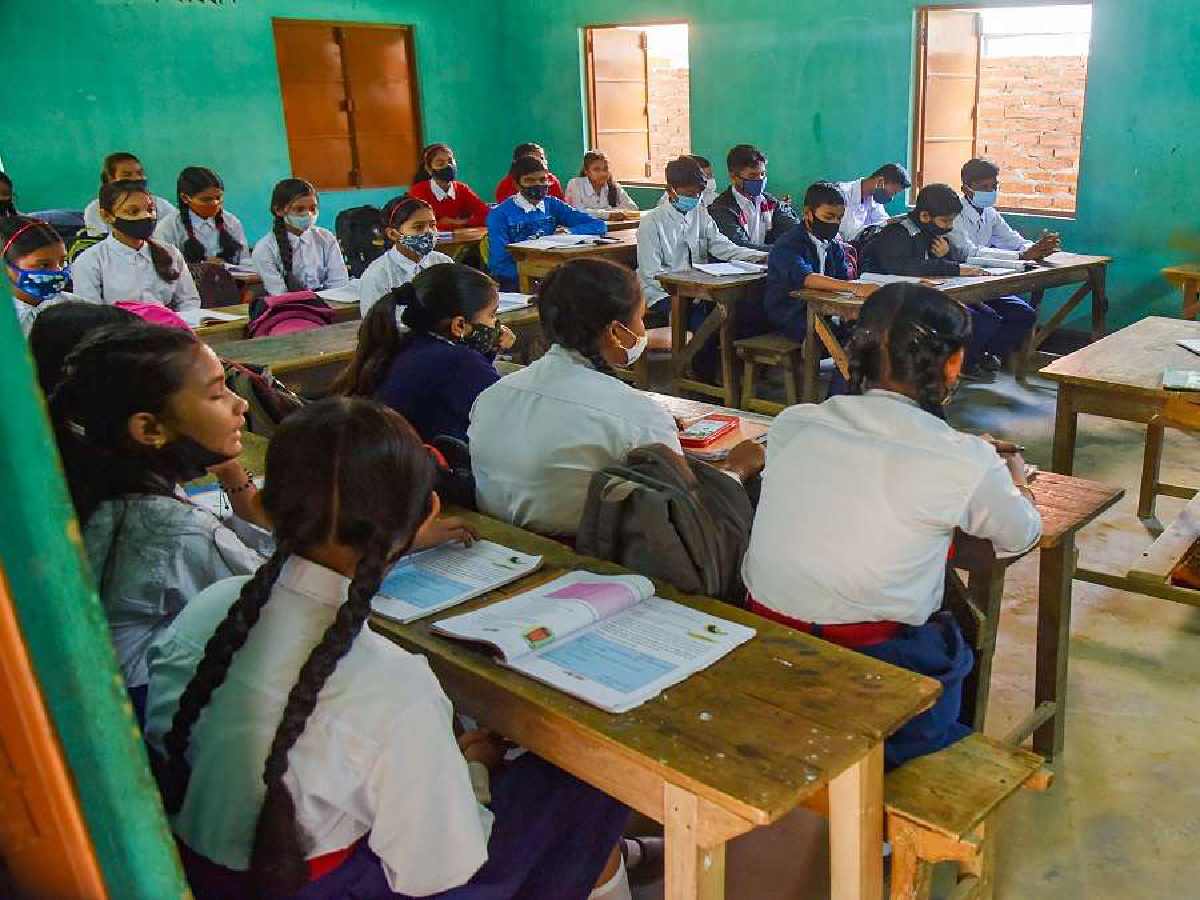
Thousands of students across the national capital are facing fresh hardships following the Delhi Government’s directive to shift schools to a hybrid mode for students up to Classes IX and XI after the Air Quality Index (AQI) slipped into the “severe-plus” category.
Parents and students from the Economically Weaker Section (EWS) say they are disproportionately affected, as access to stable internet connections and smartphones remains a luxury for many households.
According to a Directorate of Education (DoE) order dated December 13, all Heads of Schools of government, government-aided and unaided recognised private schools under the DoE, New Delhi Municipal Council (NDMC), Municipal Corporation of Delhi (MCD) and Delhi Cantonment Board have been directed to conduct classes for students up to Class IX and XI in a “hybrid” mode — both physical and online — with immediate effect until further orders.
‘We are choosing between food and a phone’
For 14-year-old Rani (name changed), a Class IX student in a government school in East Delhi, the announcement meant more days of missed classes.
“My teacher sends links on the class WhatsApp group,” she said, sitting on the floor of her one-room home. “But we have only one phone, and my father takes it to work. When I ask my classmates what was taught, they say, ‘It was online.’”
Rani’s father, a daily-wage construction worker, earns around Rs 9,000 a month, depending on how many days he gets work.
“We are choosing between food and a smartphone,” he said. “People think a phone is cheap. But even if I buy one, how will I pay for internet every month?”
The hybrid schooling decision is part of the Stage IV (‘Severe+’) Graded Response Action Plan (GRAP), aimed at preventing further deterioration of air quality in the region.
A policy that widens the gap
Under the hybrid model, schools are required to conduct both online and offline classes, allowing students to attend remotely if they are unable to come to school.
While this arrangement works for families with laptops, tablets and stable internet connections, parents say it exposes a deep digital divide that continues to haunt Delhi’s education system.
“My son is in Class XI and preparing for board exams,” said Sunita Devi, a domestic worker from Uttam Nagar. “The school says attendance is counted whether online or offline. But how will my child attend online classes without a smartphone? Sometimes the neighbour lends us her phone, sometimes she doesn’t. Education has become a matter of luck.”
Sunita earns about Rs 7,000 a month cleaning houses.
“They say education is free in government schools,” she said. “But now education needs a phone, data and electricity — nothing is free.”
‘It was explained yesterday’
For 16-year-old Aftab, a Class XI commerce student from Seelampur, embarrassment has turned into despair.
“Teachers assume we have watched the online lecture,” he said. “When I don’t understand, they say, ‘It was explained yesterday.’ But yesterday, my phone had no data.”
Aftab uses a basic smartphone shared with his two younger siblings, both of whom also attend government schools.
“Sometimes all three of us have online classes at the same time,” his mother said. “Who will attend, and who will miss out? We have to decide every day.”
Health versus education
While many parents support the idea of reducing physical attendance during periods of extreme pollution, they argue that the government has failed to address the realities of hybrid education.
“We don’t want our children to fall sick because of pollution,” said Rajesh Kumar, an auto-rickshaw driver whose daughter studies in Class VIII. “But we also don’t want their studies to stop. The government cannot just announce online classes and assume everyone is digitally ready.”
Rajesh borrowed money from relatives to buy a second-hand smartphone. “The phone is old. It hangs during video classes,” he said. “When the class disconnects, my daughter starts crying. She thinks she is failing because of the phone.”
For some families, even owning a smartphone does not ensure access.
“Recharge costs Rs 300–400 a month,” said Meena, a widow raising two school-going children. “That is one week of vegetables for us.”
Parents say they are not demanding the rollback of pollution-related safety measures. Instead, they are asking for practical support such as device banks, subsidised data plans, printed study material and flexible assessment methods.
“If schools know some children cannot attend online classes, they should provide printed notes or extra offline sessions,” Sunita said. “Don’t punish children for being poor.”
For families like Rani’s, the concern extends beyond a few missed weeks of school.
“I want to become a nurse,” Rani said, clutching her textbooks. “But how will I compete with students who attend every online class on a laptop?”
Her father looked away. “We teach our children that education can change their lives,” he said. “But today, education depends on money. That is the most polluted part of this system.”
GRAP Stage IV in force
Delhi’s air quality deteriorated sharply in December 2025, with the AQI repeatedly entering the “severe” and “severe-plus” categories. On December 13, 2025, the city recorded an AQI above 400, placing it firmly in the ‘severe’ range.
In response, the Commission for Air Quality Management (CAQM) reinstated Stage III of the Graded Response Action Plan across the National Capital Region in the afternoon. Stage III measures include bans on construction activity and restrictions aimed at reducing dust and emissions.
By evening, pollution worsened further as the AQI climbed beyond 450, triggering Stage IV measures in the capital. These include restrictions on heavy vehicle movement, work-from-home arrangements for many office employees, and the reinforcement of hybrid schooling directives for students up to Class IX and XI to limit outdoor exposure.
Several monitoring stations recorded AQI levels above 400, with Wazirpur at 445, Vivek Vihar at 444, Jahangirpuri at 442 and Anand Vihar at 439. Areas such as Rohini, Ashok Vihar, Narela, Mundka and Bawana also remained in the ‘severe’ range.
The GRAP framework categorises air quality into four stages — Stage I (Poor: 201–300), Stage II (Very Poor: 301–400), Stage III (Severe: 401–450) and Stage IV (Severe+ above 450) — with restrictions escalating as pollution worsens. Authorities rely on real-time monitoring and forecasts to invoke these measures, particularly during winter months when low wind speeds and temperature inversions trap pollutants over the city.