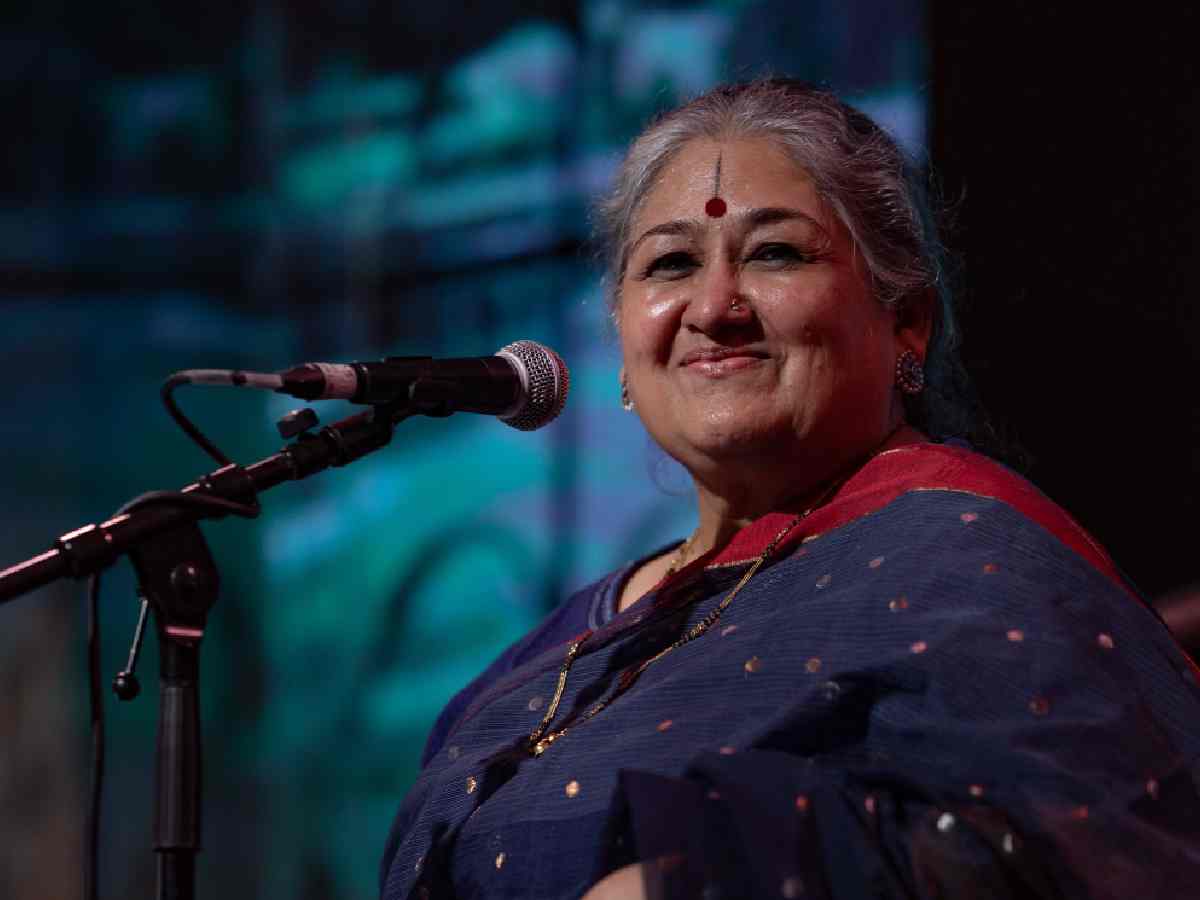
Over a career spanning more than four decades, Padma Shri recipient Shubha Mudgal has worked across Hindustani classical music and forms such as thumri and dadra, as well as pop, fusion and film music.
Although her music remains rooted in Hindustani classical training, Mudgal has continued to experiment with different forms. Her 1999 hit Ab Ke Sawan introduced her voice to a wider audience and went on to become one of India’s most recognisable monsoon songs.
Ahead of her performance at Baarish Season 2, Mudgal spoke to Patriot about the song’s enduring popularity, the discipline required to remain a student of music, the demands of social media and the unpredictability of performing live.
The sound of the monsoon
More than two decades after its release, Ab Ke Sawan is still heard every monsoon and continues to attract new listeners.
Mudgal says the song’s lasting popularity still surprises her.
“As a student of music, I have learnt countless compositions related to the Indian monsoon in different styles and genres of music. But for some reason, and to my utter delight, Ab Ke Sawan is one that has, for the last 27 years, been associated with my voice.”
Although audiences identify the song with her, Mudgal points out that she was neither its lyricist nor its composer.
“I did not write the song, nor did I compose the melody or the music, and yet it is my voice that has become inextricably linked with the track.”
Its continued popularity across generations, she says, is one of the greatest rewards an artiste can receive.
“Young artistes continue to sing their own versions and tag me on social media, people dance to it when it rains, and all this is happening even in 2026, although the song and the album were released in 1999. What more could an artiste ask for?”
Why the rains inspire music
The monsoon has occupied a special place in Indian music for centuries, inspiring composers across genres and traditions. Mudgal believes there is no single explanation for this enduring relationship.
“There is really no simple answer to that, but possibly one of the many reasons could be that humans have always been inspired by nature, and the fertility and abundance that mark this season could perhaps have been a catalyst for the artistic mind for centuries.”
For her, the rains evoke an emotional landscape as much as a physical one.
“The monsoon is, of course, the season for abundant rain, but it is also a season of the mind where love, longing, separation, heartbreak, passion, anger and joy all find a new meaning against the backdrop of the rains.”
Rooted in classical music
Mudgal has moved between different musical traditions throughout her career without leaving behind her classical foundation. However, she says such transitions have never been effortless.
“Moving between genres is never easy, at least not for me, but the discipline and training I have received and continue to follow through my study of Hindustani classical music have helped me immensely in this journey.”
For Mudgal, classical music remains a lifelong pursuit. It provides the foundation that allows her to explore new musical ideas with confidence.
Classical music in the digital age
Streaming platforms and social media have transformed how music is discovered and consumed. Mudgal sees both opportunities and challenges for classical musicians.
“Yes, artistes across genres, young or old, as well as potential audiences and committed listeners, continue to meet and discover music and artistes on social media.”
At the same time, she warns that maintaining an online presence can distract musicians from regular practice and training.
“Social media works only through repeated and regular posting, and adhering to that need for consistency in posting can become an obsession that takes away from the study of music.”
“The call of the Instagram reel can, if permitted, become louder than the call of music,” she says.
Mudgal is more circumspect about the growing use of artificial intelligence in music. She says she would prefer to understand the technology before expressing an opinion on it.
“I haven’t really tried to explore AI in music-making, so I feel I cannot comment on this.”
Advice for young musicians
Asked what she would tell aspiring musicians seeking quick success, Mudgal avoids offering generalised advice.
“I do not consider myself qualified enough to provide random and generalised advice to artistes simply because they are younger than me.”
Instead, she believes artistes should trust their instincts while continuing to learn from their teachers.
“All I could suggest is that they could perhaps follow their hearts and make the music they want to and believe in, and rely on the advice of their respective gurus with whom, hopefully, they share a good rapport.”
The lost art of listening
Reflecting on changes in the musical landscape, Mudgal says people are gradually losing the ability to listen attentively.
“The fact that we, as a nation, are becoming more than a little deaf! Literally and figuratively, we have stopped listening to each other and are, for the most part, listening to music at such high decibels that our hearing is bound to be affected.”
Also Read: Priyanka Chopra inspires me the most: Sezal Sharma
She believes audiences increasingly expect musicians to provide a visual spectacle alongside their music.
“That’s why perhaps we don’t mind listening to music where the performer also provides a spectacle, and don’t even notice that the music is off-key on some occasions.”
For Mudgal, attentive listening remains one of the most valuable qualities an audience can possess.
A tradition of interconnected arts
Festivals such as Baarish, which combine music with storytelling, crafts and other art forms, reflect a long-standing Indian tradition, Mudgal says.
“The interdisciplinarity of the arts in India is not new. Bringing focus to this aspect will only heighten the experience for audiences.”
She notes that songs celebrating the rains often tell stories extending beyond music.
“Songs about baarish often tell many stories, about the textiles one could wear in the season, the festivals and rituals observed in the monsoon, the colours associated with the season and a lot more.”
Why every concert feels new
Despite having performed around the world for decades, Mudgal says stepping onto the stage has never become routine.
“You can learn all you want, work hard for decades, gain experience, but there is never any certainty of what will happen on stage.”
That uncertainty, she says, is what makes live performance exciting.
“Whether or not a performance will be inspired remains totally unpredictable, and this uncertainty, the butterflies in one’s tummy and the attempts to calm one’s nerves and concentrate on delivering a performance make each concert a new, exciting and uncertain journey that teaches me something every time.”
As she prepares to perform for Delhi audiences again, Mudgal is reluctant to predict what listeners will take away from the evening.
“I can’t say what audiences will take away, but I do hope they will give me their love and support as they have done over several decades.”