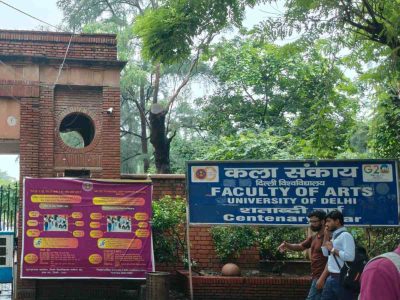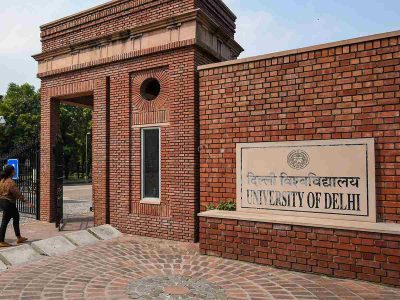
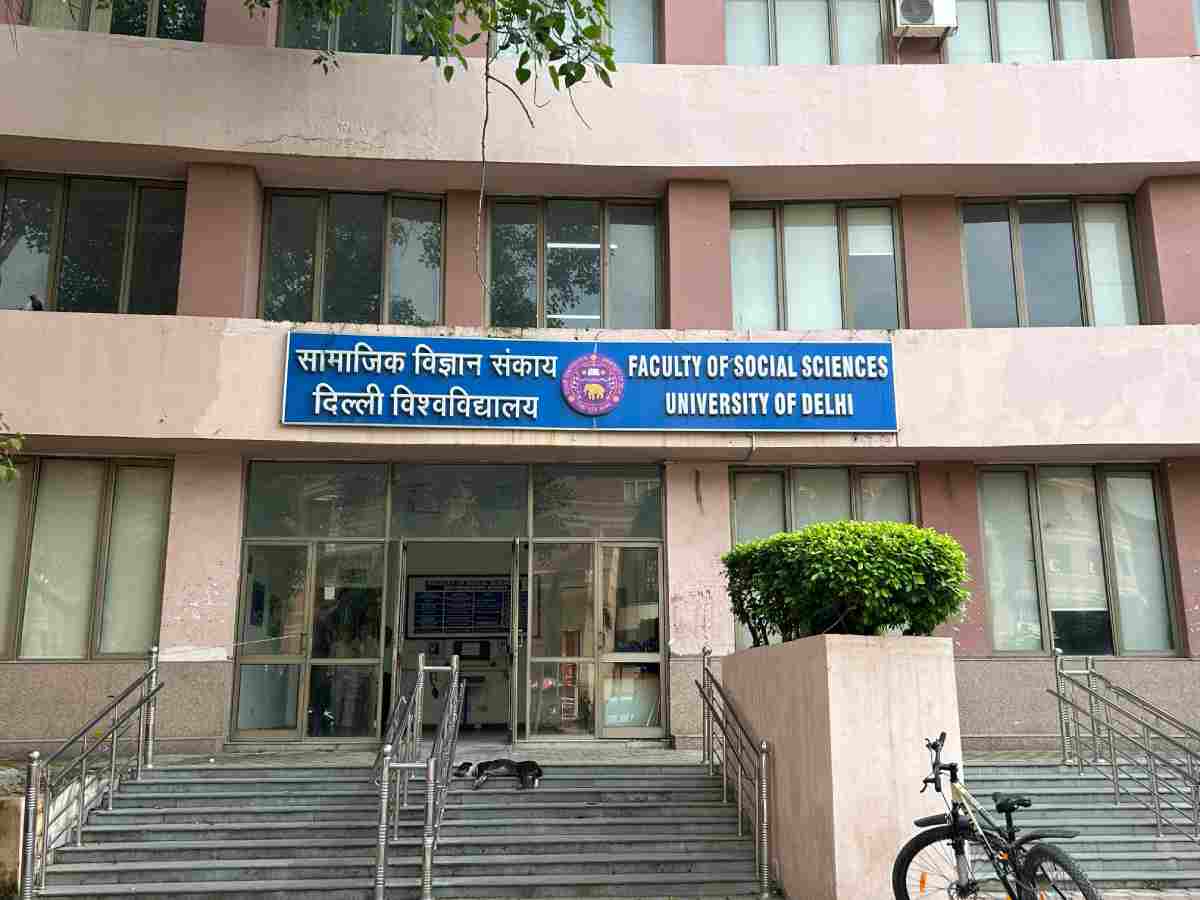
Changes to Delhi University’s history syllabus have sparked a political dispute over who decides what students learn about India’s past.
The revised postgraduate syllabus, notified on August 7, drops the specialised paper “The Delhi Sultanate: Structures of Authority in Medieval North India (13th–14th Centuries)” from Semester III. Other papers not included in the final notification include “History of North India, c. 1400–1550”, “Gender and Women in Early India: 1500 BCE to 1000 CE”, “Political Processes and Structure of Polities in Ancient India” and “Religion and Society in Ancient Indian Literature”. The History Department had proposed 38 Discipline Specific Elective (DSE) papers, of which 16 were included in the final Semester III notification. The changes involve specific papers rather than the complete removal of these historical periods or themes from DU’s entire History curriculum.
Students and faculty interviewed by Patriot say the removal of material on the Delhi Sultanate cannot be treated as an isolated academic revision. They point to changes affecting portions of early medieval history, papers on gender, an ancient history paper examining religion through literature, and gender-related material in modern Indian history. Taken together, they see an attempt to narrow the curriculum along ideological lines.
The revision followed DU’s formal syllabus process involving the Department/Committee of Courses, the Standing Committee and the Academic Council. An Indian Express news report quoted DU’s Dean of Academic Affairs K Ratnabali as saying that the Academic Council had given the Vice-Chancellor the liberty to constitute an Expert Committee to examine courses requiring review. The committee comprised three external experts, the Head of the Department and two Academic Council members. Ratnabali said the review was necessitated by changes made to some syllabi even after they had been cleared by the Standing Committee, including papers being added or deleted, units being changed and readings being removed or replaced. The Expert Committee’s chief, Professor Shri Prakash Singh, and the Head of DU’s History Department Anirudh Deshpande both refused to comment when Patriot contacted them.
Their concern is not simply that individual topics will disappear from reading lists. They argue that the revisions could break the connection between ancient and modern history, reduce the medieval period to a Hindu-Muslim conflict and exclude histories of gender and sexuality that challenge simple binaries.
For those opposing the revisions, the dispute therefore extends beyond what will appear in examinations. At stake, they say, is whether political power can shape public memory by deciding which periods, identities and interpretations remain available in the classroom.
‘Narrow political approach’
Shubh Gupta, 23, a second-year MA student specialising in medieval Indian history, said stakeholders had justified removing the Delhi Sultanate paper on the grounds that it did not sufficiently refer to Hindu rulers. He argued that this reflected a narrow political approach to the past.
“I think their vision is very, very narrow. Their vision is very linear. They do not see history as something layered and complex. Instead, they seem to view history through a political agenda,” Gupta said.
If the authorities consider a particular historical period problematic, Gupta said, that should be a reason to examine it more closely rather than remove it.
“If they think there is a problem with a particular period of history, then I think we actually need to study that period more closely. If we simply delete or remove it, then how are we supposed to critically examine it?” he said.
Gupta acknowledged that history cannot be separated entirely from politics, but drew a distinction between political interpretation and government control over the curriculum.
“It should not be the agenda of any particular political dispensation to decide what we should study and what we should not study,” he said.
‘Inherent contradictions’
Varun Gopal, 23, whose name has been changed at his request, is a student in Delhi University’s Department of History specialising in modern history. He said selective omissions could make it difficult to explain even basic political relationships between historical groups.
“If you remove the medieval chapters, then how will you explain whom the Rajputs fought and with whom they had conflicts?” he asked.
For Varun, the issue is not merely one of incomplete coverage. He said removing material to fit a predetermined narrative risks turning history into a vehicle for political messaging.
“If you want to point something out, then you have to read everything and approach it without bias,” he said. “Removing things in this manner means that history is no longer being taught as history. Very bluntly speaking, it becomes a propaganda subject.”
Such an approach, he argued, would undermine the intellectual independence that the study of history is meant to foster.
“History means complete intellectual independence. You should be able to think in every possible way and engage with every issue, no matter how controversial it may appear,” he said.
Varun connected the revisions to what he had studied about fascism and the creation of hegemony. A government seeking to establish hegemony, he said, targets educational institutions and the media because they can influence people’s thinking, shape public opinion and allow society to be manipulated in accordance with political interests.
“Today, the most important role is played by the media and educational institutions,” he said. “If you want to create that kind of influence over people’s minds, these are the two most important institutions to manipulate and create hegemony.”
From that perspective, he said, decisions about what is removed from or added to a syllabus cannot be regarded as politically neutral.
“The way a syllabus is cut down or added to, or certain ideas and perspectives are removed from or added to it, shows what the government wants students to know,” he said. “They are deciding what children should and should not learn.”
Education should instead remain a democratic space where students can question ideas, consider different perspectives and form their own understanding, he said.
“Education should be the one space where you are completely free and respected, where you can decide what you want to study and what you want to know to reconstruct the past so that we can understand its complexities,” he said, adding that this was the purpose of studying history.
A pattern beginning in school
For Varun, the Delhi University revisions do not stand alone. He referred to the removal of the chapter ‘Central Islamic Lands’ from the Class 11 history syllabus of the National Council of Educational Research and Training (NCERT).
The chapter covered the emergence and
expansion of Islam, the rise of the Caliphate, and the development of Islamic empires. It was removed during the 2022–23 rationalisation exercise.
Although, the removal took place several
years before the current DU revision and
under a separate institutional process, the two developments are often raised by
critics, to allege political interference and governmental control.
“If NCERT is also removing Central
Islamic Lands, then this has already started at the school level,” Varun said.
He said the narrowing of history
education from school onwards could
shape what students know about the past
before they enter university.
Broken historical sequence
A professor in Delhi University’s Department of History, speaking on condition of anonymity, also interpreted the revisions as part of a broader political choice over what students should know.
“It is not only the Delhi Sultanate. If you are removing the early medieval period and papers on gender as well, then it shows what the government wants students to know,” the professor said.
The political concern is accompanied by a pedagogical one. The professor said removing substantial portions between the ancient and modern periods could prevent students from understanding how Indian history developed over time.
“You cannot jump from ancient to modern,” the professor said.
Political structures, social practices, religious movements and cultural developments remain connected across centuries. Removing a large part of that continuity, the professor said, could leave students unable to understand how one period developed into another.
“If you remove early medieval history or gender, how will a student ever understand history?” the professor asked.
The professor suggested, however, that curricular control had limits because removing a subject from the official syllabus could not erase the knowledge teachers had already acquired.
“Even if you remove history from the book, it remains in our minds,” the professor said.
Teachers would continue to draw on what they had studied and taught over the years, the professor added. “A teacher will teach what they know. We cannot simply skip an entire period and jump to something else.”
The changes have implications for both students and teachers. For students, removing these papers means they will no longer be able to study the Delhi Sultanate, North India between 1400 and 1550, or the specified gender-history themes as dedicated DSEs in the current Semester III notification. For teachers, the changes could affect how courses are structured and taught, particularly where the removed papers provided a specialised framework for teaching political, social, religious and gender history. The revisions could also affect students’ examination choices and the scope of topics available for dissertations and future research. Teachers interviewed for this story said that even when a subject is removed from the formal syllabus, they may continue to draw on their existing knowledge while teaching related courses.
History beyond binaries
Gupta said the political consequences of the revisions were particularly evident in the treatment of medieval and gender history. Removing material from both areas, he argued, could make it easier to present the past through a simple Hindu-Muslim binary.
Mughal–Rajput relations were far more complicated than a history of conflict, he said, and included alliances, matrimonial ties and political negotiations. “It was not simply one community fighting another.”
Gupta is also sceptical of the claim that questions of gender and identity are entirely recent or imported from the West. Gender and sexual identities are often described as colonial or capitalist constructs that emerged only in recent times, he said, but the study of history reveals a more complicated picture.
“As students of history, as historians, and as active citizens of a country, we should try to understand that these identities are not new. They existed in pre-colonial times as well,” Gupta said.
Students can enter the classroom already convinced that such identities are Western imports, he said. Studying ancient and medieval history can challenge that assumption.
“When we actually study history, we realise that history cannot simply be divided into binaries, whether in terms of gender or anything else,” he said.
Gupta pointed to both explicit and less direct references to different genders and sexualities in accounts of the ancient and medieval periods. For him, this history demonstrates how layered society has always been and why it cannot be fitted into a definition dictated by contemporary politics.
“We cannot divide society into simple binaries and then impose a particular definition of society based on a nationalist agenda,” Gupta said.
The DU Registrar did not respond to comment on the allegations at the time of publication.