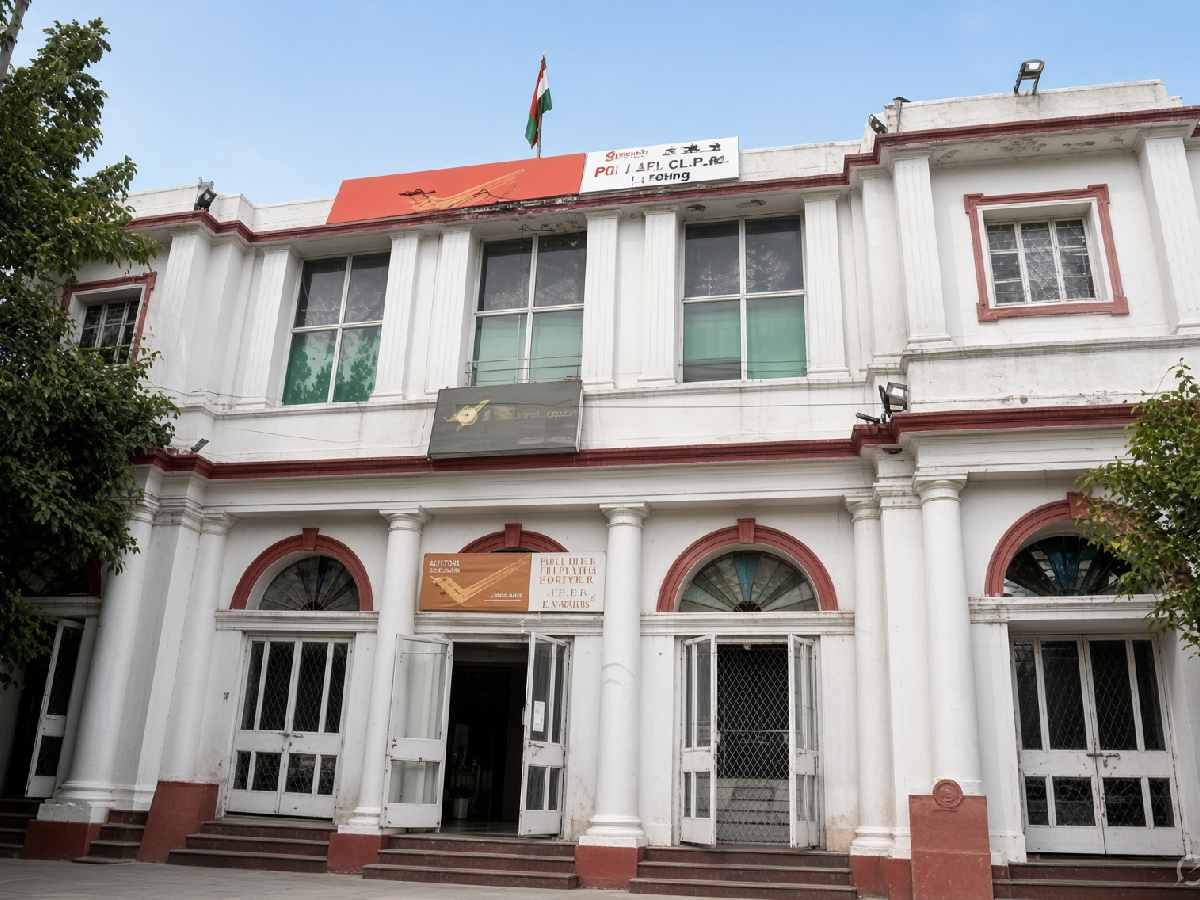
One has to be careful while entering this post office, given the heavy vehicular traffic that converges here from several directions. Once there, there is the equally pressing question emerges on how to cross the road safely. The place is none other than Gol Dak Khana, earlier known as Alexandra Place. On Postal Day, October 10, several programmes will be held here.
The Gol Dak Khana was designed by Robert Tor Russell, who designed several other well-known buildings of the new imperial capital planned under chief architect Edward Lutyens, including Connaught Place, the Western Court and the Eastern Court. While drawing up the plans, Russell kept the building low because he felt that high walls would obstruct the view of the nearby Sacred Heart Cathedral. The building has protected status and bears the PIN code 110001. From outside, it appears small; inside, however, its scale becomes apparent. Work on it continued through the early 1930s: some records date the building to between 1929 and 1931, while others put it at 1934.
Arvind Kumar Singh, author of Bharatiya Dak, describes Gol Dak Khana as the most distinctive post office in the heart of the capital.
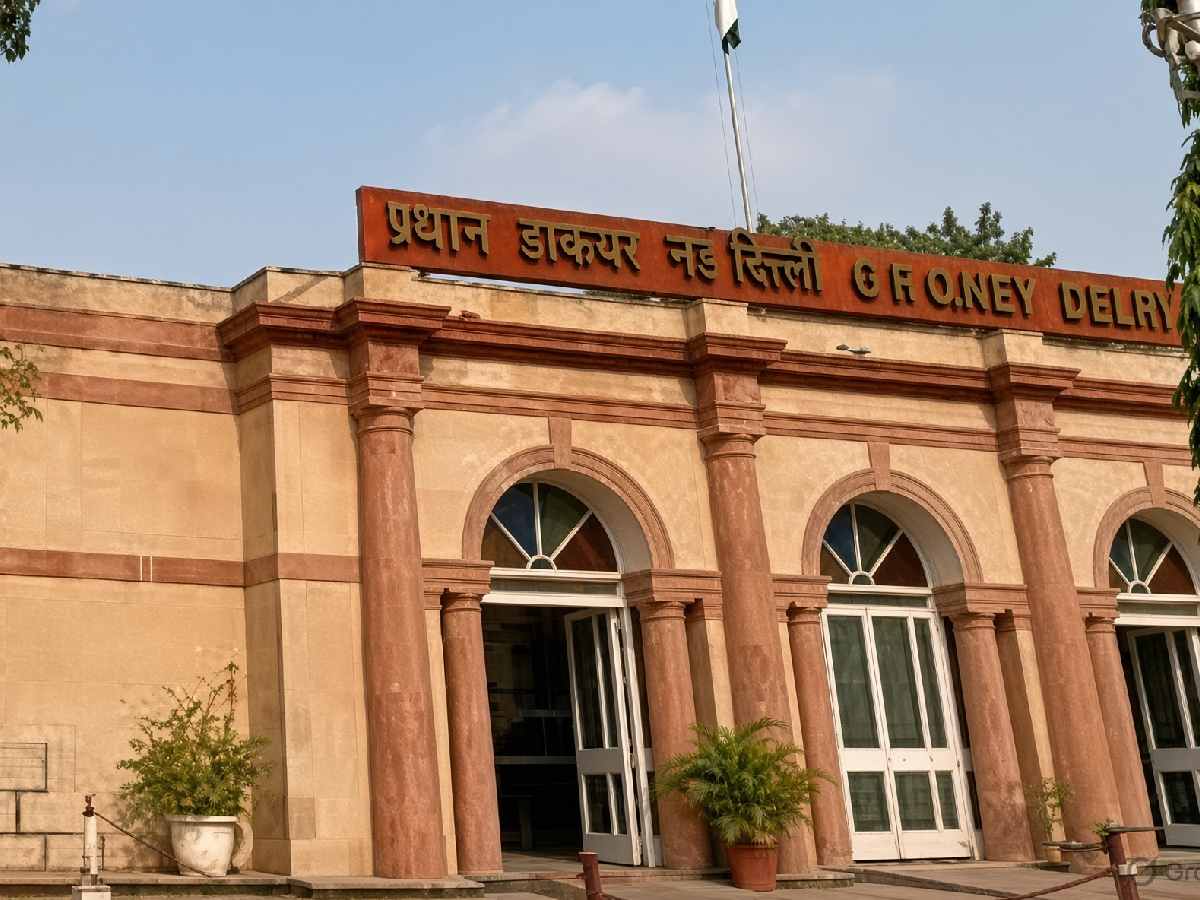
At the heart of Delhi
There is another large post office in the busy A Block of Connaught Place, directly opposite Gate 8 of Rajiv Chowk Metro station. It opened around 1940 and is among New Delhi’s older post offices. People still come here to buy stamps, postcards and inland letters, while others use Speed Post to send letters and parcels. Step inside and it feels as though one has slipped into an earlier time. Many of the customers are elderly, moving between the high walls and the old counters with the familiarity of long habits.
Rajesh Sharma, a social worker who lives on Minto Road, says he has been coming here for nearly 50 years. He used to visit the post office with his father; now he comes to send books and other parcels.
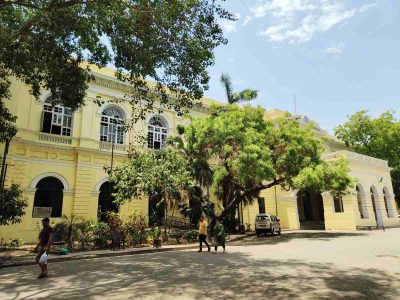
Delhi’s oldest post office is, of course, the General Post Office, commonly known as the Delhi GPO. The GPO at Kashmere Gate was built in 1885. Its two-storey structure, now classified as a heritage building, reflects British architectural design. It stands on Lothian Road, close to the old city wall, and is periodically maintained and restored. It is the oldest post office in Delhi, though not in the country; Kolkata’s GPO is considerably older.
Also Read: Delhi’s Pink Saheli Smart Card: access, not just issue, is the test
For many years, the GPO was also a workplace for Anglo-Indian families of the old city. Mary Isaac Ribeiro was chief postmistress from the 1940s onwards and is remembered as independent India’s first woman to hold that position. Her son, Sydney Rebeiro, was an English scholar who taught English at Delhi University for many years.
There is another connection to the GPO. DSP Jaswant Singh of Parliament Street police station, said to have been among the first police officers to seize Mahatma Gandhi’s assassin Nathuram Godse on January 30, 1948, had earlier served as an inspector at Kashmere Gate. His son, Gurdayal Singh, once told this reporter that while posted there, Jaswant Singh had caught the men accused of a large cash theft at the GPO. He was subsequently promoted and sent to Parliament Street. Jaswant Singh was a Punjab Police officer on deputation to the Delhi Police.
Today, both the Kashmere Gate GPO and Gol Dak Khana are heritage buildings, yet both remain in service. Kashmere Gate continues to see hundreds of people every day. Behind the old counters, however, a very different postal system has taken shape, driven by the digitisation of post offices across the country, India Post Payments Bank, Speed Post and the growth of e-commerce logistics.
Letters to power
The Parliament House post office occupies a rather different place in the city’s postal geography. It is located near Central Hall and the Prime Minister’s Office in the old Parliament House, and its small premises are popular with MPs. During Parliament sessions, many queue up to send mail by Speed Post and registered post. The office opened in 1952, and thousands of letters addressed to the Prime Minister, Cabinet ministers and MPs arrive there every day. People from far-off parts of the country write to describe the problems faced by their areas, turning the post office into an unlikely channel between the country’s citizens and its political establishment.
Elsewhere in the city, the names and locations of post offices sometimes preserve a geography that has long since changed. Where East Delhi’s Vikas Marg ends at Kadkadi Mor, Bharatendu Harishchandra Marg begins. The Krishna Nagar post office stands at this point, even though Krishna Nagar itself is nearly a kilometre away. The office, just a few steps from Vikas Marg, nevertheless continues to carry the name of the neighbourhood.
The distance notwithstanding, the staff are known for their diligence. Manoj Sehgal, a businessman based in IP Extension, says they never turn a customer away, even when office hours are about to end.
Among the older post offices of West Delhi are those on Shankar Road and in West Patel Nagar, opposite the Patel Nagar police station. The post office at Lodhi Colony may well be the oldest in South Delhi.
The long road of a letter
But the history of Delhi’s post offices goes back much further than these surviving buildings. It is not merely a history of envelopes, stamps and counters, but of a city that for centuries has been a centre of governance, trade and news. Messages once travelled by horse and foot runner, later by railway and telegraph, and today through digital networks. The technologies have changed repeatedly; the need to move information from one place to another has not.
During the reign of Alauddin Khalji, mounted and foot messengers carried royal orders and intelligence reports. Ibn Battuta, the traveller who came to Delhi in the 14th century, wrote that in Hindustan, letters were sent in two ways — by horse and on foot. According to his account, squads of the Sultan’s horsemen and posts of foot runners were stationed every few miles. Under the Mughals, the system became more regular, while Sher Shah Suri increased the speed of communication through the Grand Trunk Road and its sarais.
Also Read: JNU hostel residents flag poor maintenance, water and lighting issues
The post office acquired another significance during the freedom movement. These were not merely government establishments; they were centres of official communication and therefore became targets themselves. Old-timers recall that during the Quit India Movement of 1942, the Paharganj post office was vandalised and the post office near Sabzi Mandi was set on fire.
When India attained independence, Delhi’s postal services were not an independent unit. They came under the North-West Frontier Circle, whose headquarters were in Lahore, and were headed by the Postmaster General of Punjab.
The history of Delhi’s post offices can thus be read in several layers: the relay systems of the Sultanate and Mughal periods; the establishment of the Kashmere Gate GPO in 1885; and the emergence of Gol Dak Khana after Delhi became the capital. Between and around these landmarks came the freedom movement, Partition and administrative reorganisation, each leaving its mark on the city and its institutions.
The letters may have become fewer, and the means of communication almost unrecognisable from those of a century ago. But the buildings remain, and the counters are still open. Delhi has spent centuries building ways for messages to travel, and its post offices are where that history can still be seen.