
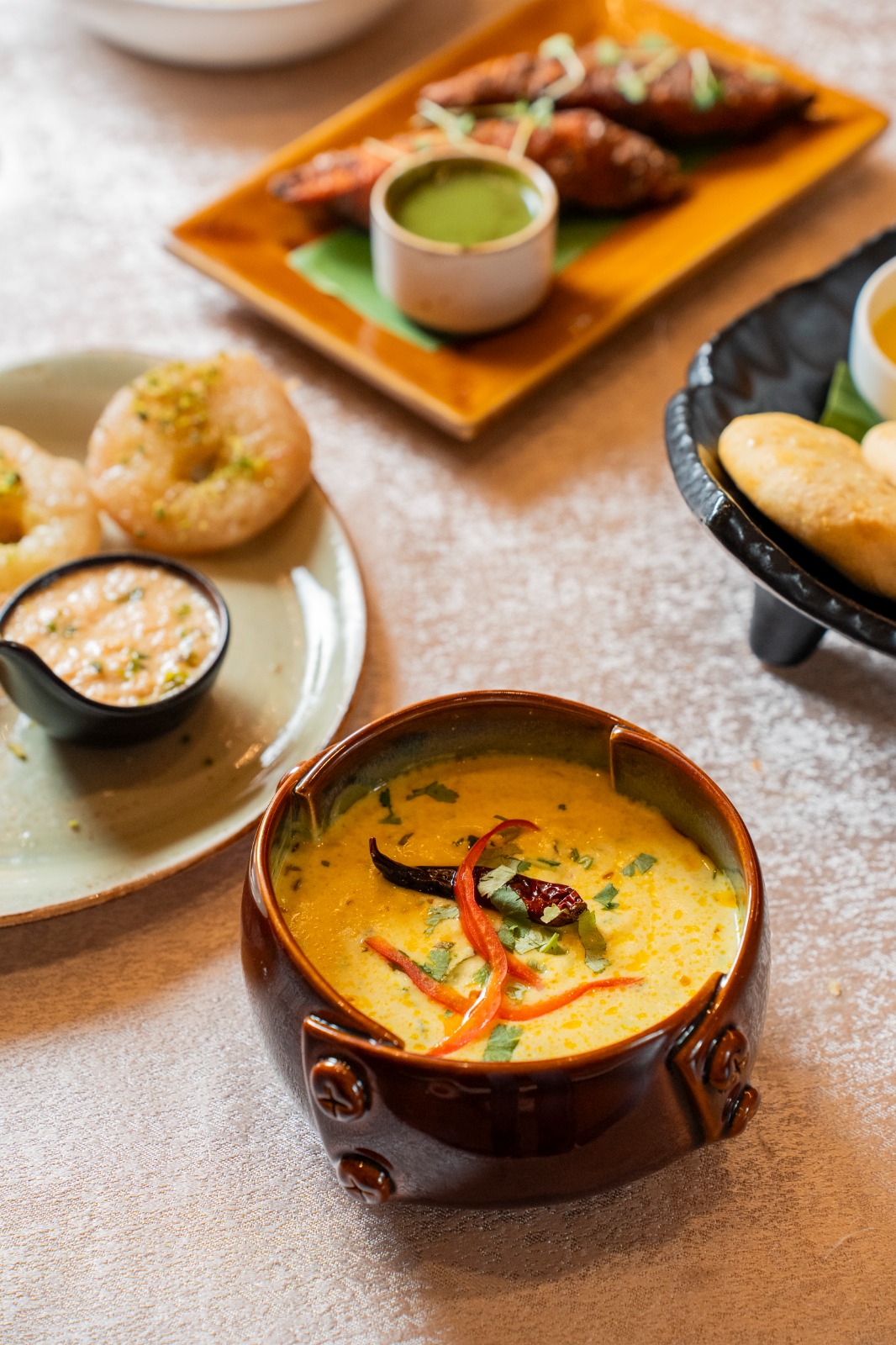
A plate of babru can look familiar to someone who knows Himachali food. The stuffed bread, traditionally deep-fried, can also be prepared differently in a Delhi hotel kitchen, where it is lightly griddled and finished with ghee. The stuffing and dough remain the same, but the cooking method changes.
The adjustment raises a question for chefs serving regional food outside its place of origin: when does adapting a dish become changing it?
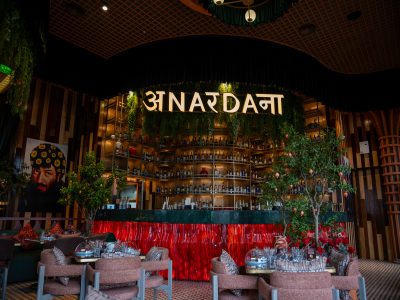
At Himachal Dhaam, a culinary experience at Blooms, Eros Hotel New Delhi, the kitchen team has had to negotiate the demands of hotel service while preparing traditional Himachali dishes. At the Himachal Bhawan canteen, Chef Babloo Maurya encounters a related challenge: introducing the flavours of Himachal Pradesh to diners in a city where familiar North Indian preparations often set expectations.
Their experiences point to a less straightforward idea of authenticity. A recipe may retain its ingredients but undergo a change in technique. A familiar ingredient may produce an unfamiliar flavour. And a dish that depends on seasonal produce may be difficult to reproduce consistently in the capital.
The question is not simply whether a recipe has been followed, but what survives when the conditions in which it was developed are no longer the same.
Recipe meets kitchen
In Himachali cooking, the method can be as important as the ingredients. Some preparations traditionally involve prolonged cooking over a low flame, using wood fires or earthenware vessels. Reproducing those conditions in a commercial kitchen is not always practical.
The culinary team at Blooms, led by Executive Chef Diwas Wadhera, with inputs from Sanjeev Sharma and Baldev Sharma, says some traditional preparations require six to eight hours of cooking. In the hotel kitchen, braising ovens and induction equipment are used to replicate slow cooking while meeting service requirements.
The aim is to retain the depth of flavour associated with the traditional process. But the change in equipment also raises a question about what constitutes an essential part of a recipe. If a dish tastes similar but is cooked differently, has its authenticity been preserved, or only its flavour?
Regional identity
The adjustment does not necessarily mean the dish has lost its regional identity. It does, however, mean that the final preparation differs from the traditional method. Whether the difference is significant depends on more than the ingredient list: texture, moisture and the effect of frying versus griddling also matter.
This is where the idea of authenticity becomes more complicated than simply retaining a recipe’s components.
Sourcing ingredients presents another difficulty. Certain varieties of rajma, wild greens and seasonal produce associated with Himachal Pradesh are not consistently available in Delhi.
The Blooms culinary team identifies ingredients such as linguda, a fiddlehead fern, and bedu, a regional wild fruit, as examples of produce that can be difficult to obtain throughout the year. For Himachal Dhaam, the team says it sources selected ingredients directly from vendors in Himachal Pradesh. Maintaining a consistent supply for a regular menu is more challenging.
When an ingredient is unavailable, the decision to substitute it depends on its importance to the dish. According to the team, if the ingredient is central to a preparation, it may be better to leave the dish off the menu than replace it with something that changes its character. A supporting ingredient may allow more flexibility.
The defining flavour
This distinction matters because not every substitution has the same effect. Replacing an ingredient that provides the defining flavour of a dish is different from adjusting one that plays a secondary role.
Yet the practical question remains: how often can a commercial kitchen afford to remove dishes because their original ingredients are unavailable? The team’s stated approach offers a principle for making that decision, but establishing how frequently it is applied would require specific examples of dishes omitted or altered.
For regional cuisine, geography is not merely a backdrop. It influences what can be cooked, how often it can be served and whether a preparation can become a permanent part of a menu.
Not all the differences between Himachali and Delhi food depend on ingredients that must be transported over long distances. Sometimes, the distinction lies in the treatment of something both places already use.
Auria dal
Chef Babloo Maurya, who works at the Himachal Bhawan canteen, points to Auria dal, a traditional Himachali preparation made with moong dal and mustard-based seasoning.
“People here eat dal, and people there also eat the same dal, though the taste of the dals vary,” he says.
The example shifts the discussion away from rare ingredients and towards cooking practices. Lentils are a staple in both places, but their flavour changes with the ingredients and methods used to prepare them.
Curd is similarly important in Himachali cuisine, particularly in preparations such as madra. Its characteristic flavour depends on the relationship between curd, spices and the cooking process. The result can be quite different from the richer, more heavily spiced gravies familiar to many Delhi diners.
The Blooms culinary team says it does not add cream to madra or extra chilli to siddu simply to bring the dishes closer to mainstream North Indian preferences. Instead, it explains the ingredients and flavours to diners.
That approach raises an important distinction between making food accessible and changing it to suit expectations. Explaining why a dish tastes different allows diners to encounter it on its own terms. Altering its defining characteristics to make it more familiar may achieve a different result.
Not another bhatura
Maurya identifies bhaturu as another way to introduce Delhi diners to Himachali cuisine.
Made with whole-wheat flour and fermented dough, bhaturu is served with chola and other curries. Its resemblance to bhatura offers a familiar reference point, but the preparation belongs to its own regional tradition.
Maurya says diners have responded positively to bhaturu, with some describing it as a healthier version of bhatura.
That comparison can help people approach an unfamiliar dish. But it also risks defining bhaturu only through its resemblance to a popular Delhi staple. Its significance lies not simply in being an alternative to bhatura, but in the ingredients and preparation associated with Himachali food.
The distinction is important for regional cuisines entering a crowded restaurant market. Familiarity can encourage diners to try something new, but it should not become the only way that food is explained or valued.
For chefs, the challenge is to offer a point of connection without erasing the differences that make a preparation distinctive.
What happens when diners want something different?
Diners’ preferences introduce another pressure. At Blooms, the culinary team says some guests have requested changes to the sourness or consistency of particular dishes. Such feedback can influence menu decisions, but the team says it does not automatically change a traditional recipe to accommodate every request.
If a dish consistently fails to attract diners, the team says it may replace it with another traditional preparation rather than alter the original. Familiar dishes can also be served alongside less familiar ones to make the cuisine more approachable.
This is a commercial calculation as much as a culinary one. A restaurant must consider whether diners will order or return for a dish, while a regional food festival also seeks to introduce preparations that may be unfamiliar to its audience.
Expectation of new audience
The tension is not unique to Himachali food. Any cuisine served outside its home region must negotiate the expectations of a new audience. But the consequences of adaptation vary: a change in presentation may leave the flavour intact, while changing a defining ingredient or cooking method may alter the dish itself.
The hotel team’s approach is to preserve the essential character of a preparation while making adjustments where necessary. Maurya, meanwhile, acknowledges that reproducing the exact taste of Himachal Pradesh in Delhi is difficult.
“We of course can’t get the exact same taste from Himachal to Delhi, but we really try to put in effort to try and get the same taste as from Himachal,” he says.
His observation captures the limits of treating authenticity as a fixed standard. Food depends on more than a written recipe; it is also shaped by the ingredients available, the methods used and the conditions in which it is cooked.
Where does authenticity end?
The examples of babru, bhaturu and Auria dal show that changes to regional food do not all carry the same consequences. A cooking method can change while the dough and stuffing remain the same. A familiar ingredient can acquire a regional identity through its preparation. A dish may also become difficult to serve when its essential ingredients cannot be sourced consistently.
For chefs, the task is to distinguish between changes that make a preparation possible in a new setting and those that alter what makes it recognisably regional.

The hotel culinary team’s position is that some ingredients should not be substituted if they define a dish. Maurya’s experience points to another limitation: even when chefs make a concerted effort, the exact taste of food prepared in Himachal Pradesh may not be reproduced in Delhi.
Neither observation provides a simple formula for authenticity. Instead, they show why the question must be asked dish by dish, with attention to ingredients, technique and flavour rather than appearance alone.
When regional food enters a Delhi kitchen, adaptation may be unavoidable. The more important question is whether the people preparing it understand what is changing, what that change does to the dish and what must remain for it to retain its identity.