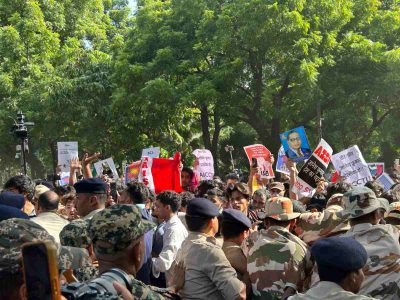
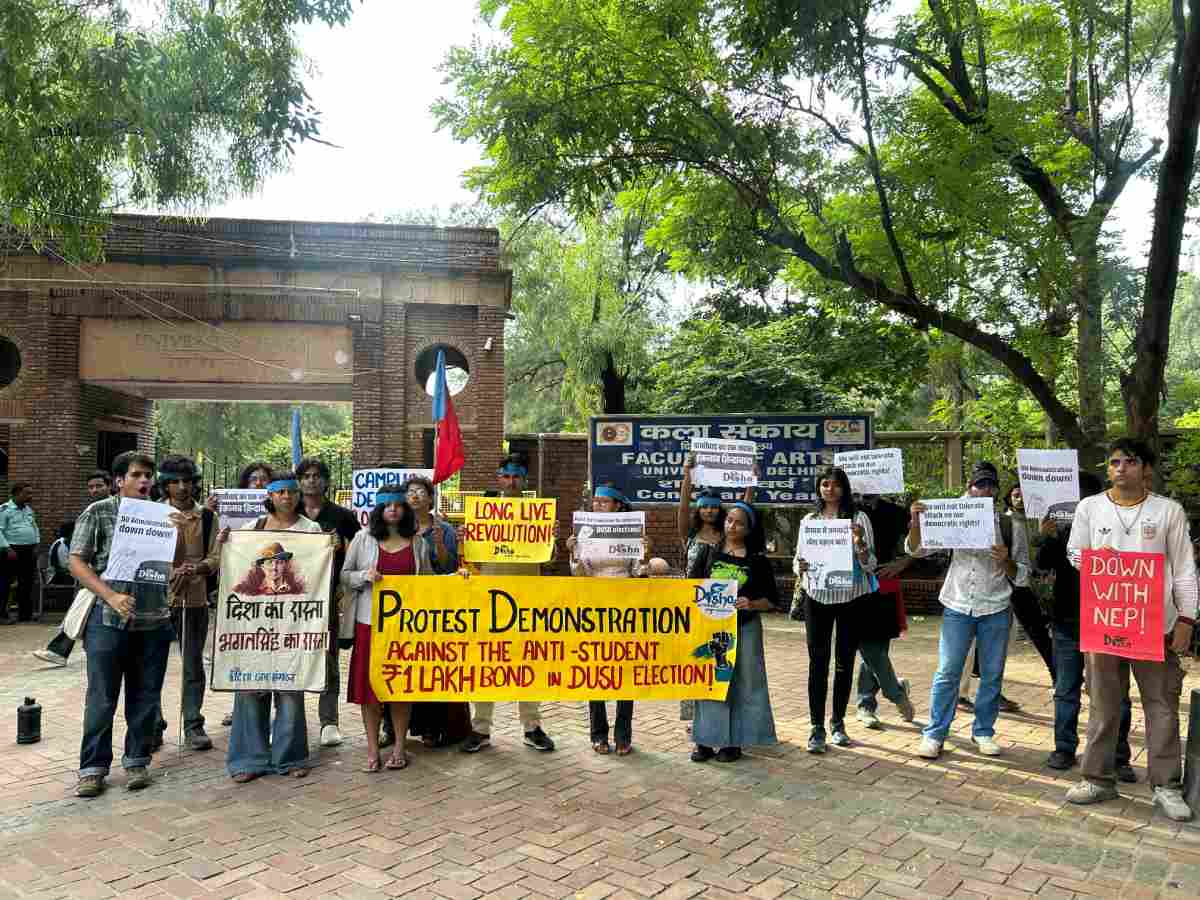
Students at Delhi University (DU) are up in arms against rules issued by the election committee for the upcoming Students’ Union (DUSU) polls. The issue mainly centres on a Rs 1-lakh surety that candidates have to provide as part of the election undertaking.
Disha Students’ Organization protested against the mandate on Thursday at the Faculty of Arts, saying the condition could make it difficult for many students to contest the election.
Chiranshu, a Disha member and a master’s student of History at DU, said the requirement is unfair to students who may not have financial support. “This demand is completely baseless. If candidates have to submit a bond of Rs 1 lakh to contest the DUSU election, how can ordinary students participate in the election?” he said.
The administration has clarified that the Rs 1 lakh is not an upfront fee that candidates have to pay to contest the election. It is a surety linked to violations of election rules. According to the undertaking that all candidates are required to provide, the amount can be recovered if a candidate or their supporters violate the election guidelines, including by damaging or defacing university, college or public property during campaigning.
The university has argued that the rule is meant to prevent damage to university property during elections. It told the Delhi High Court that college walls and other public property are often left damaged after election campaigns, following a challenge by two All India Students’ Association (AISA) members — Ananya Raturi and Akshat Shikhar — to the undertaking. Their objection was not only to the Rs 1-lakh surety but also to the requirement that parents or guardians give consent and stand as sureties for candidates.
AISA argued that students contesting the election are adults and should not need their parents’ permission to participate in the process. The organisation also raised concerns about students whose families may not support their political participation, particularly women students.
The court on Thursday clarified that the surety need not be the candidate’s parents. Anyone who is financially capable of paying Rs 1 lakh can stand as surety, including a guardian.
The court said the purpose of the condition was to make sure that someone capable of paying the amount would be responsible if election rules are violated. While the Rs 1 lakh surety remains, candidates are no longer restricted to having their parents provide it, said Justice Jasmeet Singh and disposed of the plea.
Also Read: Where do women stand in DUSU politics?
AISA, meanwhile, continues to oppose the requirement for students and their parents or guardians to sign the election form, contending that adult students should be able to make their own decision about contesting the election without needing parental consent.
Disha and AISA are raising different concerns about the same election rules. While Disha is questioning whether the Rs 1-lakh surety could make it harder for students to contest, AISA is questioning why adult students should need their parents’ consent in the first place.
With the DUSU elections set for September 18 and the results expected on September 19, these rules have become an important point of discussion among students and student groups on campus.