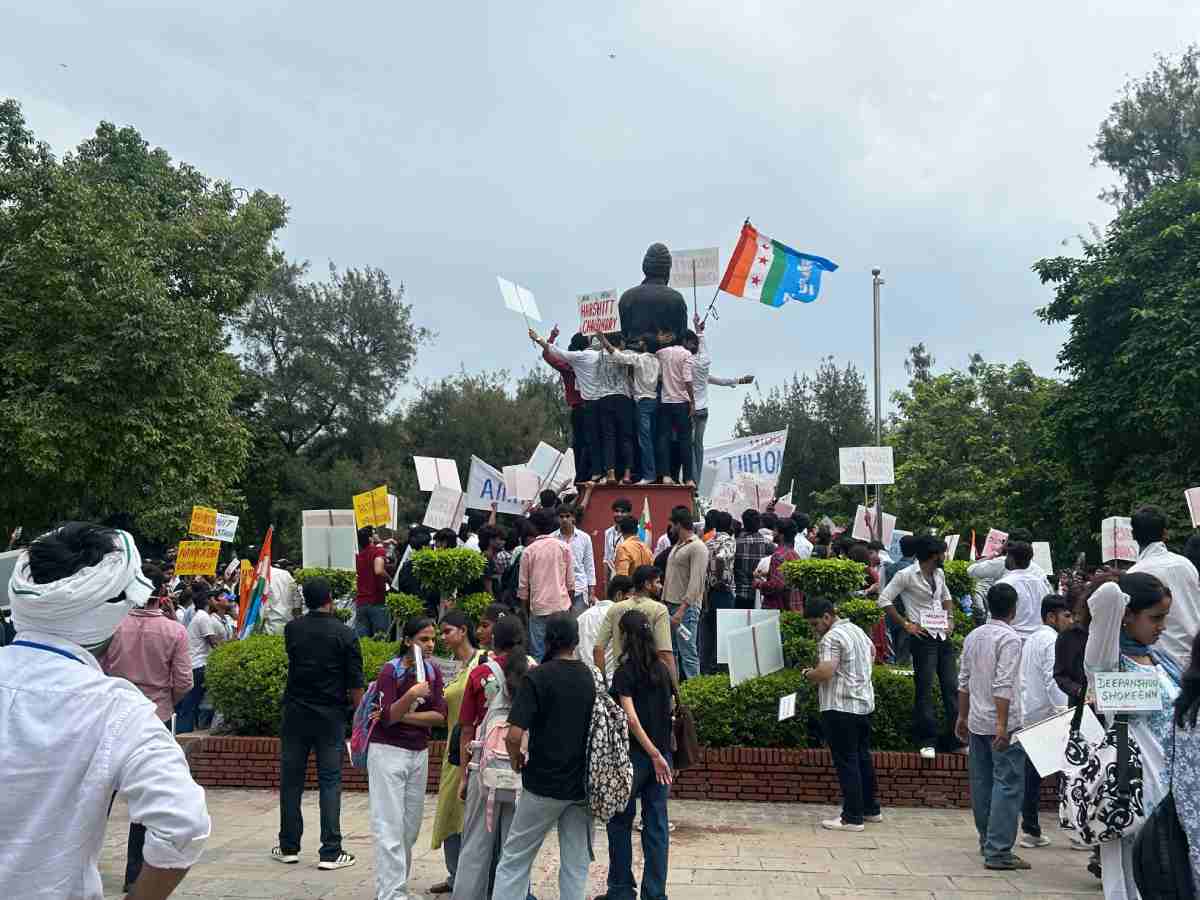
The Delhi University Students’ Union (DUSU) election is one of the most visible forms of student politics in the country. Campaigning begins weeks before polling, political organisations mobilise students across campuses, and the four central posts can become a stepping stone into mainstream politics.
But women’s place in this political system has remained less straightforward. Sixteen years passed between the last woman DUSU president and the return of a woman candidate to the centre of the presidential contest in 2025. In the 2024 DUSU election, only nine of the 21 candidates contesting the four central posts were women, according to reports.
The university has acknowledged the gap. In October 2024, Delhi University constituted a DUSU Elections Reform Committee and specifically included “reservation of women in DUSU composition” among the issues it was asked to examine. A proposal before the Delhi High Court noted that only six of DU’s 43 colleges are women’s colleges affiliated to DUSU, while women students in the remaining colleges constitute almost half of the student strength. It suggested that the university could consider rotational reservation for women in one office-bearer post.
But the numbers only tell part of the story. Speak to women students, and another picture emerges — one where student politics is often experienced not through the DUSU office or an election manifesto, but through the water cooler, the washroom, the bus stop, the hostel search and the road outside the college gate.
Women colleges have their own election
At Daulat Ram College, first-year student Preeti (name changed), 18, said the DUSU election is not the one through which they directly choose their college representatives. The college has its own election process, she said, in which students can put their names forward and contest.
“There’s no election happening with DU. We have our separate elections happening despite affiliating with Delhi University,” Preeti said.
However, the college has a presence of both ABVP and NSUI, she said, and political groups sometimes raise issues affecting students, including clean drinking water, poor infrastructure, harassment and other student-related issues.
“We don’t get clean drinking water, and the washrooms are often dirty. Students face these problems every day. Political groups do raise the water issue sometimes, but the problem still remains there,” Preeti said.
Ria (name changed), 19, said classes take place regularly, but they often start late because teachers arrive late. Speaking about women’s hygiene, she also mentioned the availability of sanitary napkins on campus. “Napkins are available, but sometimes we have to pay more for them,” she said.
Students also do not always get information about events in advance. “Sometimes we find out about an event after it has already happened. Some groups tell us about it later, but by then the event is already over,” she said.
The Department of Philosophy offers a much smaller version of student politics.
Ankit and Shreya, both postgraduate students, said candidates sometimes put their names forward and then appear before students in a seminar hall. Students are asked to raise their hands to indicate whom they support.
“Sometimes there are around five students who give their names. They come to the seminar hall and ask students to raise their hands for whoever they want to vote for. That is basically how the election happens,” Shreya said.
The process is informal, but it highlights the distance between the DUSU election that dominates university-wide political discussion and the elections students experience inside their own departments.
The university is now examining whether that centralised system should change. A proposal placed before the Delhi High Court suggested replacing the existing single-tier DUSU election with a two-tier system in which colleges, departments and institutions would first elect representatives, who would then take part in choosing DUSU office-bearers.
For women students, such a system could also change the way their concerns reach the central union.
At Shyam Lal College, 21-year-old Anjali Kushwaha said students often talk about problems that rarely feature in election campaigns. “There are no proper hygiene facilities for female students, and the infrastructure is also poor. Drinking water is the main issue raised by students,” she said.
Kushwaha said fans do not always work. The college has its own library as well as access to the DU Central Library, but even at the Central Library, students do not always get water — she said a 20-litre water supply is used by students there.
Transport is another concern for students. They receive bus cards, but many still use e-rickshaws because buses do not usually come from the Vishwavidyalaya metro station. “Most students take e-rickshaws because buses don’t come regularly from the metro side. Even if we get three or four free e-rickshaws, it would help students a lot,” she said. For Kushwaha, these are not distant election promises but problems students deal with while attending college every day.
The sanitary napkin divide
Free sanitary napkins and menstrual facilities have featured prominently in recent DUSU manifestos. In 2025, the ABVP, NSUI and the SFI-AISA alliance all included women’s issues in their election promises, ranging from sanitary-pad vending machines and menstrual leave to women’s hostels and gender-sensitisation measures.
But the students’ accounts suggest that the first question is still whether the basic facility exists.
Demand for more hostels
For a student arriving in Delhi from another state, university life can begin with a problem that has little to do with classrooms — where to live.
For many women, DU is their first experience of leaving home. The absence or shortage of hostel accommodation means that students may have to find PGs or rented accommodation in an unfamiliar city, which can make the first year of university particularly difficult.
The hostel issue also changes the meaning of safety. A student living far from college has to think about the cost of travel, the route to the metro, the journey back after an evening class and whether she can comfortably attend college events after dark.
The demand for women’s hostels has appeared repeatedly in DUSU politics. The 2025 election manifestos included promises around hostel expansion and improvement. Students have also raised the absence of women’s common rooms. They said that, apart from Ramjas College, such spaces are generally not available.
Election season puts gender gap in focus
The political culture becomes particularly uncomfortable for some women during election season.
Kushwaha said women students sometimes face harassment when boys and political groups come to colleges during elections. She described the harassment as often subtle — comments, behaviour or groups gathering around the campus.
“During elections, there are more boys and political groups around the college, and sometimes women feel uncomfortable even when they are just trying to go to class. It is not always one big incident. Sometimes it is the smaller things that make you want to leave the area,” she said.
The concern is not new. Earlier reporting on DUSU elections described the campus election culture as “hyper-masculine” and linked violence and intimidation with women’s lower participation in student politics. More recently, students at Miranda House reported catcalling, stalking and harassment during the 2025 DUSU election campaign.
The university has rules restricting threats, physical assault, disruption of academic activity and conduct derogatory to women during campaigning. But students’ accounts suggest that safety is also about how comfortable a woman feels simply walking through her campus while campaigning is underway.
When silence feels ‘safer’
Ayushman Patel, 26, who has been associated with DU for around five years and is now pursuing a PhD, said another problem lies in what happens when harassment involves someone who has academic power over a student.
He said some women students hesitate to report inappropriate behaviour by professors because they fear the consequences for their academic careers. He described instances of professors allegedly making sexist comments or speaking to female students in an overly familiar manner.
“Students know there is a hierarchy. If your research or PhD depends on a professor, you can be scared of what happens after you complain. Sometimes students think it is better to stay quiet than risk their academic future,” he said.
Patel also spoke about relationships between professors and students, saying the academic hierarchy can make such relationships unequal even when both individuals appear to be consenting. He said some students eventually leave their colleges and move to other universities.
These are accounts provided by Patel and are not findings against any particular faculty member. DU has formal mechanisms, including Internal Complaints Committees, for dealing with sexual-harassment complaints. The concern raised by students is whether those mechanisms feel accessible enough to use.
Also Read: ‘Mummy, I am hurting a lot’: the student death that shook IIT Delhi
The DUSU contest is shaped by competing political ideologies. ABVP and NSUI remain the two dominant organisations, while Left groups including SFI, AISF and AISA, as well as Aam Aadmi Party’s ASAP also have a presence on campus. In the 2025 election, women’s safety, hostels, menstrual facilities and student welfare featured in the campaigns of the major contenders.
For the 2026 DUSU elections, ABVP has announced Alok Attri, Ayushi Sharma, Ishu Maurya, Krishna Yadav, Lakshya Raj Singh, Nitin Tanwar, Priyanshu Mahamana, Riya Chhawri, Riya Malik, Sunny Dedha, Tanya Mavi, Varun Yadav and Yash as probable candidates; NSUI has named Deepanshu Shoukeen, Harshit Chaudhary, Jannat Bishnoi and Mohit Bhalotia; SFI has B. Parijat and Stanzin; AISF has Yashika also of now; and ASAP has campaigned with prospective candidates Pankaj Dhingra, Janhvi Kataria and Kunal Tyagi.
But the women students interviewed for this report did not describe their concerns in ideological terms.
They want clean water. They want functioning washrooms. They want affordable sanitary products. They want hostels and common rooms. They want reliable transport. They want to be able to walk through campus during election season without feeling uncomfortable.
These demands are easy to put into a manifesto. The harder part is delivering them.