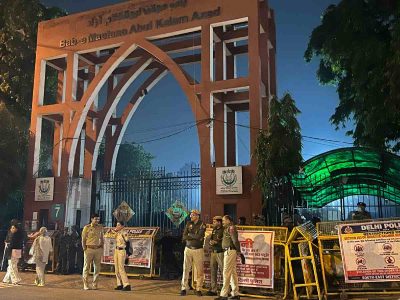
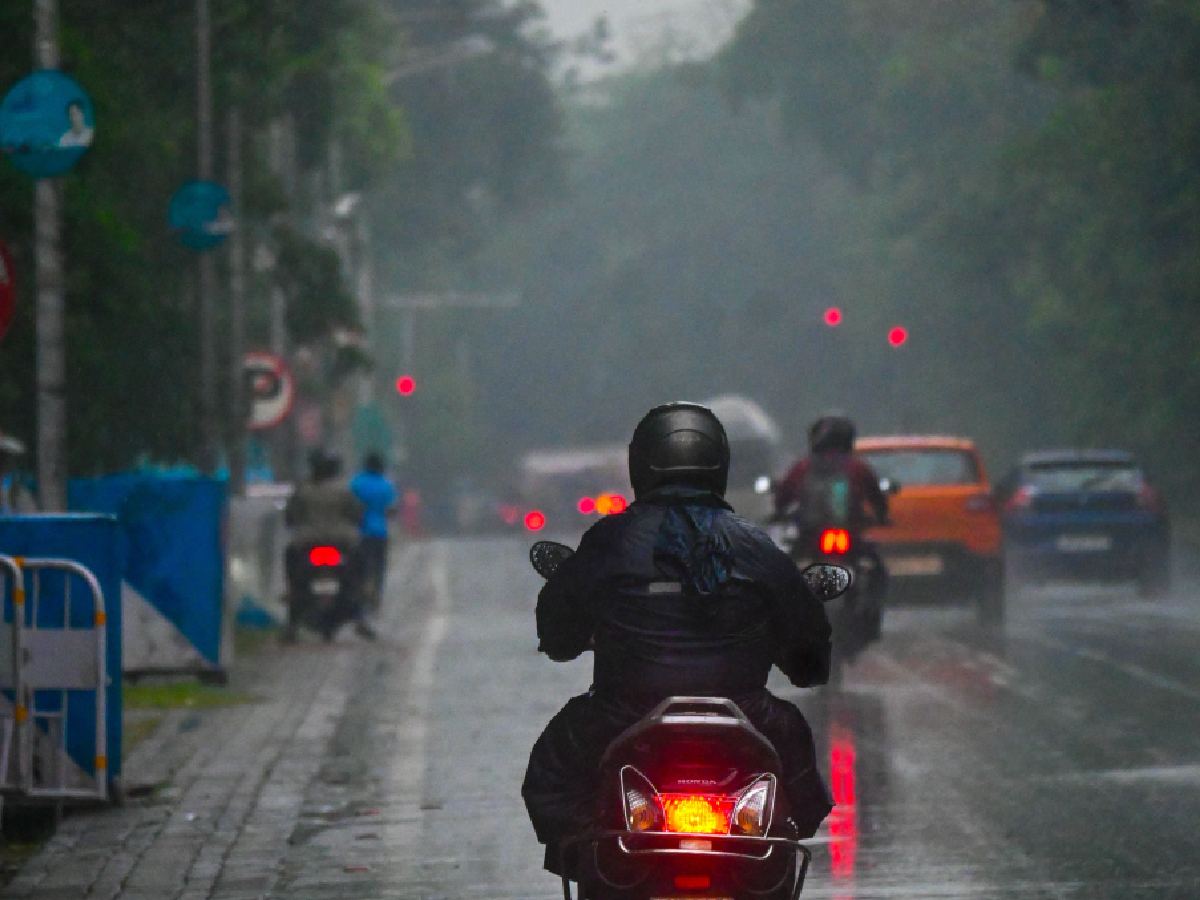
Dark clouds and mist enveloped the capital on Friday morning after overnight rain brought a chill to the air, as Delhi recorded its wettest October day in four years and its highest monthly rainfall since 2022.
The change of weather has made the air quality in the city ‘satisfactory’.
The India Meteorological Department (IMD) issued a ‘red’ alert for the next few hours, warning of more rain and thunderstorms across several parts of the capital.
The city received 61.4 mm of rainfall in the 24 hours ending at 8.30 am on Friday, with the month’s cumulative rainfall reaching 123.3 mm, according to weather data.
The last time Delhi recorded higher rainfall in a single October day was on October 9, 2022, when it received 74 mm. The city had recorded 128 mm of rainfall during the entire month of October that year, a total that the current month’s rainfall could approach or exceed as more showers are expected.
The IMD said light to moderate rain accompanied by thunderstorms and lightning was very likely at most places over the next three hours, with heavy rainfall expected at isolated locations.
The weather department’s ‘red’ alert covered parts of southeast Delhi, east Delhi, Shahdara, central Delhi, northeast Delhi, south Delhi, New Delhi, southwest Delhi, west Delhi, northwest Delhi and north Delhi.
The minimum temperature at Safdarjung, Delhi’s base weather station, settled at 17.2 degrees Celsius, 1.1 degrees above normal, according to the weather body.
Station-wise data showed that Palam recorded a minimum temperature of 15.4 degrees Celsius, 1.6 degrees below normal, while the minimum at the Ridge was 16.8 degrees Celsius, 0.5 degrees below normal. Lodi Road recorded 18 degrees Celsius, 3 degrees above normal, and Ayanagar registered 17.4 degrees Celsius, 1.1 degrees above normal.
The maximum temperature is expected to settle around 27 degrees Celsius.
Station-wise rainfall data for the period between 8.30 am on Thursday and 6 am on Friday showed that Jharoda Kalan recorded the highest rainfall at 89 mm, followed by Lodi Road at 63 mm and Safdarjung at 56.5 mm.
Jhajjar recorded 47 mm of rainfall, while Narayana received 44.5 mm. Pitampura recorded 42.5 mm, Pusa 41.5 mm and Kamla Nehru Nagar in Ghaziabad 41 mm. Pragati Maidan received 40.9 mm, Gurugram 36 mm, Janakpuri 35.5 mm, Muradnagar 35 mm and Northcap University in Gurugram 30 mm.
Lower rainfall totals were recorded at Mayur Vihar, which received 9 mm, and Jafarpur, which recorded 1 mm. Data was not available for Najafgarh, Mehrauli, Chhatarpur and Hindon in Ghaziabad.
The rainfall brought relief from pollution, with Delhi’s Air Quality Index (AQI) standing at 90 at 9.30 am, placing it in the ‘satisfactory’ category, according to the Central Pollution Control Board (CPCB).
Data on the CPCB’s SAMEER app showed that 36 monitoring stations across the city recorded air quality in the ‘satisfactory’ category, while 16 stations were in the ‘moderate’ category.
Under the CPCB’s AQI scale, readings between zero and 50 are classified as ‘good’, 51 and 100 as ‘satisfactory’, 101 and 200 as ‘moderate’, 201 and 300 as ‘poor’, 301 and 400 as ‘very poor’, and 401 and 500 as ‘severe’.