Delhi: A large number of students in the national capital are failing to continue their education at the secondary and higher secondary levels, with dropout rates emerging as a serious concern, particularly among marginalised communities.
The issue was raised in the Rajya Sabha by Delhi MP Swati Maliwal, who sought details on students failing in Delhi government schools and their subsequent enrolment in the National Institute of Open Schooling (NIOS). In its response, the Ministry of Education presented data on the total number of students who failed, alongside those who opted for open schooling as an alternative pathway.
Explaining the role of NIOS, Minister of State for Education Jayant Chaudhary said, “Education being a concurrent subject, an overwhelming majority of schools in the country are managed by respective States and UTs. One of the objectives of NIOS is to provide opportunity to students of government schools who fail repeatedly, from dropping out of the school education system.” He added that students who pass Class X through NIOS are brought back to formal education in their parent schools.
Low return to schooling
The data reveals a stark mismatch between the number of students who fail and those who re-enter the education system through NIOS.
In 2024–25, as many as 70,296 students failed in Class 9. However, only 11,974 sought admission to NIOS in the subsequent 2025–26 academic session. A similar pattern is evident in the previous year: in 2023–24, 1,01,344 students failed, but just 7,794 enrolled in NIOS during the following session.
As a result, only around 17% of students who failed returned to mainstream education during 2025–26, even through open schooling. The proportion was significantly lower in 2024–25, at just 7.6%.
Also Read: Air traffic control system failure, staff shortages expose stress points in India’s aviation network
According to the Ministry of Education, the average dropout rate for secondary education in Delhi stands at 8.2%. However, the burden falls disproportionately on girls and students from Scheduled Caste communities. In 2023–24, the dropout rate among girls was 9.1%, while for Scheduled Caste students it stood at 9.4%.
Dropping out without choice
For many families, economic hardship and limited social support play a decisive role in forcing children out of school.
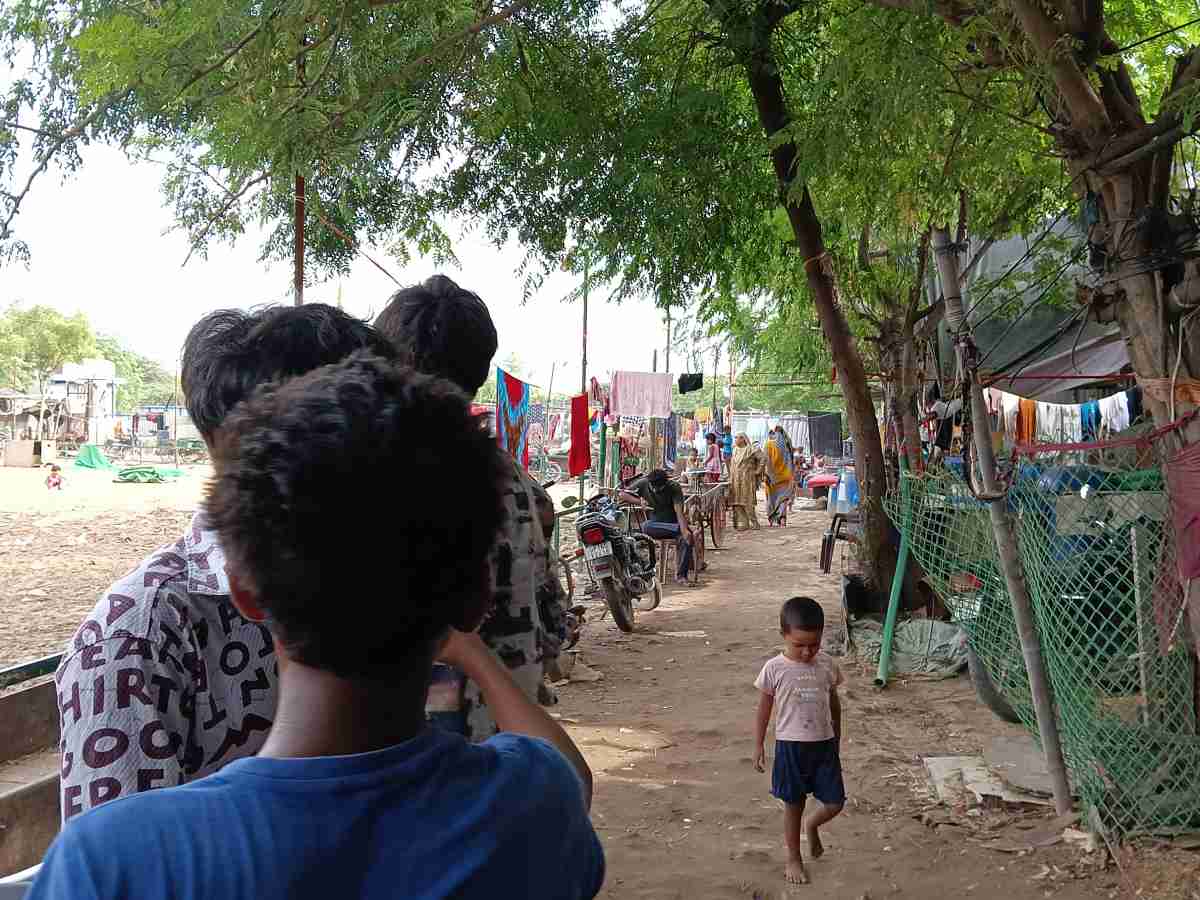
Kaushalia, a resident of a slum cluster along Anandmayee Marg in Okhla, said her son attended a nearby government school regularly until Class 5 but was eventually compelled to discontinue his studies. “My son used to go to a government school till he was in Class 5. He keeps asking us to send him back to school but now it’s too late, he is 16 now,” she said.
She explained that the family withdrew him from school so that he could help his father make clay figurines. “He could have balanced both of it out but now, we can’t have him admitted again. The schools won’t take him,” she added.
Why children leave school
Citing findings from the Ministry of Statistics and Programme Implementation’s Periodic Labour Force Survey (PLFS) 2023–24, the Ministry of Education outlined the most common reasons for school dropouts.
“They are mainly made to dropout to supplement household income, to attend domestic chores, not interested in studies, unable to cope up with studies, child suffering with some disability, poor health, education not considered necessary by the parents, preparation of competitive examination, marriage,” Chaudhary said in his reply to the Unstarred Question.
In some neighbourhoods, however, the reasons extend beyond economic distress.
In Bengali Colony near Vasant Kunj, residents say fear, discrimination, and violence have emerged as significant factors driving children out of school. “My son has stopped going to school for the past year because he is scared that the other boys will beat him up or bully him for being Bengali,” said Safina Begum, a resident of the area.
Recalling a particularly violent incident, she said her son once returned home with a deep wound on his forehead, narrowly missing his eye. “Since then, he has never returned to school,” she said. She added that some children who continue to attend school have begun carrying blades or other weapons for self-defence.
Research and policy response
Earlier in April, the State Council of Educational Research and Training (SCERT) announced multiple research projects aimed at understanding the causes of student dropouts and improving the overall quality of school education in Delhi.
One of the key areas under examination is the impact of Right to Education (RTE) entitlements, including the PM Poshan scheme, according to an SCERT official. The Pradhan Mantri Poshan Shakti Nirman programme, which provides hot meals to students in government and government-aided schools, is closely linked to efforts to reduce dropout rates.
Another focus area is the evaluation of leadership training programmes for school heads conducted by SCERT. The research will assess whether school heads are actively analysing enrolment, attendance, and dropout data to make informed decisions that improve school performance.
A separate study is also underway to develop effective methods to measure and enhance teacher performance. Data for these projects has been collected from school heads, teachers, students, and parents.
A troubled past
Concerns over dropout rates in Delhi government schools are longstanding. In 2022, the National Commission for Protection of Child Rights (NCPCR) released a report highlighting poor learning outcomes and persistent attrition in the city’s schools.
While the transition rate from primary to upper primary education (Class 5 to Class 6) stood at 99.86% and the rate from elementary to secondary education (Class 8 to Class 9) was 96.77% in 2015–16, the commission noted that both declined in subsequent years.
“Though in the year 2018–19 the rate increased, it is still lower than the transition rate in 2015–16,” the NCPCR observed. It noted that in 2016–17, 3,99,916 students were enrolled in Class 5, but enrolment in Class 6 fell to 3,70,803 the following year, leaving nearly 30,000 students out of the system.
Enrolment declined further in 2018–19, when only 3,69,484 students were enrolled in Class 7, indicating that additional children either dropped out or were forced to repeat a grade.