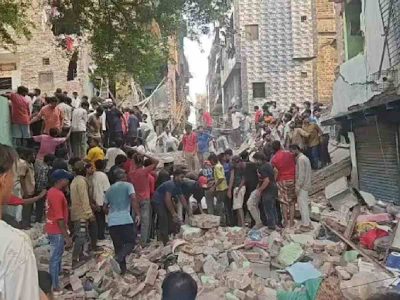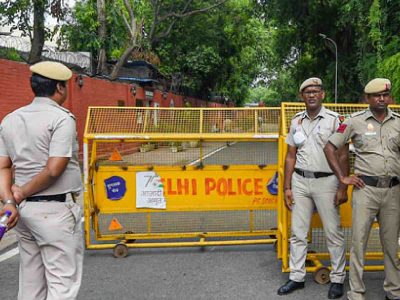
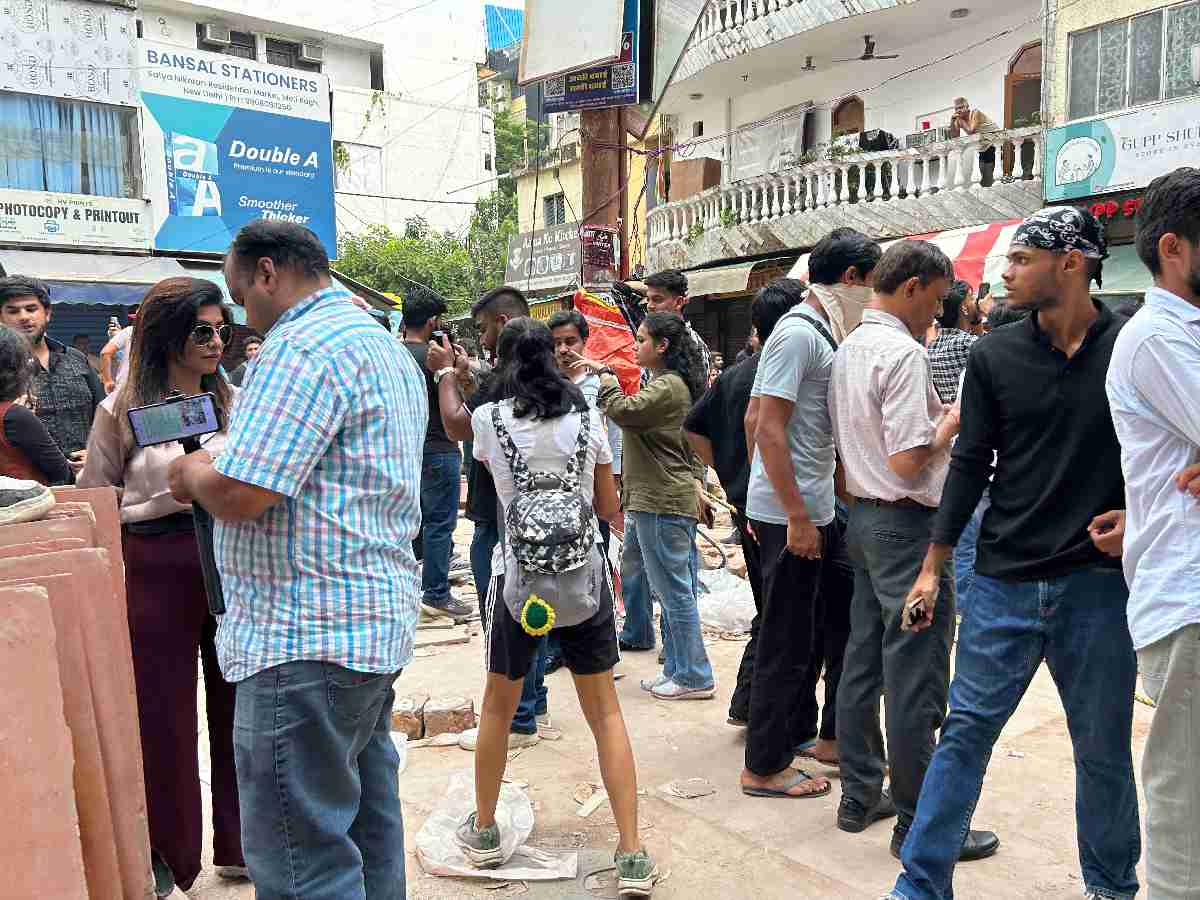
Left organisations representing students, teachers, workers and women on Thursday demanded safe and affordable accommodation for students in Delhi, contending that the deaths in the Satya Niketan building collapse exposed the city’s “unregulated, profit-driven” student housing market.
They also cited findings of the survey they conducted in Satya Niketan area, involving over 100 students, and said above 79 per cent expressed fear about continuing to live there after the building collapse.
The demand featured in the joint press note issued by the Students’ Federation of India (SFI), Democratic Youth Federation of India (DYFI), Delhi Teachers’ Forum (DTF), All India Democratic Women’s Association (AIDWA) and Centre of Indian Trade Unions (CITU).
The organisations said the collapse of the five-storey paying guest (PG) building in Satya Niketan — which killed seven, including students — should not be viewed as an isolated building accident.
They alleged that the incident was the result of inadequate university hostel facilities, a lack of regulation of private PG accommodation and failures in government oversight and enforcement.
The organisations said they had conducted a survey of 117 students living in PG accommodations in Satya Niketan and found that the students came from at least 15 states and Union territories. Most of them were studying in colleges in Delhi University’s South Campus and nearby areas, they said.
According to the survey, monthly PG rents ranged from Rs 5,000 to Rs 30,000, while the average rent for a double-sharing room, including food, was around Rs 14,000.
The survey also found that security deposits ranged from one to three months’ rent and, in some cases, reached around Rs 50,000. At least 31 per cent of the students surveyed had obtained accommodation through brokers and paid an additional commission, the organisations claimed.
Students also reported cracks in walls, faulty cooling systems and repairs being delayed for months. Several respondents complained of unsafe and irregular water supply, including dirty or brown water, while some alleged that they were charged Rs 11 to Rs 15 per unit for electricity.
The organisations said 66 per cent of the students surveyed preferred university or college hostels over private PGs, while 79 per cent expressed fear about continuing to live in Satya Niketan after the building collapse.
“This shows that students are choosing the private PG market not by choice, but out of compulsion,” the press note said.
The organisations also expressed concern over student housing in areas such as Munirka, GTB Nagar, Mukherjee Nagar, Katwaria Sarai and Laxmi Nagar.
Referring to a recent survey by the Municipal Corporation of Delhi, they claimed that 99 per cent of PGs in the city did not have fire safety clearance and more than 70 per cent lacked approval for the required layout plan.
The organisations said merely sealing unsafe PGs after an accident would not resolve the crisis and that students should not be left homeless as a result.
They demanded mandatory registration and licensing of all PG and student accommodation facilities, along with regular safety inspections and publicly available information on their safety status, approved capacity and other essential details.
They also called for clear standards relating to structural safety, fire safety, sanitation, water and electricity supply, occupancy limits, rent and security deposits.
The organisations demanded that the dependents of those killed in the Satya Niketan collapse be provided compensation of Rs 1 crore each, while the injured should receive compensation ranging from Rs 2 lakh to Rs 5 lakh.
They also sought the construction of adequate and affordable public hostels and increased budgetary support for universities, including Delhi University. Grants for higher education should be increased and dependence on debt-based models such as the Higher Education Financing Agency (HEFA) reduced, they said.
The groups proposed the creation of a Delhi Student Accommodation Monitoring and Regulatory Authority, with representation from the Delhi government, MCD, universities, the University Grants Commission, the Ministry of Education, the Fire Department, experts, students, teachers, youth and workers’ organisations.
Also Read: Satya Niketan collapse: Families recall last conversations with victims
The proposed authority should oversee registration, safety inspections, monitoring, grievance redressal and public reporting, they said.
The organisations also suggested that Delhi University study student housing systems at universities such as Oxford and develop a Student Accommodation Monitoring Model suited to Delhi, involving universities, government agencies, local bodies and students.
“Safe, affordable and dignified accommodation is an integral part of every student’s right to education,” the organisations said.