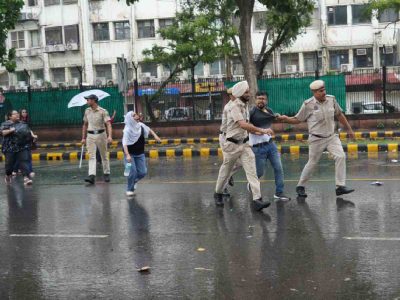
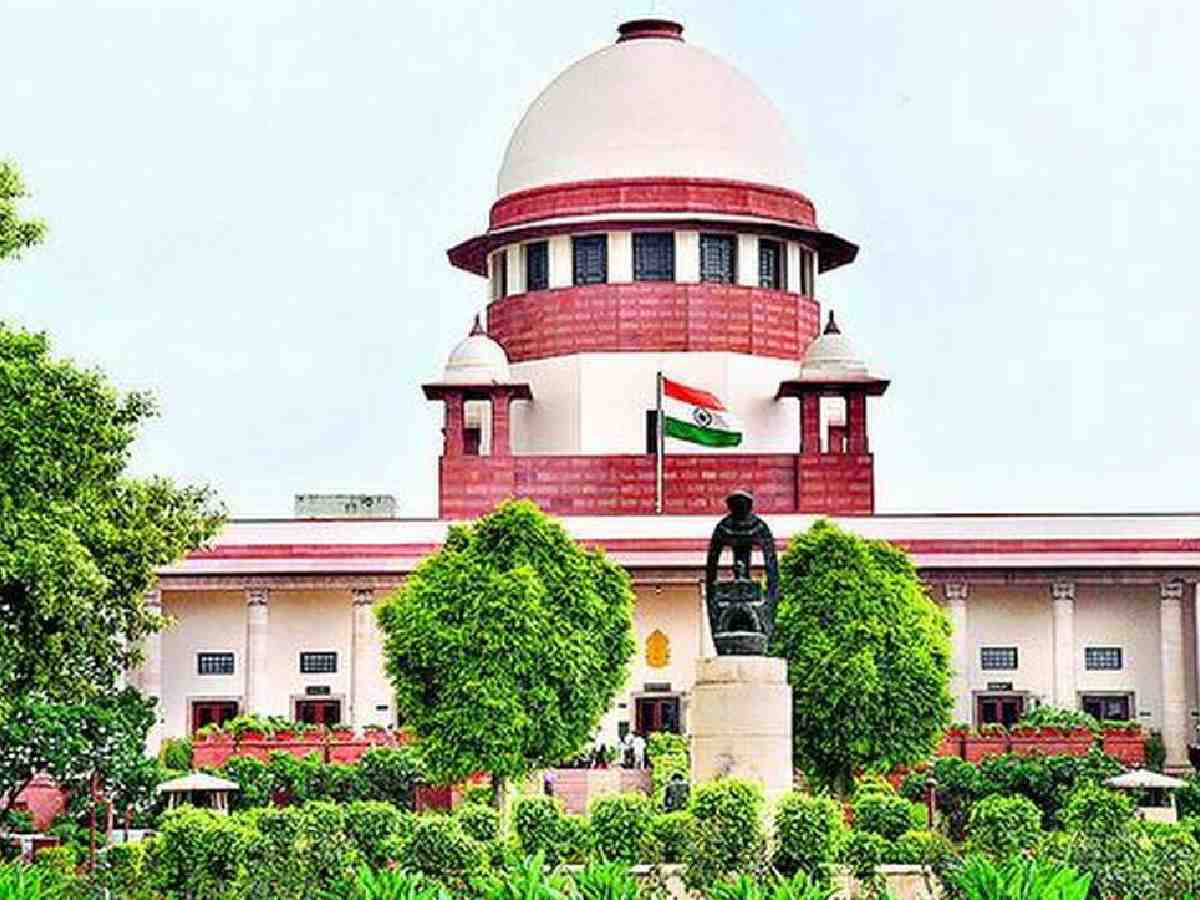
Stressing the importance of crime detection and prevention, the Supreme Court has directed Delhi Police and the city government to enhance beat patrolling, particularly around educational institutions, and undertake strict verification of drivers and assistants of public transport vehicles.
Passing a slew of directions in a suo motu case titled ‘In Re: Recent rape incidents in Delhi NCR’, the apex court directed that unauthorised liquor shops and establishments operating without requisite permissions be identified and dealt with in accordance with law.
A bench of Justices J B Pardiwala and K Vinod Chandran issued notice to the Union Ministry of Home Affairs and the Delhi Transport Department and posted the matter for hearing on November 16.
In its order dated October 5, the bench said the manner in which public spaces are maintained, visible police patrolling and surveillance, and the promptness with which reported deficiencies are addressed are equally relevant to crime prevention.
“These would simultaneously instil confidence amongst citizens and fear amongst potential perpetrators that public spaces all across the city are being effectively watched and monitored,” it said.
Also Read: Astha Kunj incident lays bare old racket of fake cops preying on couples
It also underscored the importance of effective real-time monitoring of police patrolling and CCTV infrastructure through dedicated control room command centres or “war rooms”.
The bench said the information gathered through these control room command centres must feed into an effective field-level response mechanism to facilitate timely deployment or intervention as soon as a vulnerability, incident or deficiency is detected.
“Therefore, the Commissioner of Police, Delhi and the Chief Secretary, Government of NCT of Delhi, are hereby directed to furnish a joint report on (i) whether dedicated control room command centres of this nature currently exist within the NCT of Delhi and, if so, their exact number and the corresponding areas of coverage,” the bench said.
It said the joint report will also be on the protocols presently in place for real-time coordination, communication and deployment of emergency intervention once information is received by the command centres.
The top court said it is necessary to encourage citizens to communicate their grievances and to share information concerning criminal or delinquent activity in their neighbourhoods.
“Hence, the police and the local administration shall consider instituting regular citizen-engagement meetings under the supervision of an officer to be designated for the purpose so that grievances may be received directly and their follow-up monitored efficiently,” it said.
Also Read: JNU hostel residents flag poor maintenance, water and lighting issues
The bench said training in preventive policing should form part of the induction of police personnel and be reinforced through periodic training at regular intervals thereafter.
It directed that measures, including enhanced beat patrolling on an immediate basis, be undertaken immediately by Delhi Police, local administration and Delhi Transport Department.
“There shall be strict verification of drivers and assistants engaged in public transport vehicles like (a) government-operated buses and private buses, and (b) cabs, taxis, rickshaws, etc., which are linked to app-based vehicle aggregator services like Ola, Uber, Rapido, etc., as well as the cabs, taxis and autorickshaws that operate privately,” the bench said.
It said only duly registered and verified persons should be permitted to operate such vehicles.
“All such vehicles shall display, in an area visible to the passenger, the names and photographs of the verified driver(s) and assistant(s) associated with such vehicle so that the passenger may immediately identify and report when unauthorised persons are involved,” it said.
The bench said a dedicated avenue for registration of such complaints must be provided, especially for government-operated buses, private buses and other cabs and rickshaws not registered with app-based services.
“Any finding of non-compliance or violation by any driver or assistant must invite prompt regulatory action, including but not limited to suspension/dismissal from service of the driver/assistant and seizure of the concerned vehicle, as the case may be, with immediate effect,” it said.
The bench said particular attention should be given to eateries and establishments where liquor is being served unlawfully.
Also Read: Between classrooms and counselling rooms
“Beat officers shall remain vigilant in this regard and bring such instances to the notice of their superior officers. Furthermore, beat officers shall ensure that any loitering, crowding or assembly of persons around liquor shops is promptly dispersed, to prevent harassment and ensure unhindered safe movement for pedestrians,” it said.
The bench emphasised that pursuit of preventive policing cannot become a justification for arbitrary or excessive or disproportionate exercise of police powers.
“The police must act firmly where the law requires intervention, but such intervention must remain within the bounds of legality, proportionality and accountability,” it said.
Accountability is integral to effective policing and governance. The citizens’ faith in the system must be gained through effective enforcement, especially when the system is challenged, as is the case with the recent turn of events, it added.
The bench said a system which seeks to inspire confidence in citizens must necessarily be the one in which citizens are protected not only from crime, but also from unlawful or disproportionate exercise of State power.