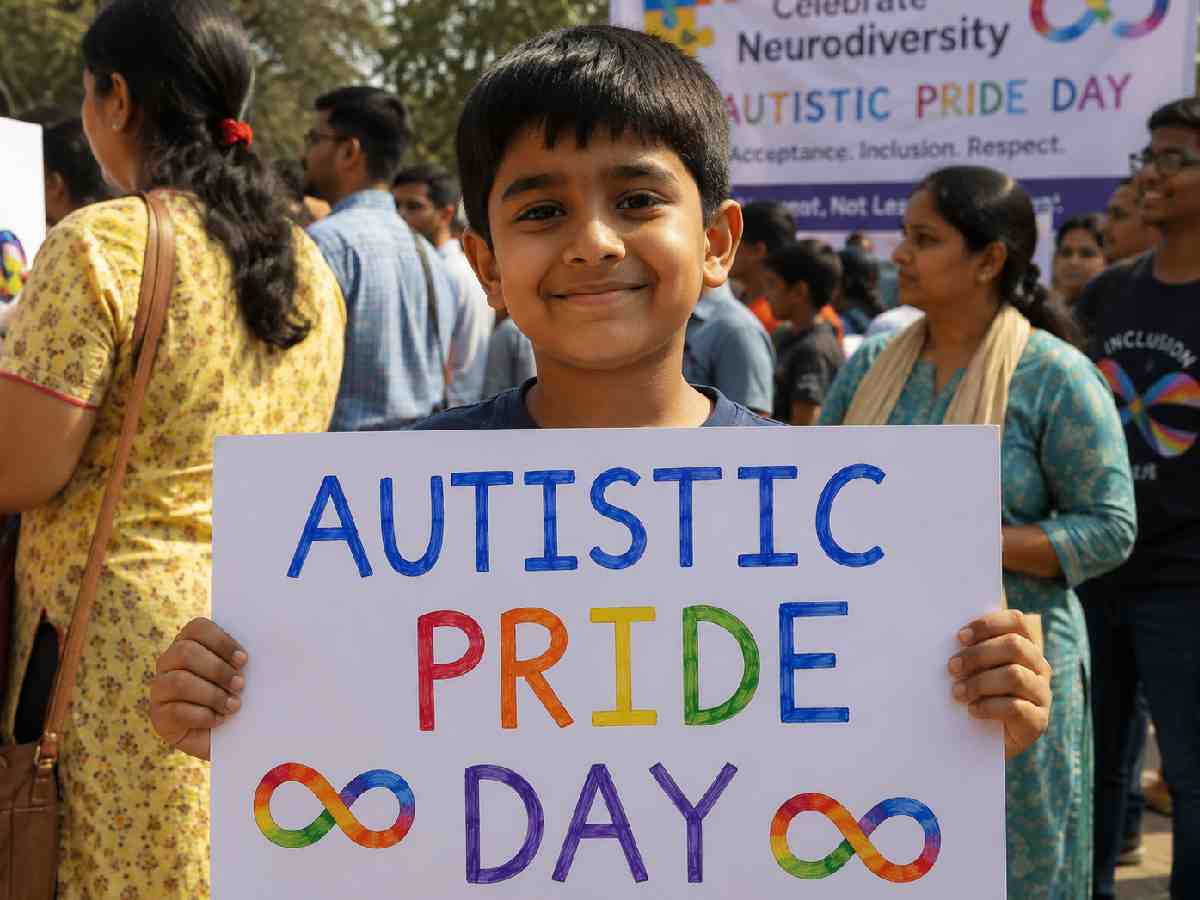
Observed every year on June 18, Autistic Pride Day was created by autistic people themselves. Unlike awareness campaigns that often focus on challenges and interventions, the day celebrates neurodiversity, the idea that differences in the way people think, communicate and experience the world are a natural part of human diversity.
In a classroom in Delhi, special educator Yashaswini Kularia says she has witnessed a gradual change in attitudes over the past decade.
“When I started teaching, most conversations with parents were about how their child could become like everyone else. Now, more families want to understand how their child learns and experiences the world. It may seem like a small change, but it makes a huge difference,” she says.
For Kularia, inclusion begins with recognising that autistic children may learn differently, but that does not mean they are less capable.
“Many autistic students notice details others miss. Some have incredible memories, some are highly creative and some develop deep knowledge in subjects they enjoy. We need to spend more time recognising those strengths,” she says.
Understanding autism
Autism, or Autism Spectrum Disorder (ASD), affects how people communicate, interact and process information. Experiences vary widely from person to person. While some autistic individuals require significant support in daily life, others study, work, live independently and advocate for disability rights.
Yet misconceptions remain common.
Twenty-eight-year-old Madhav Tyagi, a chef at Otenga restaurant in the city, was diagnosed as an adult after years of feeling different without understanding why.
“Growing up, I was usually described as quiet or awkward. I always felt like there were social rules everyone else seemed to understand automatically,” he says.
Receiving a diagnosis, he recalls, helped him make sense of experiences he had struggled to explain.
“It wasn’t about getting a label. It was about understanding myself better. A lot of things suddenly made sense,” Tyagi says.
For many autistic adults in India, diagnosis often comes later in life because awareness remains limited and autism is still frequently associated only with childhood. Researchers have repeatedly pointed out that autism-related services, particularly for adults, remain limited.
One of the largest population-based studies on autism in India, published in the Indian Journal of Pediatrics in 2017 by researchers from the National Institute of Mental Health and Neurosciences (NIMHANS) and collaborating institutions, screened more than 28,000 children across rural, urban and tribal populations and estimated autism prevalence at 0.15% among children aged one to 10 years. The authors noted that limited awareness, variations in screening methods and under-diagnosis may mean the actual prevalence is higher.
A 2021 scoping review titled “Autism Research in India: A Scoping Review” by Divan et al, published in Autism Research, found that most Indian studies continue to focus on diagnosis and early intervention, while issues such as employment, independent living, mental health and quality of life among autistic adults remain significantly under-researched.
More recently, a 2023 study titled “Research Priorities for Autism in India”, led by researchers from the University of Cambridge, the Centre for Autism and other partners, and published in Autism, brought together autistic people, parents, practitioners and researchers to identify key priorities for the community. The study highlighted inclusive education, employment opportunities, community participation, independent living and support across the lifespan as among the most pressing concerns.
Beyond deficits
For disability rights advocates, this is precisely why conversations around pride matter.
“People often think pride means ignoring challenges, but that’s not what it means at all,” says social worker and entrepreneur Yusra Khan. “It means recognising that autistic people deserve respect, opportunities and dignity without having to prove their worth.”
Khan believes discussions around autism have historically focused too heavily on deficits while overlooking strengths and individuality.
“When we only talk about autism as a problem, we miss the experiences, talents and perspectives autistic people bring to society,” she says.
Across India, schools are increasingly experimenting with more inclusive approaches. Quiet corners, sensory breaks, visual learning tools and flexible communication methods are slowly becoming part of educational settings.
According to Anjali Baisla, a lawyer by profession and a volunteer teacher at ASMI in Delhi, these changes often benefit all students.
“We’ve learnt that flexibility helps everyone. Some children prefer visual instructions, some need quieter spaces and some need more time to process information. Once you stop treating those needs as unusual, the classroom becomes better for everyone,” she says.
Autistic voices lead the shift
The shift is also being driven by autistic people themselves.
Social media has created spaces where autistic adults can share experiences directly, challenging stereotypes that have long shaped public perceptions.
For 22-year-old Jamia Millia Islamia student Laiba Tarannum, who is associated with ASMI, those online communities offered a sense of belonging.
“I came across autistic creators talking about sensory overload, routines and social exhaustion. For the first time, I saw people describing experiences that felt familiar,” she says.
Tarannum believes Autistic Pride Day is important because it highlights autistic people as individuals rather than as medical cases.
“A lot of conversations are about therapies and support needs. Those are important, but autistic people also have careers, hobbies, friendships and ambitions. Pride is about recognising the whole person,” she says.
Globally, the neurodiversity movement has gained momentum over the past two decades. Advocates argue that autism should not be viewed solely through a medical lens. Instead, they encourage society to focus on reducing barriers and creating environments where autistic people can participate fully.
The growing visibility of Autistic Pride also reflects a broader shift in how autism is understood around the world. According to the latest data from the US Centers for Disease Control and Prevention (CDC), about one in 31 8-year-old children were identified as autistic in 2022, compared to one in 36 in 2020 and one in 150 when the CDC first began large-scale monitoring in 2000. Researchers say the increase is linked not only to growing awareness but also to improved identification and access to diagnostic services.
The CDC’s findings also show that autism is being identified across racial, ethnic and socioeconomic groups, while more girls and children from historically underrepresented communities are being recognised than in previous decades. Experts say this demonstrates the importance of expanding access to diagnosis and support services rather than relying on outdated stereotypes about who can be autistic.
For advocates, however, the significance of Autistic Pride Day extends beyond statistics.
“It is about being seen as a person first,” says Khan. “Not as a problem to be solved, but as someone who deserves the same opportunities, respect and freedom as everyone else.”
Towards belonging
As June 18 approaches, events, campaigns and discussions marking Autistic Pride Day will take place across the world. While awareness remains important, many within the autism community hope the conversation continues moving further towards acceptance and inclusion.
For Kularia, the message is simple.
“Every child wants to be understood and respected,” she says. “Autistic children are no different.”
Autistic Pride Day is not about ignoring challenges. Rather, it is about recognising that autistic people have a place in society exactly as they are. As schools, workplaces and public institutions become more inclusive, advocates hope the conversation around autism will continue to move beyond awareness and towards something more meaningful: belonging.