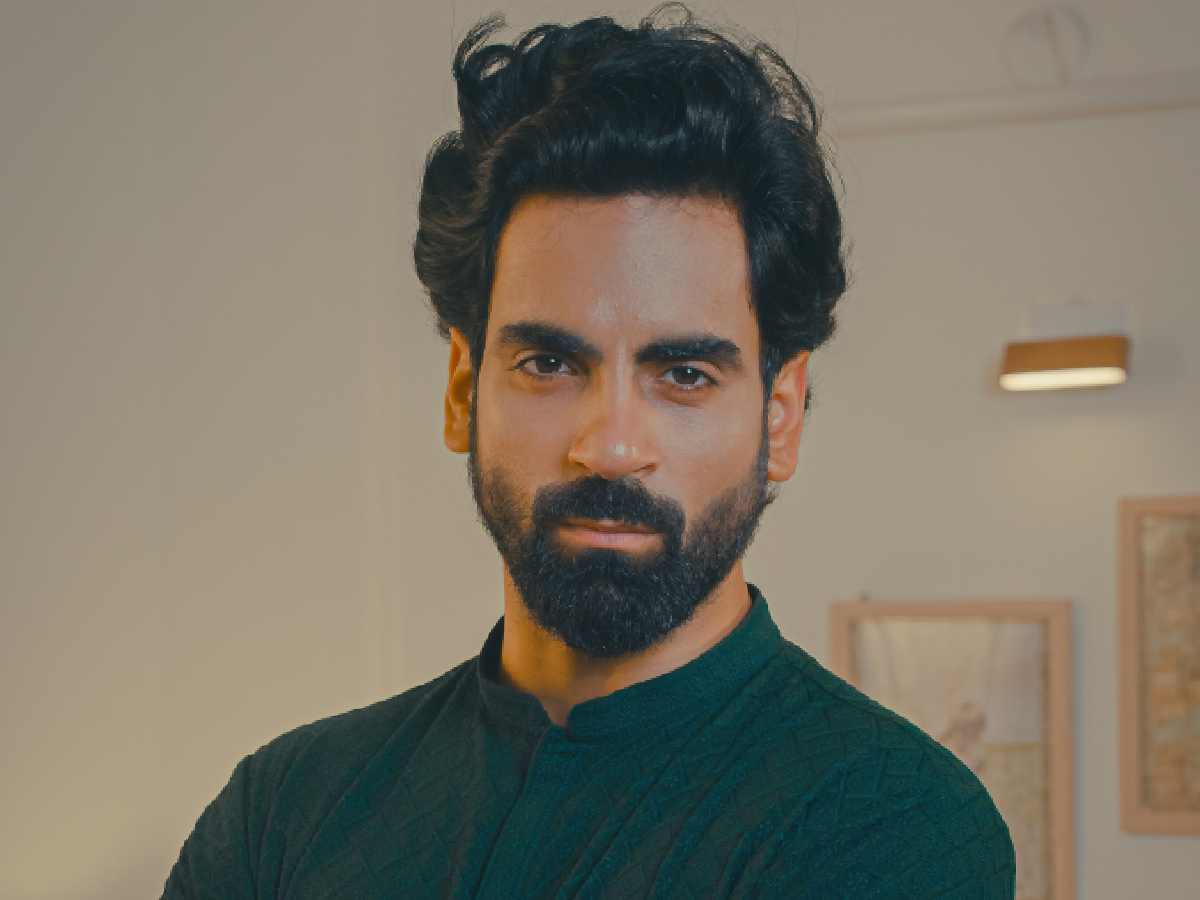
For Sumit Arora, the release of Bisharashki in India marks more than an international film debut. It is the latest milestone in a career he chose to rebuild from scratch after walking away from a secure seven-year position as a theatre teacher at a reputed school.
Now based in Mumbai after beginning his acting journey in Delhi, Arora has spent 12 years in theatre and worked across screen projects. Around a year and a half after leaving his teaching job, he is waiting to see what his biggest gamble yet will bring.
“I call it the heroic comeback, if the comeback happens of course, which I feel it will, God willing.”
‘Why not?’
Arora did not need much convincing when the opportunity came.
“It’s an international film, it’s an experiment and I should do it. It’s a massy film and why not? The only ‘why’ I had was — why not? So I did it.”
The opportunity itself was almost accidental. Around June, Arora appeared in an advertisement for Acco, which caught the attention of casting director Shweta Bindra. She contacted him, but he missed the message and discovered it later while going through his unread messages.
“I thought, oh, I didn’t send her my profile. I should send it now.”
After he sent his profile, Bindra told him she had something for him: an international film unlike anything he had worked on before.
By chance
Arora auditioned for the role with an English-translated script; the original dialogues were in Kazakh and Russian. The casting, however, was less about language than what he could communicate without it.
“They wanted someone who could portray the inner feelings,” he says. “They wanted an Indian actor who could portray all of this through emotions and expressions.”
He received the call around mid-August, followed by conversations with director Bakyt Kader and a longer selection process before shooting began in October.
The language barrier also meant that Arora had only a limited character brief before filming. He knew his character was the villain and that he worked for a Kazakh character. Much of the performance was developed on set.
The director would enact scenes for him, Arora would offer suggestions, and the two would improvise despite not sharing a language.
“I used all my knowledge of Indian cinema. That was my biggest preparation.”
Playing bad
Arora plays a negative lead, something he had not expected.
“I have always been fascinated by villains. But my look doesn’t really support that. People in the industry always tell me I have a very hero-like face. So I never thought playing a negative character was even possible for me.”
That contrast was part of the attraction.
“So when the team saw me in that light, that was the first thing that attracted me. I thought, if they can see me like that, I should also give it a try.”
He credits both Indian cinema and Kader for helping him find the character.
“I would like to give full credit to Indian cinema and, of course, my director Bakyt Kader for Baabu.”
Across cultures
Working with the Kazakhstan-based production team gave Arora another unexpected lesson. He was struck by the combination of discipline and informality on set.
“They were laser-sharp, super dedicated and so chill. I never saw anyone shout on set.”
He also noticed the absence of the star culture and hierarchy he had encountered elsewhere.
“No star culture. Single vanity van for all the leads. We had a language barrier, but we had the same love for cinema, so we understood each other anyway.”
That shared passion, he says, became a language of its own.
All kinds of roles
The experience has reinforced Arora’s desire not to put himself in a particular box.
“I am an actor and I want to do everything.”
Heroes, villains, comic characters, troubled characters or romantics — he wants to try them all, even if some experiments fail.
“I don’t fear failing. I am not afraid of failures. I want to be somebody who wants to try every single thing.”
He does not have a single dream role either.
“I don’t think there is a dream role. Of course, there are dream performances, but the dream was to be an actor and I am living it.”
The theatre
For all the novelty of an international film, Arora’s approach to acting remains rooted in his 12 years in theatre.
“Theatre has taught me that you should never forget that it’s a process, and you have to trust the process. No matter where you are, just keep learning.”
His method is straightforward: understand the character, the relationships around them and the moment itself.
“Be the character, understand the character, understand your relationships, and be in the moment. Live the moment. Be present.”
Theatre has also taught him that an actor is only one part of a much larger creative process.
“I am just a medium through which things are being portrayed. So not to take it on my head, and still make sure that I do my job honestly.”
“It’s not a one-man show. Actors are just the face, it’s the team that runs the place.”
Starting over
For Arora, theatre has also meant learning to begin again, regardless of experience.
“It has taught me that no matter how experienced you are, you have to start again from scratch. And no matter if you are just a beginner, you have to show up every single day and work hard to prove yourself.”
That philosophy shaped his response when he learned he was making his international debut.
“I didn’t feel like a newcomer or a veteran. I just felt that it is another day, another special day, a performance day where I have to put in my everything.”
It was also the mindset he needed when he left his teaching job.
“That took a lot of courage, belief and faith to finally go after the dreams I wanted to live.”
Leaving behind seven years of security was difficult.
“I had to leave that cushion and set out on a completely new journey.”
On the wish list
Arora names Irrfan Khan, Shah Rukh Khan and Amitabh Bachchan among the actors he would have liked to share the screen with. Irrfan, in particular, remains someone he deeply admires, while Shah Rukh’s performance in Baazigar helped make acting seem possible to him.
Among directors, he names Imtiaz Ali, Anurag Kashyap, Aatish Kapadia, Sanjay Leela Bhansali, Aditya Chopra, Rajkumar Hirani and Vidhu Vinod Chopra.
More than any particular collaboration, however, he wants to become “a director’s actor” — someone filmmakers can trust to realise their vision.
The starting line
Arora does not know what audiences should necessarily take away from his performance in Bisharashki in India. Instead, he hopes his journey can encourage people who are still trying to begin.
“When you are running a race, even if it’s against yourself, you start from the starting point. But there are some people who first have to fight just to reach the starting point.”
For him, the important thing is having the courage to get there.
“It’s never too far, never too late to try. And they start believing in themselves.”
His own experience, he says, has taught him that the first step matters more than knowing exactly where the race will end.
“If I can do it, anybody can. All you have to do is believe, put in the hard work and, of course, trust the Almighty.”
And as he waits for audiences to see his international debut, Arora remains focused on the thing that started the journey in the first place.
“I hope I continue to do it till the end of my time in this beautiful universe.”