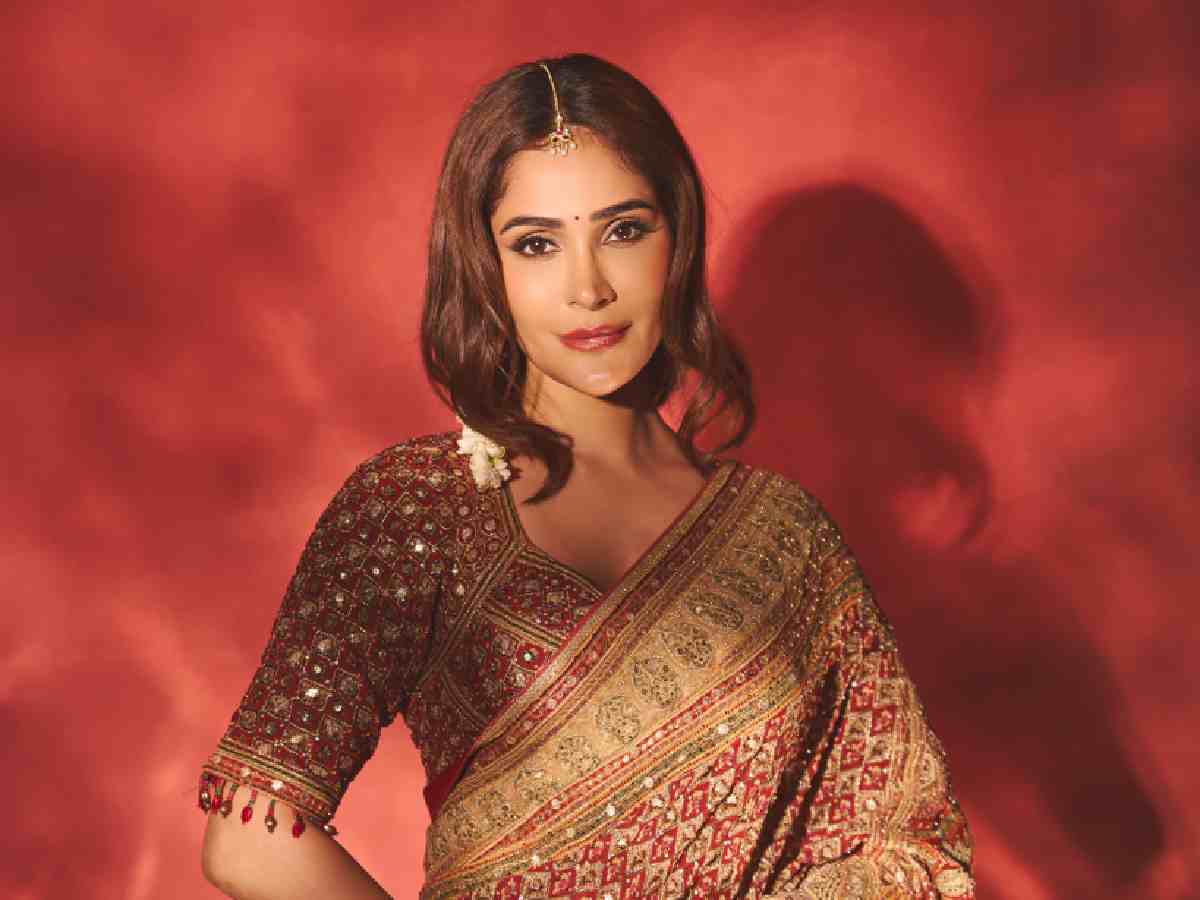
For Alankrita Sahai, the journey from beauty pageants to acting has never been simply about moving from one glamorous platform to another. It has been about redefining what an actor can be, and refusing to let an early association with beauty determine the roles she can play.
Having worked across pageantry, modelling, music videos, films and more than 250 campaigns, Sahai says she is now at a stage where she wants audiences to see the actor before everything else.
“I believe that the stage I am at is to actually expand, explore and redefine the idea of being an actor,” she says. “People need to understand that women are not just confined to beauty and pleasure. We belong to a plethora of ideas where we can play different characters and roles.”
For Sahai, that means embracing characters at opposite ends of the spectrum. She wants to play a police officer, a woman in power, someone vulnerable or weak, a gangster, a housewife or even a transgender person. “I don’t mind playing a cop, I don’t mind playing a gangster, I don’t mind playing a housewife, I don’t mind playing a daughter, but something that’s juicy and meaty and adds substance to the role that I’m a part of, the film that I’m part of, the project that I’m a part of,” she says.
Pageant to screen
Born in New Delhi, Sahai studied at the American Embassy School and Khaitan Public School before pursuing higher education at Gargi College, University of Delhi, followed by the University of Southern California.
Her public journey began with beauty pageants. She went on to win multiple titles at the Miss Earth competition in the Philippines, becoming the first Indian contestant to win seven titles at the pageant. But the transition from being a beauty queen and model to being taken seriously as an actor was not without its challenges.
“The phase that challenged me the most was actually the transition from being Miss India to becoming an actor, being a role model for girls and then transforming and transcending into an industry where redefining myself and the purpose of my path was very, very crucial,” she says.
She believes beauty pageant winners are sometimes viewed through a narrow lens.
“People don’t really take you seriously sometimes. They think that we’re very rigid and very perfect in terms of the way we want to look and feel and be,” she says.
But she points to actors such as Priyanka Chopra, Aishwarya Rai, Sushmita Sen and Manushi Chhillar as examples of women who have moved beyond pageantry to establish themselves in different spheres of entertainment.
“It was difficult; once you love your job, I don’t think there’s anything else in this world that can stop you from becoming what you want to be,” she says.
Her own transition eventually took her to the screen, with her acting debut in the Netflix film Love Per Square Foot in 2018, followed by Namaste England.
Amitabh Bachchan memory
Before films, music gave Sahai one of her earliest introductions to the entertainment industry.
Her first major project was a music album with Himesh Reshammiya, launched in the presence of Amitabh Bachchan and Salman Khan.
“I think what I remember about those days was being mesmerised and astounded by the magnificent personality of Amitabh Bachchan sir,” she recalls. “I forgot it was my launch and I forgot about everyone but the legendary man.”
Music videos subsequently became an important part of her career. Her work includes songs such as Coka, 5-7, Allah Ve, Lalala, Raaz Apne Dil Ke, Funk Billo and Tere Bin 2.0.
For Sahai, the appeal of music videos lies in their ability to constantly transform an actor’s identity.
“I get to work with the most amazing artistes, get to work with great different directors and labels, and I get to be different characters and wear different outfits and play different scenarios in each video,” she says.
Relationship with appearance
Years of modelling and advertising taught Sahai how to work with the camera, lighting and deadlines. But acting, she says, eventually changed her relationship with her own appearance.
“I am not worried about my make-up and hair anymore. I am just so evolved in my scene and character that I stopped worrying about my looks like I used to worry about which side,” she says.
For someone whose career began with beauty and modelling, the shift is significant.
“My way of approaching a script and the narrative does not come from who Alankrita is,” she says. “I don’t take it anymore as I used to.”
Changing face of OTT
Sahai sees OTT as one of the biggest changes in the entertainment industry, particularly because it has created room for performers who may not always be conventional stars.
“OTT has changed the game, and I’m so happy that it has because it has space for everyone now to be themselves in terms of they can show up, perform and transcend and transform,” she says.
“It has allowed performers to become the stars of the show and no longer just big names becoming stars of the show,” she says. “If you’re a performer and you act well, you carry the load of the film on you.”
For Sahai, that evolution is particularly important because she sees acting as a craft that requires constant work.
“You have to keep working on your craft. You can’t give up,” she says. “You have to keep doing workshops, keep learning dance, keep working on your language and your diction.”
Beyond the numbers
Her years in advertising have brought collaborations with major brands, but she says the experience also taught her the importance of relationships
“Your network is your net worth,” she says.
Also Read: What you do while you wait defines your journey: Madhurima Tuli
At the same time, she acknowledges that the industry continues to judge actors, particularly women, on appearance.
Social media has added another layer, with followers, views and reach increasingly becoming part of how performers are perceived.
“But I think talent is the biggest goal for anyone,” she says. “Talent can eat up everything.”
Waiting for roles
Sahai is drawn towards characters that allow her to disappear into a world different from her own. Crime thrillers, detective stories, comedy and romance all interest her, but she repeatedly returns to one idea: characters with substance.
“I would really like to take on a proper crime thriller or maybe the role of a lawyer,” she says.
Her ambitions extend beyond Hindi cinema. She hopes to work with filmmakers across Bollywood and the South Indian cinema.
“I want to do international indie films as well, and I want to be different characters,” she says. “I’m an artiste. I enjoy doing everything my job requires me to do.”