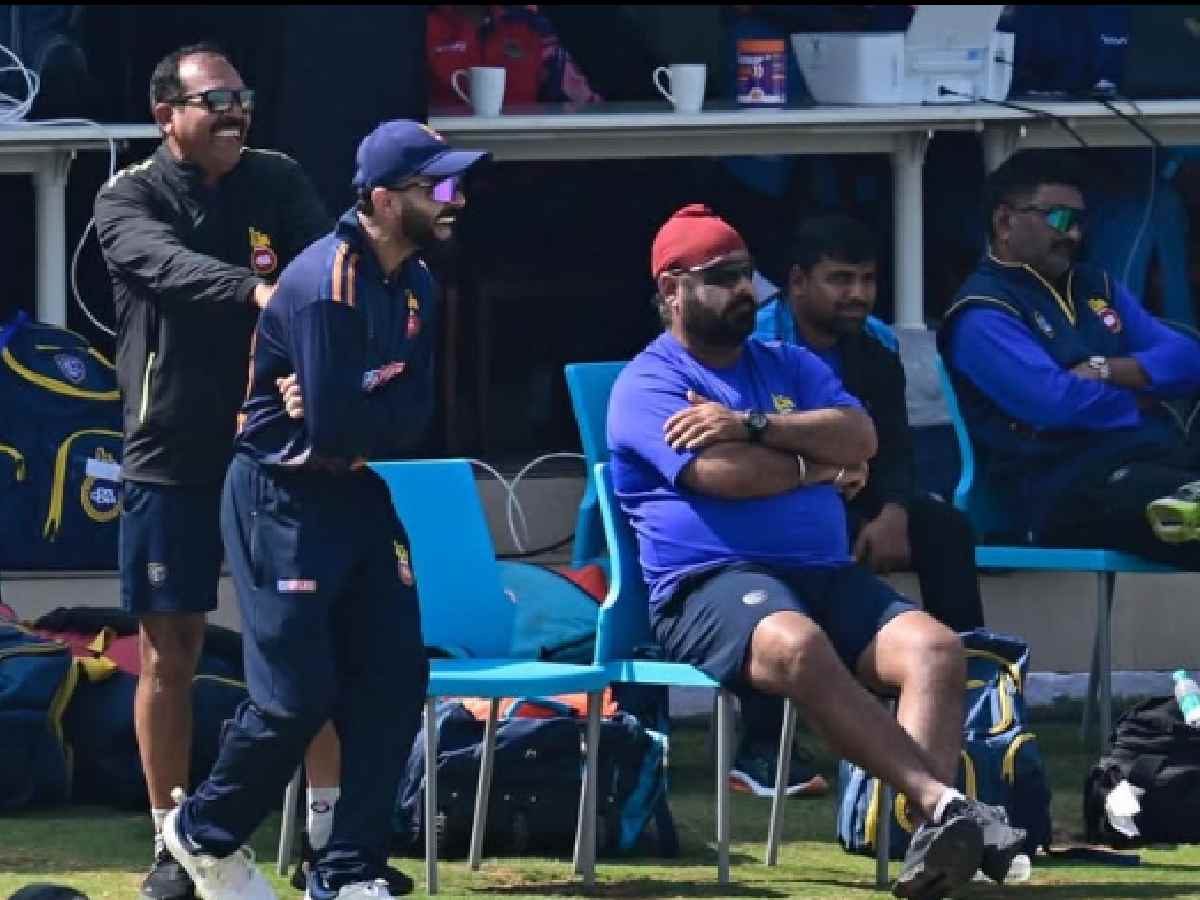
A major reason Delhi reached the quarterfinals of the 50-over Vijay Hazare Trophy was the motivational presence of Virat Kohli in a couple of league matches, which propelled the team to a flying start. Although Delhi lost to eventual champions Vidarbha in the quarterfinal this month, Kohli played a huge role in paving the way for the Rishabh Pant-led side to enter the knock-out round for the first time in five years.
In Delhi’s opening match, Kohli scored a 101-ball 131 against Andhra in a Group D game to give the campaign a brilliant start at the BCCI’s Centre of Excellence (CoE) in Bengaluru. Chasing Andhra’s imposing 298 for eight in 50 overs, Delhi suffered an early blow when opener Arpit Rana fell for a solitary run. Kohli then joined the promising Priyansh Arya (74 off 44 balls), and the pair laid a solid foundation, adding 113 runs off just 71 balls for the second wicket.
After Arya’s dismissal, Kohli featured in an even bigger stand, adding 160 runs off 123 balls for the third wicket with Nitish Rana (77 off 55 balls). These two partnerships proved decisive — along with pacer Simarjeet Singh’s five-wicket haul, which earned him the Man-of-the-Match award — as Delhi cruised to a comfortable four-wicket win.
Another crucial win
In Delhi’s second match, Kohli’s broad bat again decimated the opposition, guiding his team to a narrow seven-run victory over Gujarat with a 61-ball 77 at the same venue. Asked to bat first, Delhi lost early wickets and slumped to 74 for two, 98 for three, and 108 for four.
Through this collapse, Kohli held one end together. He was involved in a run-a-ball 72-run partnership with Arpit Rana for the second wicket. Lower down the order, a crucial 73-run stand for the sixth wicket between Pant and Harsh Tyagi (40 off 47 balls) lifted Delhi to a competitive 254 for nine in 50 overs.
Also Read: How Delhi has featured in India’s World Cup plans
Gujarat began steadily, led by opener Aarya Desai’s 57. However, Delhi’s pacers — Prince Yadav (three wickets), Ishant Sharma (two), and Arpit Rana (two) — delivered with the ball, bundling Gujarat out with a little over two overs to spare. Kohli was adjudged Man of the Match for his responsible knock that anchored the Delhi innings.
Thanks largely to Kohli’s guidance in those matches, an inspired Delhi topped the group to qualify for the quarterfinals, winning six of their seven pool games.
Seamless integration
Delhi team manager Mahesh Bhati, who captained Jamia Millia Islamia to its maiden Rohinton Baria Trophy title in 1990, highlighted the shift in the team’s outlook following Kohli’s arrival.
“Virat’s intensity with the Delhi team was the same as he shows while representing India, and that reflected in the on-field performances in those two matches. He stayed with the team at the hotel. However, he would have dinner in his room, while the rest of us would go for the buffet,” Bhati told Patriot.
“We also ensured he wasn’t disturbed in the evenings, since we spent the entire day together anyway — often joking and recalling old times. Due to security reasons, Delhi’s Vijay Hazare Trophy matches were played at the BCCI’s Centre of Excellence, where spectators were not allowed,” he said.
Bhati recalled casually asking Kohli to make himself more available for Delhi’s matches. “I told him that if he was around, Delhi would benefit from his mere presence. Only because he was there did all the players push themselves to keep pace with him during training and running. The motivation level was noticeably different when he wasn’t around,” he said.
The team manager stressed that Kohli effortlessly put everyone in the dressing room at ease. “When he came to play the last match of the 2024–25 Ranji Trophy, Virat knew only a handful of people, including the dressing-room attendants. He has known me for over 20 years — I was the Delhi Under-19 coach for four successive seasons starting in 2004–05, when he was part of the team. He was also familiar with coach Sarandeep Singh and had heard of youngsters Ayush Badoni and Yash Dhull, though he hadn’t met them,” Bhati said.
“Yet Virat knows the art of making youngsters comfortable, even if they themselves hesitate about how to strike up a conversation with him. That hesitation is understandable, given that he has been a role model for all of them,” he added.
Biggest crowd-puller
That Kohli remains the biggest crowd-puller in Indian cricket was evident when a few die-hard fans attempted — unsuccessfully — to scale the boundary walls of the Centre of Excellence to watch him bat.
The BCCI had shifted Kohli’s matches to the CoE precisely to avoid the chaos his presence could trigger, which is why the two Delhi games were played without spectators. When Kohli turned out for Delhi’s last Ranji Trophy match against Railways at the Arun Jaitley Stadium in January 2025, the response bordered on frenzy.
An estimated 12,000-plus fans turned up, far exceeding expectations at the Delhi and District Cricket Association (DDCA) and among the Delhi police, which had initially deployed only a few constables. Additional forces had to be rushed in to control the crowd.
Punctual as ever
Bhati underlined Kohli’s professionalism, describing him as unfailingly punctual during the Railways match.
“The reporting time for the players was 8 a.m., but Virat would reach the stadium at 7 a.m., complete his gym and workout sessions, and then practise with the team,” he said.
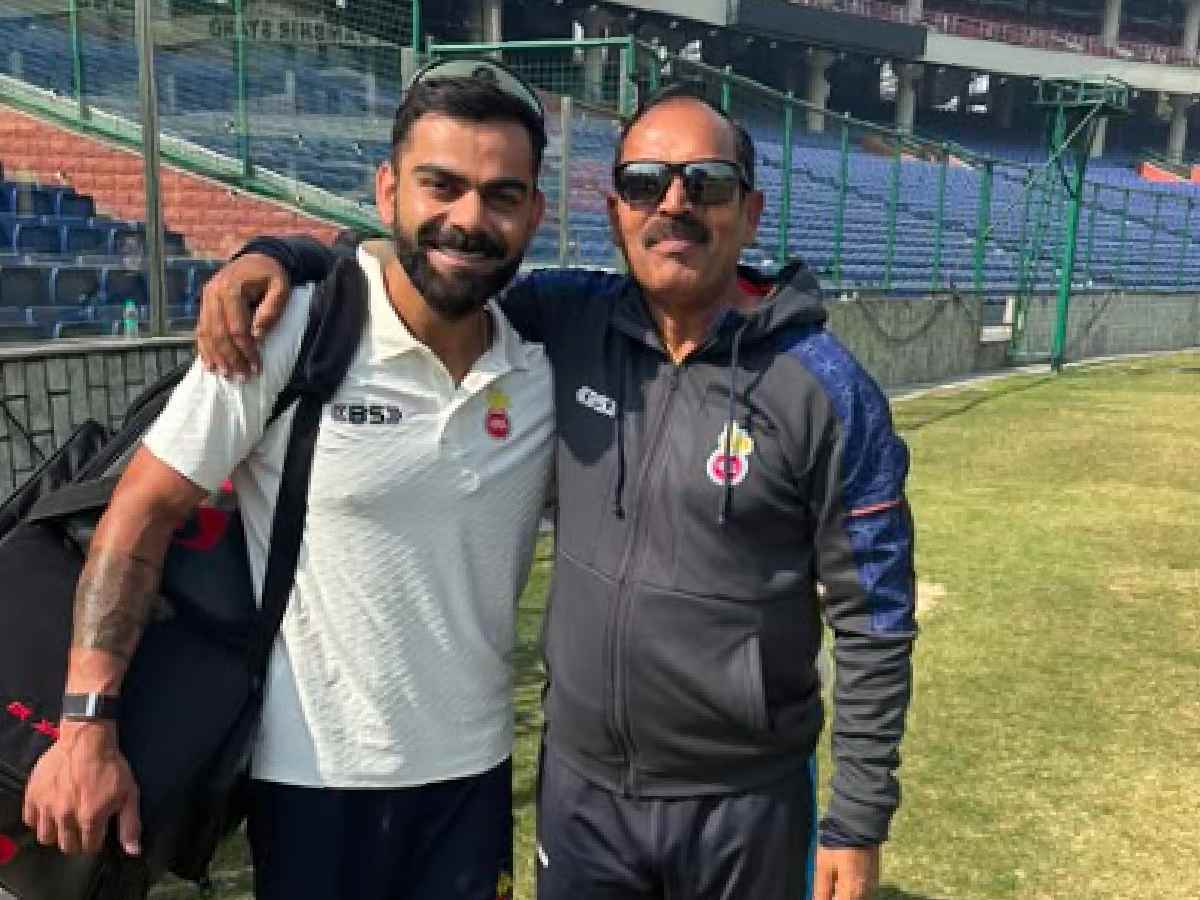
“On practice days, he would drive in from his Gurgaon home with his security guard. Once the match began, he shifted to a hotel in Delhi, as daily travel from Gurgaon would have been tiring.”
An innocent question
Bhati also recalled a fond memory from Kohli’s Under-19 days. In the mid-2000s, the Delhi Under-19 team had a match at Salt Lake in Kolkata, almost at the same time as a Duleep Trophy game involving the north zone — of which Kohli was a member — at Eden Gardens.
“For some reason, the north zone squad had only 12 players, including Virat. He was still eligible to play Under-19 cricket. When I found out he was not in the playing XI, I approached the right people and got him to play for the Delhi Under-19 team instead. He went on to smash a big hundred,” Bhati recalled.
“The cutest moment came later, when Virat asked me which match fee he would get — the higher one for the Duleep Trophy or the Under-19 game. It was a question born of pure, child-like innocence,” Bhati said, smiling.