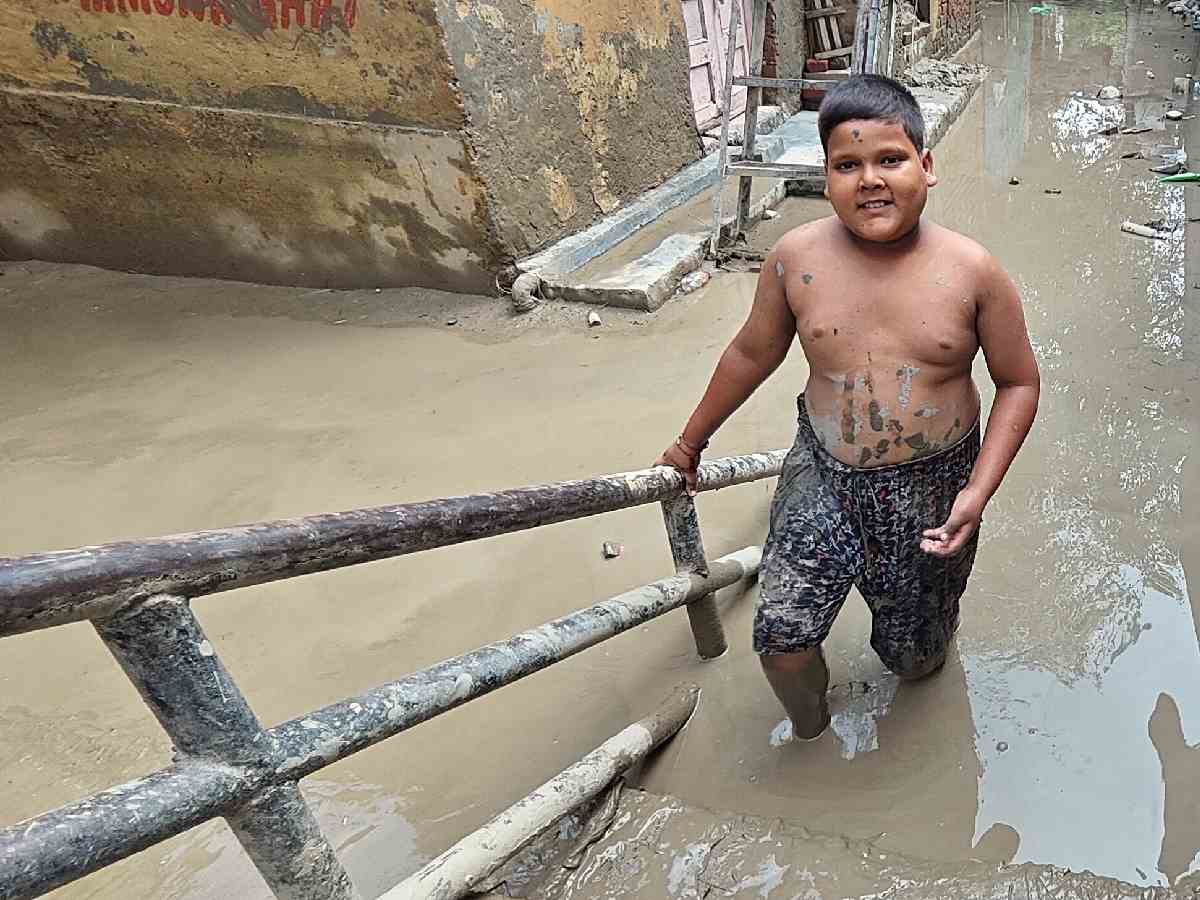
The alleys of Yamuna Bazaar are caked in layers of silt, carrying the sharp smell of damp earth mixed with rot. Inside broken homes, school bags lie hardened with mud, notebooks have swollen into shapeless lumps, and uniforms hang stiff on ropes where families attempt to wash away the filth. Amid this wreckage, children wander barefoot, caught between relief camps and what remains of their homes.
At Yamuna Bazaar’s ghat number 21, twelve-year-old Golu worked with his parents to clear the thick layer of mud from their one-room home. He moved slowly, dragging a battered tin plate through the sludge and piling it outside. What struck him most were the swollen notebooks, torn school uniforms, and a schoolbag hardened by silt.
“How can we go to school now?” Golu asked, pausing to wipe his forehead. “Our uniforms and books are gone. Even our slippers are missing. Everyone talks about school reopening, but how will we study like this?”
The river has not only taken away homes and belongings but has also swept away an entire school year for many children.
A pause in learning
The lanes outside the relief camps are filled with children who should be in classrooms. Instead, they wander aimlessly or sit in groups, trying to pass time.
Nine-year-old Ankush pedalled a small bicycle in circles. He wore a half-dry school shirt, its collar stained brown, paired with loose pyjama bottoms. He had not been to school for seven days. “My clothes are dirty and my mom told me to wear the shirt again until our other clothes get dry,” he said with a shy smile.
The children’s education has come to a pause since their families’ displacement. Adults recall the scramble to escape the floodwaters — most left behind books, uniforms, and other essentials.
Kamlesh, a 62-year-old grandmother, sat on a cot in the camp, watching her grandchildren play in the dust.
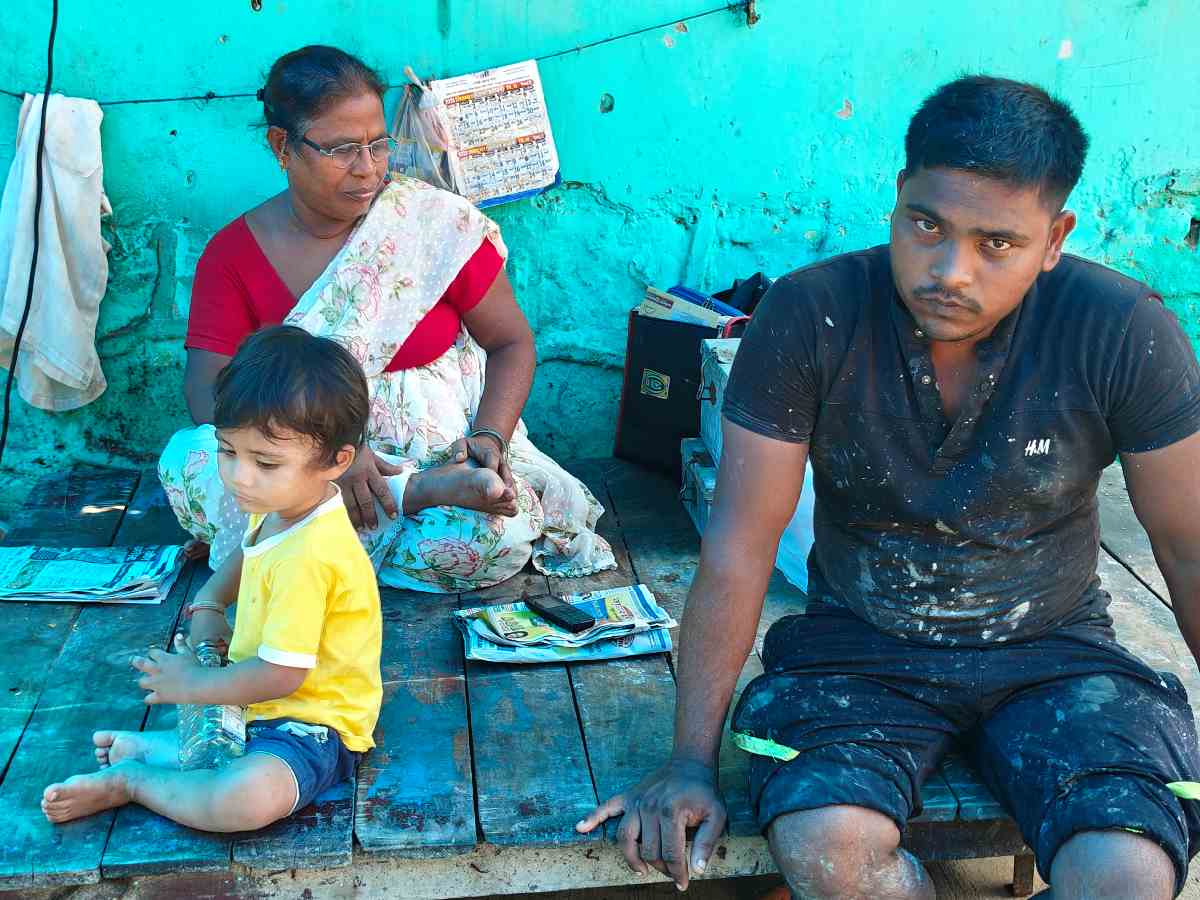
“They have not gone to school since the flood. Their copybooks, pens, and even their identity cards are gone. We only managed to bring them out safely,” she said.
Students speak
At one end of the camp, nineteen-year-old Muskaan held out a bundle of drenched textbooks. Pages clung together, impossible to separate. “All my books are ruined. How will I complete my admission process now? I have already missed my computer classes. The government should do something for us,” she said.
Many students told Patriot about similar fears. Srija, a 20-year-old college student, was blunt: “We lost everything — our books, notes, clothes. Even going to college is impossible when we are stuck here. Our education has stopped.”
Also Read: Yamuna floods leave Delhi residents stranded and struggling
Seventeen-year-old Rukhsar, in Class 11, had managed to save only one textbook. She carefully spread its damp pages on a bedsheet in the sun. “I lost almost all my notebooks and stationery. Who will buy us new ones now, in the middle of the year? I try to copy from friends when possible, but I am already behind,” she said.
Her neighbour Meena, preparing for Class 10 board exams, feared the worst. She explained that her syllabus books and even her uniform had been lost. Without these, she could not attend classes and might be forced to miss her exams.
Parents’ worries
Parents in the camps worry not only about food and shelter but also about their children falling permanently behind in studies.
Ramesh Kumar, a daily wage worker, said his daughter, who studies in Class 9, had missed crucial lessons. “Education is the only way forward for my daughter. If she misses classes and exams now, her whole year will be wasted. I can take a loan for food, but how can I buy new books and uniforms?”
The uncertainty is heavy. “We worked hard so our children could study. Now they sit idle in the camp,” said Preeti, a mother of three. “Even when teachers send homework on WhatsApp, the children cannot do it without notebooks.”
Sickness in the camps
As days pass in crowded tents, illnesses have begun spreading among children. Many parents spoke of fever, coughs, and stomach problems.
Nine-year-old Tanya lay wrapped in a blanket, too weak to join her friends. Her mother said she had been sick since wading through the dirty floodwaters. “She has missed her school tests. How will she catch up now?” the mother asked.
Another father, Shiv Kumar, said two of his sons were unwell. “They have fever and rashes from the water. Even if schools open tomorrow, how can they attend when they are sick?” he said, holding a strip of tablets he had managed to buy.
Across the Yamuna Khadar, families displaced by the floods echoed the same concerns. Seema, a mother of three children aged six to thirteen, described nights without shelter. “We are sleeping under plastic sheets. When it rains, the children stay awake shivering. How can they focus on studies when they don’t even get proper sleep?” she said.
For many families, health problems have compounded the disruption to education, leaving children doubly vulnerable.
Fear of the future
The sight of children in half-dry uniforms, using torn notebooks, and spending afternoons in idle play speaks of a generation at risk of falling through the cracks. Parents are most fearful of the long-term damage.
“If my daughter misses her Class 10 board exams, it will ruin her future,” said Meena’s mother. “We may rebuild the house slowly, but we cannot rebuild her lost year.”
Children too seem aware of what is at stake. Sitting outside his mud-soaked home, Rohan turned the brittle pages of a ruined textbook. “I want to become a teacher one day,” he said. “But how will I study without books?”
Everywhere in the camps, the struggle repeats itself — students spreading wet pages in the sun, parents making mental calculations they cannot afford, and children growing restless as days slip by.
Unlike houses and shops, education has no compensation, no visible measure of loss. It is quietly suspended, at risk of being abandoned altogether.
A call for urgent action
Gopal Jha, Secretary of the Yamuna Bazaar Residents’ Welfare Association, said children’s futures were now at risk.
“The biggest loss here is the children’s education,” Jha told Patriot. He explained that when the floods came, the water rose eight feet inside houses. Families shifted to the Mori Gate relief camp, but from there the school was too far, forcing many children to drop out temporarily. Even now, three to four feet of silt still lies in homes. “How can children return to school in this situation?” he asked.
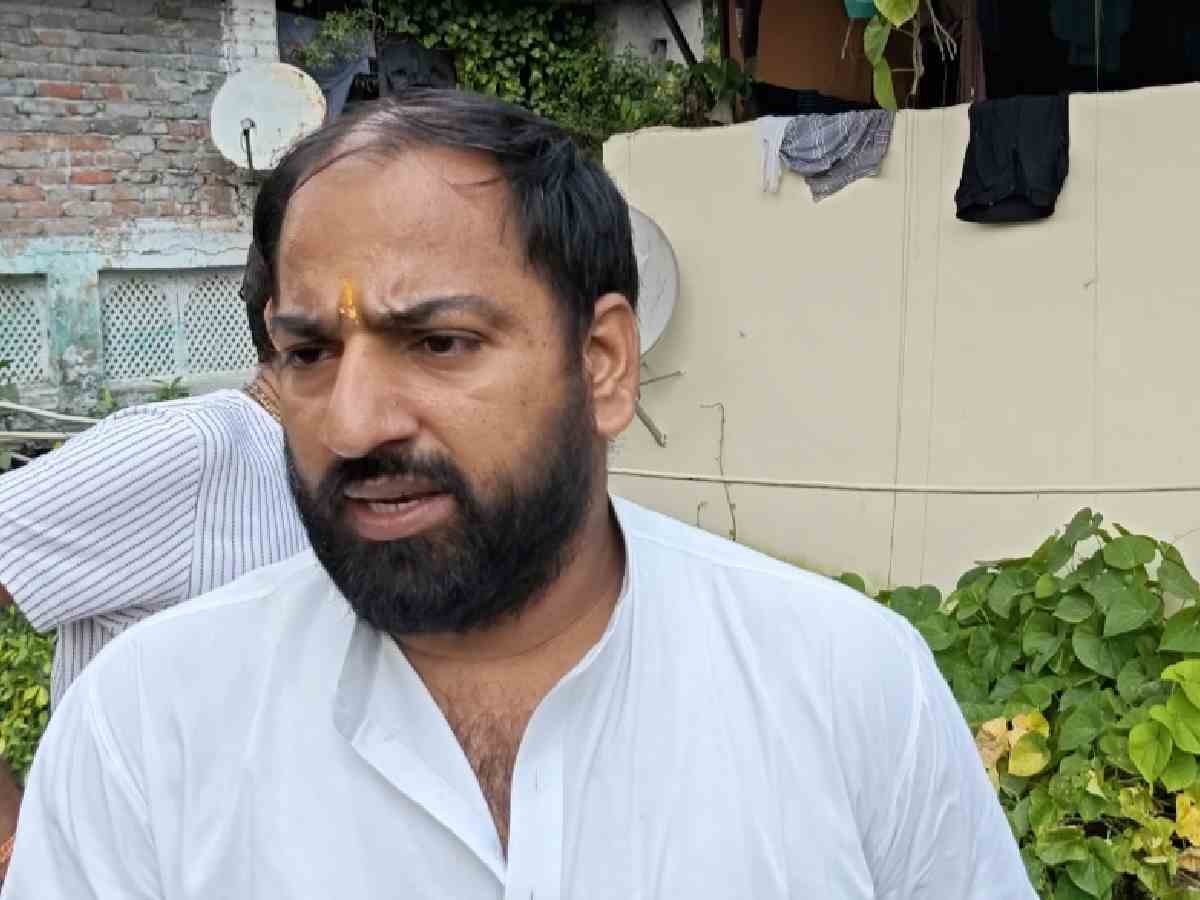
According to him, almost all notebooks and textbooks were destroyed. “The kids could not save their belongings. Their books are ruined, their uniforms gone. Parents are still dependent on outside food, so how will they think about education? My appeal is simple: the banks must be cleared of soil first, and children should be given school supplies. Without that, how can they continue?”
He added that commuting from the camps was impossible for many. “From here to school, a child would have to spend nearly Rs 200 on travel. Poor families cannot afford that. Children are already exposed to mosquitoes, malaria, dengue, even fungal infections. That is why we need both an education camp and a health camp inside the relief centres. Without this, children will remain stuck for weeks.”