
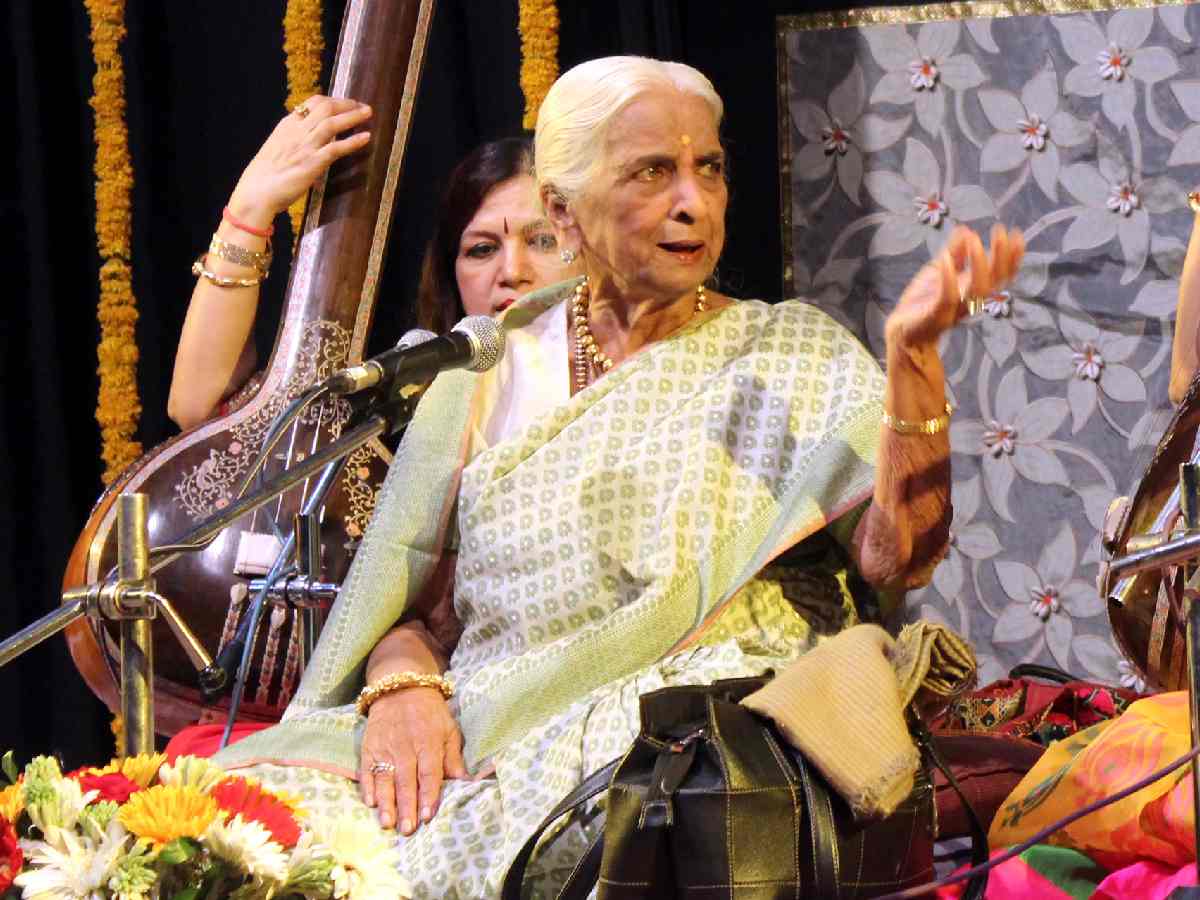
Two memorial concerts in Delhi and Banaras this week have brought renewed attention to the vast musical legacy of Vidushi Girija Devi, one of the most influential voices in Hindustani classical music.
In Delhi, at Kamani auditorium, vocalist Sunanda Sharma held a tribute on May 7, featuring sitarist Purbayan Chatterji and Thumri exponent Shubha Mudgal. In Banaras, Malini Awasthi continues her annual tribute on May 8 — Girija Devi’s birth anniversary — now held on a barge on the Ganga.
Far-reaching influence
A recent concert in the Capital by a sitar player from Kolkata also served as a reminder of her far-reaching influence. Samanvay Sarkar, who had trained under several eminent sitar maestros, became a disciple of Girija Devi in 2008 and remained so until her passing in 2017. Along with fellow disciple Debapriya Adhikari, he has also worked on a film on her life, titled ‘Girija – a life in music’.
It is rare, though not unknown, for instrumentalists to learn from vocalist gurus; violinist Kala Ramnath from Pt Jasraj and violinist Milind Raikar from Vidushi Kishori Amonkar come to mind. But the calibre of the vocalist has to be exceptional for this to happen.
Girija Devi was indeed such a musician. From being a Banaras gharana exponent in the 1950s, she flowered into the definitive Thumri icon of our times. Deeply loved by her contemporaries, she was regarded as a family member by many, including Ustad Amjad Ali Khan and Pt Birju Maharaj. At a celebration of her 80th birthday in Banaras, both icons collaborated with her on stage in remarkably informal and unique concerts.
Performer for 7 decades
Girija Devi remained an active performer for more than seven decades; she shaped the perception of Thumri for more than one generation of listeners. Ever open and receptive, she had a vast repertoire of compositions from across traditions, not confined to her immediate lineage. The importance she gave to lyrics was significant, as was the emotional appeal of her music. Equally important was her personality and her connection with audiences, which earned her the title of the ‘Queen of Thumri’.
Speaking about the book he wrote on her life, ‘Girija: A Journey through Thumri’, Yatindra Mishra said, “I was only 22 years old when I wrote this book, my first on music, incidentally. She inspired me hugely. I first met her in 1997 in Banaras, at her home in Nati Imli. Thereafter, she became like a family member and visited our home in Ayodhya annually. In fact, the recipient of the annual Vimla Devi Award, instituted in my grandmother’s name, was always selected in consultation with her. I was lucky to have heard rare musical forms, including ‘gul’, ‘baith’, ‘dharu’ and ‘naqsh’, which she never sang in public.”
Prolific teacher
A prolific teacher, Girija Devi taught over 100 musicians, ranging from the late Bimla Poddar to Vidushi Manju Sundaram and Vidushi Dhalia Raut. Several disciples today continue to carry her music forward, including Malini Awasthi and Sunanda Sharma.
Malini Awasthi said, “There are so many disciples of Appaji (as Girija Devi was affectionately known) across cities around the world; she had such warmth and magnetism that anyone who once came into her orbit never left her.”
Influence beyond music
Her teaching extended beyond music. Malini recalls learning the importance of respecting the tradition in its entirety. Appaji would insist that younger disciples touch the feet of elder ones — a gesture of reverence not just for individuals but for the art itself. Accompanying her on stage also taught students how to respond to different audiences. Malini, who was passionate about folk traditions, was encouraged by her guru to embrace them rather than view them as secondary, and was taught several rare compositions.
Sunanda Sharma, from Himachal Pradesh, began learning from Appaji in 1991. Remarkably, Girija Devi herself invited her to become a disciple after hearing her perform at the Harivallabh Sangeet Samaroh in Jalandhar, saying, “I really want to train a fine Punjabi voice.”
Also Read: Khan Market: stories behind a landmark
Sunanda lived in her guru’s home in Banaras for years. Even after her marriage in 2009, she chose not to move to Norway with her husband, recalling Appaji’s advice: “Whatever ups and downs you face in life, don’t give up music. This is your calling.”
Today, through concerts, disciples, and ongoing reinterpretations, Girija Devi’s legacy continues to resonate — not just as memory, but as a living tradition.