Once celebrated as the world’s second most bird-rich capital city after Nairobi, Delhi is quietly losing that distinction. The mornings that once belonged to birdsong now belong increasingly to traffic. Wetlands that once drew thousands of migratory birds are shrinking under concrete and sewage. What is happening to Delhi’s birds is no longer a gradual ecological shift — it is a measurable decline documented across multiple studies and bird censuses. Data from recent years suggest that the trend is continuing.
A city for birds
Delhi’s geography was, for centuries, a gift to wildlife. The Yamuna River defined its eastern edge, while the Delhi Ridge ran north to south through the city’s heart. Wetlands spread westward into Haryana, and the floodplains fed into the Central Asian Flyway — one of the world’s major migratory bird routes connecting the Arctic to the Indian Ocean. Over 90% of bird species using this flyway depend on Indian wetlands as stopover points.
The Delhi bird checklist, compiled by ornithologist Sudhir Vyas in his 2019 annotated checklist published in Indian BIRDS Monograph 1, records 457 bird species — residents, seasonal breeders, and winter migrants arriving from Central Asia and Siberia. Another 27 species have not been recorded since 1970 and are considered historically lost from the region.
Declining numbers
The State of India’s Birds report, released in August 2023, assessed 338 species across the country for long-term population change. Around 60% showed a declining trend.
For Delhi specifically, three species recorded sharp declines: the Common Babbler fell by 81% over 30 years, the White-browed Wagtail by 85%, and the Brown Rock Chat by 65%.
“The number of insectivorous birds is declining in Delhi due to the overall decline in insect populations. Though there is no comprehensive data, anecdotal evidence strongly points to this,” said conservationist Sohail Madan, who contributed to the report.
At Okhla Bird Sanctuary, bird counts from recent years reveal similar trends. Great Cormorant numbers dropped from 475 in 2016 to 350 in 2018. Northern Shovellers declined from 96 in 2016 to 18 in 2017, before falling to three in 2018. Common Pochards fell from 77 to two, while Gadwall numbers dropped from 142 to three.
According to ecologist and environmentalist TK Roy, the annual Big Bird Day count across Delhi-NCR recorded 268 species in 2017 and 238 in 2018. The summer bird count similarly fell from 195 species in 2017 to 174 in 2018.
Decline of the Yamuna
In its natural state, the Yamuna’s seasonal flood cycles deposited sandy islands where River Terns, Indian Skimmers, Black-bellied Terns, and pratincoles nested in colonies. Migratory waders gathered on exposed sandbanks as summer advanced.
The construction of barrages during the 1980s and 1990s drastically altered these ecological conditions. Reduced river flow and increasing pollution transformed large stretches of the Yamuna passing through Delhi into stagnant channels heavily affected by sewage and industrial discharge.
“The nesting colonies of terns, skimmers, pratincoles, and other birds that earlier enlivened the river are gone,” Vyas wrote.
Two nesting sites of the Pallas’ Fish Eagle, once documented along the Yamuna within Delhi, no longer exist.
The Asian Waterbird Census 2018 recorded a sharp decline in waterbird populations along the Yamuna floodplains — from 2,640 birds in 2017 to 594 in 2018 — with pollution, human interference, and climate disruption identified among the major causes.
Wetlands under pressure
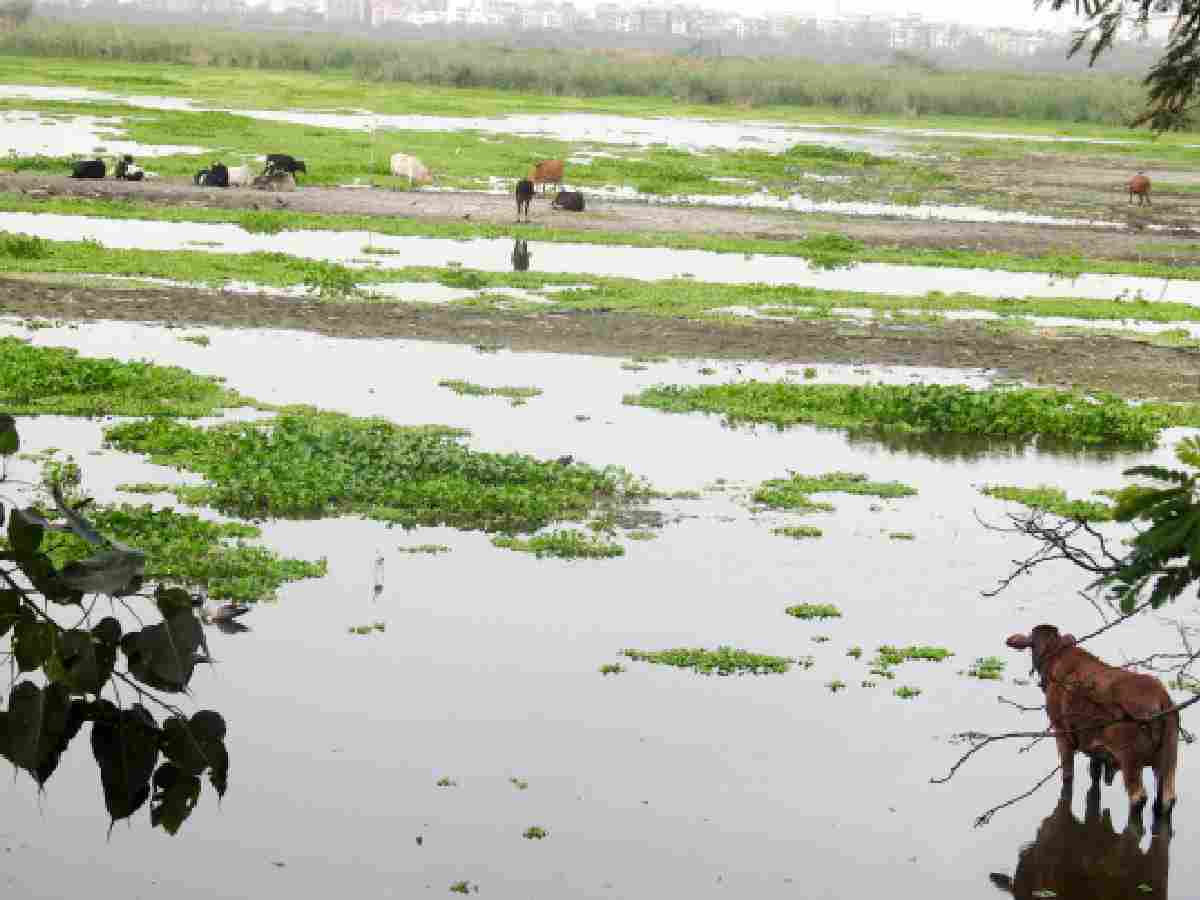
Between 1970 and 2014, Delhi and the National Capital Region lost 38% of their wetlands to encroachment, construction, and pollution, according to Wetlands International South Asia.
The IUCN Red List currently places 180 Indian bird species in threatened categories, up from 173 the previous year.
In parts of the Yamuna, aquatic plants such as Hydrilla and Vallisneria — important food sources for waterfowl — have disappeared.
A 2021 study on winter birds in Delhi’s ponds found that 37% of the city’s known bird diversity was recorded in water bodies smaller than five hectares.
Researchers mapped 574 wetlands through satellite imagery and surveyed 39 of them, documenting more than 170 bird species.
“Even though ponds formed only 0.5% of Delhi’s area, we recorded more than 170 bird species — one of the highest known diversities of any urban wetland system,” said KS Gopi Sundar of the Nature Conservation Foundation.
Between 30% and 40% of those birds were migratory species using Delhi’s ponds as stopover sites along the Central Asian Flyway.
These smaller water bodies are also among the most vulnerable to encroachment and dumping.
“Marshlands are being encroached upon rapidly by infrastructure projects. The Steppe Eagle’s food sources are depleting. Diclofenac use is severely impacting raptors,” said Faiyaz A Khudsar, scientist-in-charge at Yamuna Biodiversity Park.
The Wetland Authority of Delhi has listed 1,043 wetlands and has been working towards formally notifying them under the Wetland Protection Rules, 2017, which would provide legal safeguards against encroachment and dumping.
Ridge fragmentation
Delhi’s Ridge — the northernmost extension of the Aravalli Range — once functioned as a continuous wildlife corridor linking the city’s scrub forests to the larger Aravalli ecosystem.
Today, it stands fragmented into isolated sections separated by roads, urban expansion, and construction.
The invasive species Prosopis juliflora, introduced during earlier afforestation drives, has displaced much of the native vegetation on which several bird species depended.
Of Delhi’s 194 known breeding bird species, 19 now show declining trends.
The White-rumped Vulture is considered locally extinct. Tawny Eagles, once known to breed within city limits, are now rarely seen. Laggar Falcons — once described as among the most common resident falcons in India — have nearly disappeared from the region.
Indian Nuthatches and Indian Spotted Creepers are also believed to have vanished locally.
The House Sparrow, once ubiquitous across Delhi neighbourhoods, is now declining within the city.
Experts attribute this to a combination of habitat loss, disappearing nesting spaces, reduced insect populations, and changing urban infrastructure.
Professor R Prabhakar Rao, Principal of Zakir Husain Delhi College, Delhi University, said the disappearance of common urban bird species reflects broader ecological deterioration that ultimately affects human well-being too.
Census warnings
The Asian Waterbird Census 2026, conducted by Wetlands International in January along Delhi’s Yamuna stretch, recorded 20 waterbird species with a total population of 1,564 birds — down from 2,123 in 2025 and 2,037 in 2024
Black-headed Gulls numbered 1,275, compared to 1,636 the previous year. Great Cormorants stood at 63. Winter migratory ducks were represented by a single flock of 16 Gadwall.
Resident bird species also declined, including Black-winged Stilts, Red-wattled Lapwings, Grey Herons, and Little Cormorants.
The near-threatened River Lapwing was recorded only twice along the entire 22-km stretch of the Yamuna passing through Delhi.
“Gulls cannot remain for long in degraded and polluted riverine habitats because of the lack of food and therefore keep moving elsewhere,” said Roy, who is also the Delhi co-ordinator of the Asian Waterbird Census.
The census, conducted simultaneously across 27 countries, found Delhi’s Yamuna among the more depleted waterbird habitats along the Central Asian Flyway.
The way forward
Conservationists say the solutions are well known, even if implementation remains difficult.
The Yamuna requires ecological flow regimes that allow natural flooding and help restore sandbanks used by nesting birds. Wetlands require stronger legal protection and active restoration. The Ridge needs invasive species management and the revival of native vegetation.
Urban planners, researchers argue, must begin treating water bodies and ecological spaces as critical infrastructure rather than obstacles to development.
“It may not be possible for urban planners to create entirely new green spaces,” said researcher Monica Kaushik, “but it is certainly possible to manage existing wetlands and green areas in ways that support greater biodiversity.”