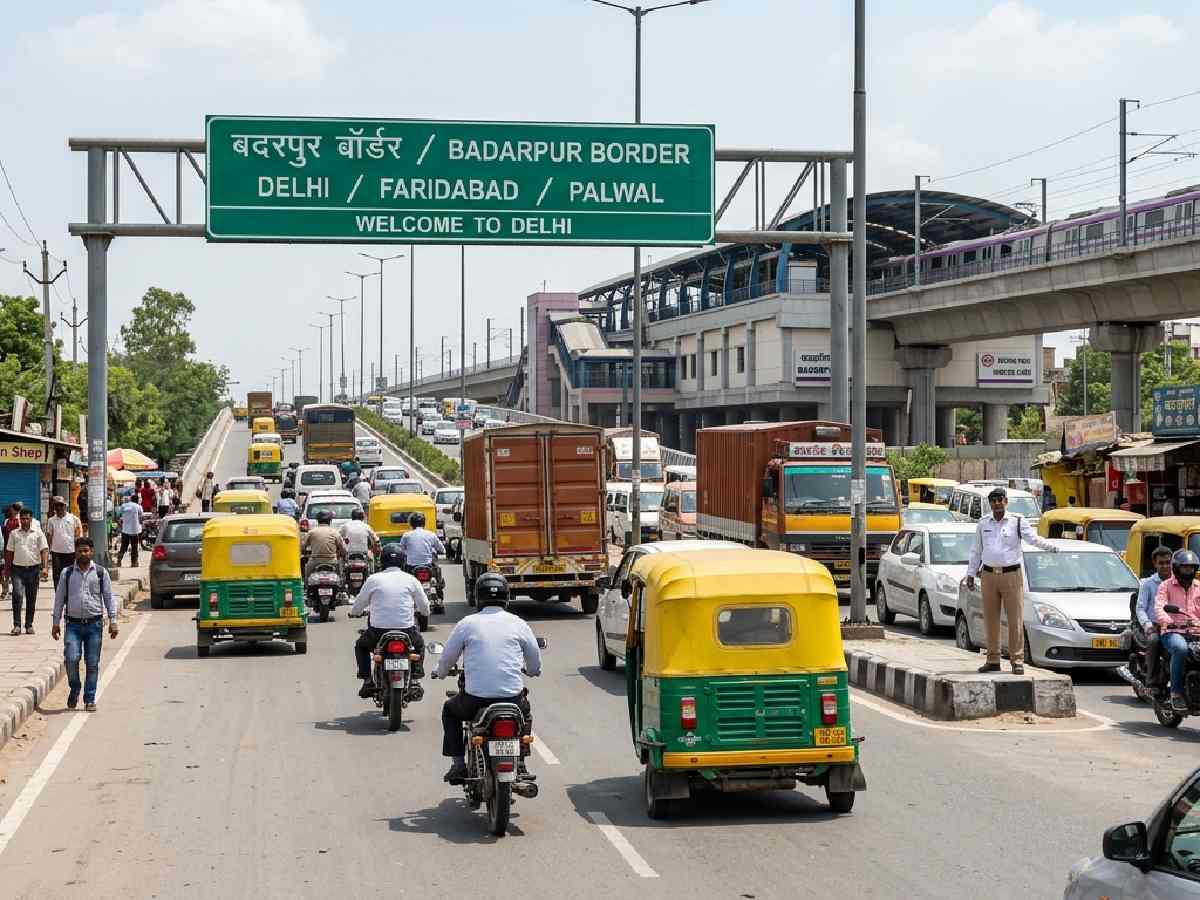
At the Badarpur border, the road into Delhi carries more than traffic. It carries people heading to construction sites, homes where they work as domestic help, shops, offices and delivery points across the city.
For many of them, the vehicle they arrive in is not a luxury. It makes their workday possible.
That routine could change from November 1, when Delhi is set to restrict the entry of petrol and diesel vehicles registered outside the Capital that do not meet the required BS-VI emission standard.
The move is part of the city’s winter pollution-control measures. But at the southern edge of Delhi, where the distinction between the national capital and its neighbouring cities is mostly invisible to commuters, the rule raises concerns over what people who cannot bring their older vehicles into Delhi will use instead and how much the change will cost them.
Also Read: The Ashok: seven decades of Indian hospitality
For some, the answer could be a Metro ride. For others, it could mean a bus, an e-rickshaw and another connection. For workers carrying equipment or travelling to several locations during the day, there may be no simple replacement.
The difference could be measured not only in rupees but also in hours.
Vehicle as the workplace
Ramesh Kumar, 42, lives in Faridabad and works at construction sites across South Delhi. His old diesel van carries drilling equipment, tools and other material. He says leaving the vehicle outside Delhi and continuing by public transport is practically impossible.
“My vehicle is part of my work. I cannot carry everything in the Metro,” he says. Kumar estimates that he currently spends around Rs 250 a day on diesel when travelling for work. The cost varies according to the number of sites he visits.
Replacing the vehicle would be a much larger expense. A newer one, he says, would require a substantial down payment followed by monthly instalments.
“I can manage fuel because I earn according to the work I get. But a fixed EMI every month is different. Even if there is no work for ten days, the EMI does not stop.”
His problem is different from that of a commuter who needs to get from home to an office. For him, the vehicle is an income-generating asset.
Also Read: Before the lights: two Diwalis Delhi can never forget
When time is cost
For Sunita Devi in Jaitpur, the problem is slightly different.
The 36-year-old domestic worker travels to several houses in South Delhi, and uses an older scooter because her workplaces are spread across different neighbourhoods.
Her first house is usually followed by another several kilometres away. “If I have to depend completely on buses, I will lose time between houses,” she says.
At present, she estimates that fuel costs her roughly Rs 70-90 a day. A switch to public transport could involve a combination of bus, Metro and e-rickshaw. Depending on her destinations, she estimates the daily cost could rise to around Rs 120-150.
Also Read: CPCB flags high pollution at Sahibabad, Shahdara drains
The amount may not appear large in isolation. But over 26 working days, an additional Rs 50 a day would mean roughly Rs 1,300 a month. For a household already managing rent, food and school expenses, that is not an insignificant amount.
“I cannot simply increase my salary because my travel has become expensive,” she says.
The other cost is time.
“If I arrive late, the people I work for will not wait. I could lose a job, perhaps a house.”
Essential arithmetic
For many commuters, the question is not whether public transport exists. It is whether it can replace their existing journey at a manageable cost.
Consider a worker currently spending Rs 80 a day on fuel. If that person shifts to public transport and spends Rs 50 on Metro and bus fares, the monetary cost might initially appear lower. But the calculation changes when you add last-mile transport. A Rs 30 e-rickshaw ride at either end can take the daily cost beyond Rs 100. If the worker has to make multiple trips during the day, the expense rises further.
Also Read: Where do we belong?’: Delhi tenants worry over SIR deletions
A direct motorcycle journey from Faridabad to South Delhi may take less than an hour outside peak congestion. A combination of public transport modes could take considerably longer. For workers paid by the day, or those with multiple employers, that additional travel time can have an economic value of its own.
Gig workers
At Jaitpur, Mohammed Imran, 29, works as a delivery agent. His motorcycle is his primary tool for work.
“I don’t only use it to come into Delhi. I use it throughout the day. If I leave it outside the border, I cannot do the same work,” he says. For Imran, public transport is therefore not a substitute.
His alternative would be to purchase a newer motorcycle that meets the required standard. But the cost of replacing an old vehicle is precisely what worries him. He estimates that financing a new motorcycle could mean a monthly instalment of several thousand rupees.
Also Read: 24 hours, no more: the rules on police detention
“My income changes every month. Some months are good, and some are bad. A loan does not work like that.” He says he would rather spend more on fuel than take on another financial commitment.
The restriction therefore creates a problem not immediately visible in a pollution-control notification: upgrading costs much more for someone already living close to the edge of their monthly budget.
Situation at border
The physical border could become an important part of the new system. A commuter arriving in a restricted vehicle may have to leave it outside Delhi and continue by another mode.
For someone travelling from Faridabad to a workplace in Okhla, leaving a vehicle at Badarpur may make sense only if the onward journey is convenient. For someone travelling further into Delhi, it may add another connection and another expense.
Anil Verma, who lives near Jaitpur, says the government needs to think beyond enforcement.
“If you stop the vehicle at the border but don’t provide a convenient alternative, the problem simply moves from one place to another,” he says. He supports restrictions on highly polluting vehicles but believes commuters need time and options to adjust.
Beyond reach
The most obvious solution to the restriction is also the least accessible to some commuters: replacing an old vehicle with a newer one. For a salaried professional, that might mean selling the existing car and financing another. For a domestic worker or construction worker, it can mean taking on debt.
The difference matters because Delhi’s borders bring together people with very different incomes.
Also Read: Acid available freely in Delhi despite curbs, reveal ground visits
A commuter driving an older car may be doing so because it is the only vehicle they can afford. A worker using a 15-year-old scooter may have already paid it off and rely on it because it has minimal monthly costs.
Replacing it reverses that equation.
Public transport question
Delhi’s pollution strategy increasingly relies on shifting people away from private vehicles. But for that strategy to work for border commuters, public transport has to function as a genuine alternative, not merely a paper option.
That means adequate buses, reliable Metro connectivity, affordable last-mile transport and reasonable travel times. For gig workers with fixed shifts, service frequency can be as important as the fare. For women travelling early or late, safety can also influence whether a particular route is practical. For workers carrying goods or equipment, public transport may not be suitable.
These differences mean that there is no single answer to what commuters will do after November. Some will change vehicles. Some will shift to public transport. Some may share rides. Others may pay more for the same journey.
For people crossing Delhi’s southern border every day, the real test of the new rule may therefore not be how many older vehicles are kept out. It may be whether the people inside those vehicles have an affordable way to get in.