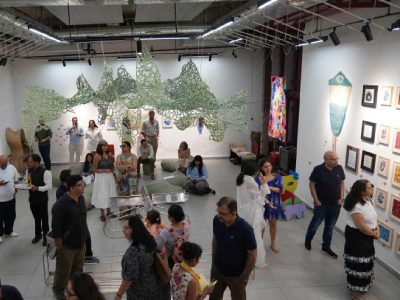
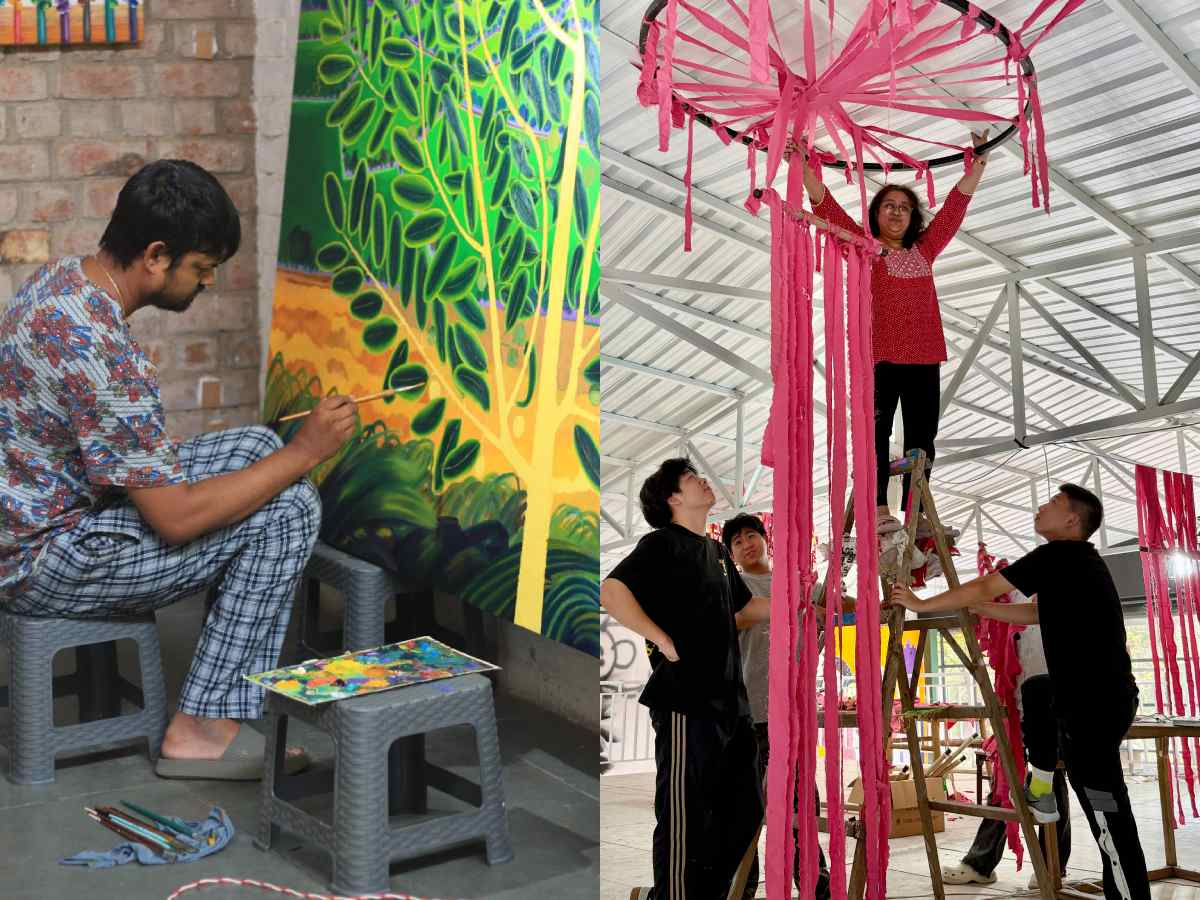
As one steps into Eikowa Contemporary in Gurgaon, Wild Grass unfolds not as a nostalgic return to the village, but as a layered inquiry into its present condition. Curated by Yash Vikram, the exhibition brings together Bhuri Bai, Hiren Patel, Mukesh Sah, Vaishali Oak, and Xewali Deka—artists whose practices are deeply embedded in lived rural realities, yet attuned to the complexities of a rapidly transforming India.
Set within a landscape shaped by migration and infrastructural ambition, the exhibition positions the village not as a relic of the past but as an active site of negotiation—where memory, labour, ecology, and aspiration intersect.
Beyond nostalgia and deficit
For decades, the idea of the rural in India has oscillated between extremes—either romanticised as a site of purity and harmony or dismissed as regressive and in need of reform. Wild Grass deliberately unsettles these binaries. Instead of presenting the village as something lost or lagging behind, it foregrounds it as a space undergoing constant redefinition.
“The exhibition resists the tendency to simplify the rural,” curator Yash Vikram said. “What we are witnessing today is not disappearance but transformation. Villages are absorbing the pressures of digitalisation, migration, and environmental change, and in doing so, they are reshaping themselves.”
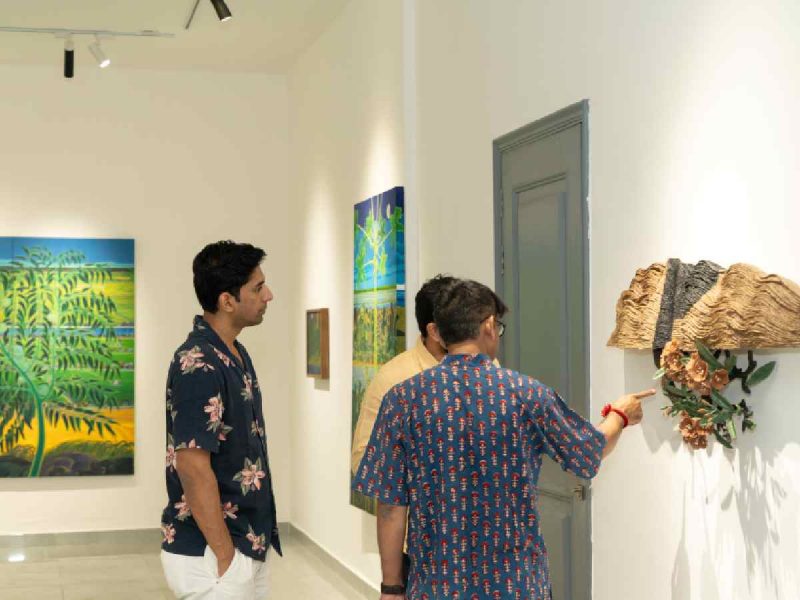
This framework allows the works to move beyond representation into reflection—each artist engaging with the rural as a lived, evolving condition rather than a fixed identity.
Practices rooted in lived experience
At the heart of Wild Grass lies a commitment to lived experience. Each artist brings a distinct vocabulary shaped by geography, community, and personal history.
Bhuri Bai, widely recognised as a pioneering Bhil artist, presents works that bridge tradition and innovation. Having been the first woman from her community to translate Pithora wall paintings onto paper and canvas, her practice represents both continuity and rupture. Her vivid compositions—often populated with animals, deities, and scenes from everyday life—carry an immediacy that is both intimate and expansive.
“I paint what I have seen, what I remember,” Bhuri Bai said. “The village is always with me—its stories, its rhythms, its people. Even when the world changes, those memories remain alive in my work.”
Her journey—from painting mud walls in her village to exhibiting internationally—mirrors the broader trajectory of rural art entering global contemporary discourse, without losing its rootedness.
Hiren Patel, whose practice is grounded in the agricultural landscapes of South Gujarat, approaches the rural through the lens of farming. His works reflect the tensions embedded within contemporary agricultural practices—where traditional knowledge intersects with mechanisation, and ecological concerns collide with economic pressures.
“There is a paradox in farming today,” Patel explained. “On one hand, there is deep-rooted knowledge passed down through generations. On the other, there is a push towards modernisation that often disrupts that balance. My work tries to hold both these realities together.”
Through layered imagery and printmaking techniques, Patel captures the uncertainty and resilience that define rural livelihoods today.
Mukesh Sah’s work, meanwhile, draws from the mountainous terrain of Uttarakhand. Having grown up amidst forests and rivers, his practice is shaped by an acute sensitivity to landscape. His shift from a career in media to full-time art-making reflects a desire to engage more deeply with these formative environments.
“The Himalayas are not just where I come from—they are central to how I see the world,” Sah said. “The relationship between people and landscape, especially in rural areas, is deeply interdependent. That connection is something I try to explore in my work.”
His works often evoke the fragility of these ecosystems, highlighting how environmental change is altering both physical and cultural landscapes.
Material, memory, and the body
For Vaishali Oak and Xewali Deka, material becomes a critical site through which rural narratives are articulated.
Oak’s practice, rooted in textile, challenges conventional distinctions between craft and fine art. Trained as a painter, she approaches fabric as a surface capable of holding depth, texture, and memory. Her layered compositions evoke both personal histories and broader cultural traditions.
“Textile is deeply connected to everyday life,” Oak noted. “It carries traces of labour, of touch, of time. In many ways, it becomes a repository of memory.”
Her work reflects the often-overlooked labour embedded in textile practices, particularly those associated with women, while also situating them within contemporary artistic discourse.
Xewali Deka’s interdisciplinary practice operates at the intersection of art and agriculture. As both artist and farmer, her engagement with rural life is direct and ongoing. Her works often incorporate elements of land, labour, and collective memory, blurring the boundaries between lived experience and artistic expression.
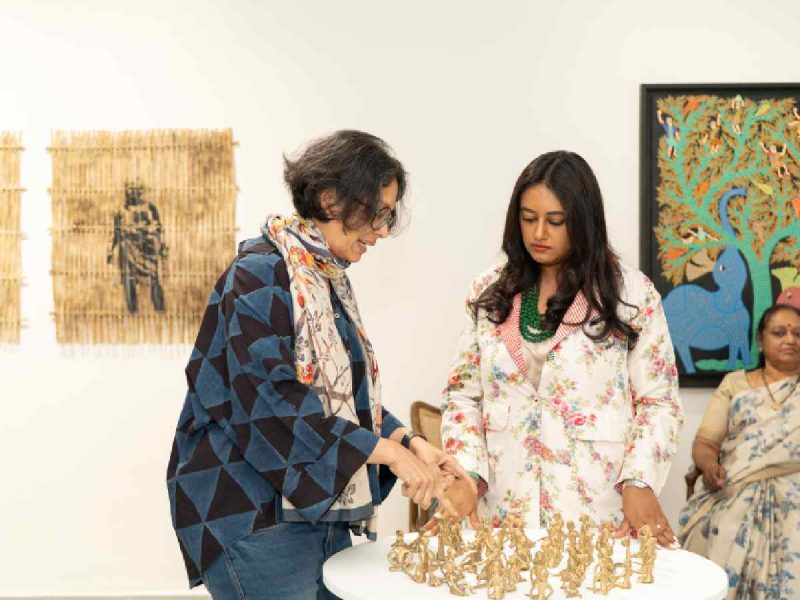
“For me, farming and art are intertwined,” Deka said. “They are both processes of care, of observation, and of responding to the land. My work emerges from that relationship.”
Her perspective introduces a critical dimension to the exhibition—foregrounding labour not merely as a theme but as an embodied practice.
A landscape shaped by movement
Across the exhibition, the rural emerges as a space defined by movement. Migration, in particular, plays a crucial role in reshaping village life—altering social structures, economic patterns, and cultural identities.
“The village today cannot be understood in isolation,” Vikram said. “It is deeply connected to the city through flows of labour, capital, and aspiration. That movement creates both opportunities and tensions.”
Climate change further complicates this landscape. Shifting weather patterns, water scarcity, and environmental degradation are not abstract concerns but lived realities for many rural communities. The works in Wild Grass subtly reflect these pressures—through imagery, material choices, and thematic concerns.
At the same time, the exhibition acknowledges the role of digitalisation and infrastructure in redefining rural spaces. Access to technology, new forms of communication, and evolving economic opportunities are transforming how villages are perceived and experienced.
Between continuity and change
What makes Wild Grass particularly compelling is its refusal to offer a singular narrative. Instead, it presents the rural as a site where continuity and change coexist. Traditional practices persist even as new ones emerge; memory remains even as landscapes transform.
“There is no one way to define the rural today,” Vikram noted. “It is made up of multiple, often contradictory realities. The exhibition embraces that complexity rather than trying to resolve it.”
This multiplicity is evident in the works themselves. Bhuri Bai’s vibrant compositions speak of continuity and cultural memory, while Patel’s prints highlight tension and transition. Sah’s landscapes evoke fragility, Oak’s textiles embody memory, and Deka’s practice foregrounds labour and ecology.
Together, they form a constellation of perspectives that resist easy categorisation.
An invitation to reflect
Rather than presenting definitive conclusions, Wild Grass invites viewers into a process of reflection. It asks them to reconsider their own assumptions about the village and to engage with it as a dynamic, evolving entity.
“We hope the exhibition opens up new ways of thinking about the rural,” Vikram said. “Not as something distant or static, but as something deeply connected to our present and future.”
In doing so, the exhibition also gestures towards broader questions—about sustainability, identity, and the relationship between humans and their environments.
As India continues to urbanise at an unprecedented pace, these questions become increasingly urgent. Wild Grass suggests that the answers may not lie in looking forward alone, but in understanding the complex, shifting realities of the rural.
An evolving discourse
Eikowa Contemporary’s exhibition arrives at a moment when Indian contemporary art is increasingly engaging with questions of place, identity, and ecology. By foregrounding artists whose practices are rooted in rural experience, Wild Grass contributes to this evolving discourse.
“The exhibition is as much about listening as it is about seeing,” Vikram added. “It asks us to pay attention—to the stories, the materials, and the lives that shape these works.”
In that sense, Wild Grass is not merely an exhibition but a conversation—one that continues beyond the gallery space. It invites viewers to recognise the rural not as a peripheral presence, but as central to understanding contemporary India.
The exhibition is on view at Eikowa Contemporary, Gurgaon, and will run until April 18, 2026.