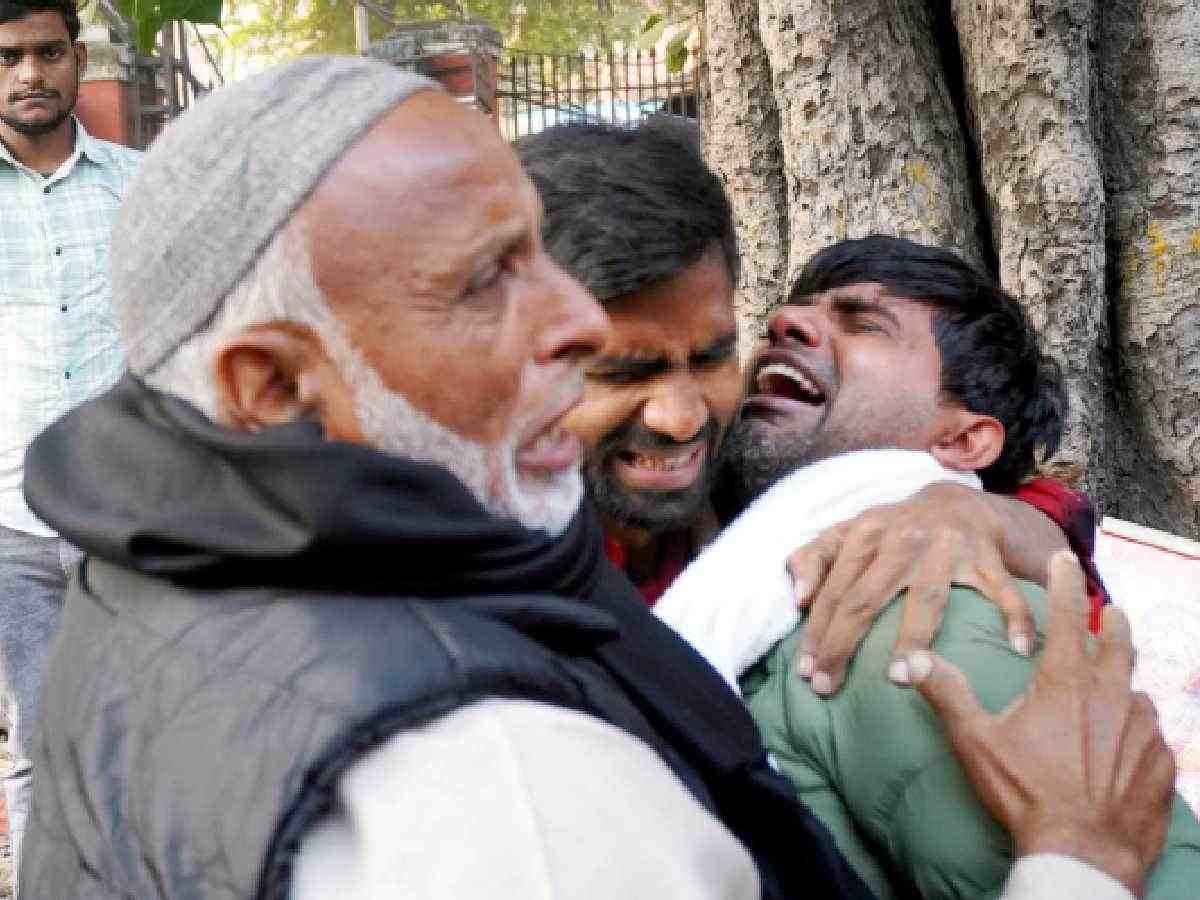
Standing outside the mortuary at Maulana Azad Medical College, families of the Red Fort bomb blast victims remained in a state of shock and terror. The sight of bodies covered in white sheets hit them like a punch in the gut.
Furkan, a resident of Shamli and uncle of one of the victims, Noman, stood in disbelief as he recounted the chain of events that led to his nephew’s death. Noman owned a small cosmetics shop in his hometown and had travelled to Delhi the previous day to purchase supplies for his business.
“He went to the market and never came back,” Furkan said quietly. “We received a call saying he had met with an accident. When we rushed to the hospital, we found his body lying there. It was unbearable.”
His voice hardened as he demanded accountability. “We want strict action against those responsible for this tragedy.”
For Noman’s family, the loss is devastating not only emotionally but also economically. “He was the only breadwinner,” Furkan said. “His younger brother, around twenty-two, suffers from acute kidney disease and cannot work. He also leaves behind four sisters and our ageing parents. How will they survive now? The entire family is shattered. Everything is finished.”
Torn between loss and anger
Mohsin’s family from Meerut is also grieving. His mother, Sajeeda, could hardly speak through her tears. “I want justice for my son,” she said. “He has small children who are still studying. Now, who will take care of them? Who will ensure they can continue their education?”
Also Read: Delhi Red Fort blast: eyewitnesses recount scene of horror
Mohsin’s brother provided a grim account of that night. “We found out around 1.30 or 2 in the morning that there had been a blast,” he said. “When we reached the site, his body was lying there, but we weren’t allowed to go inside. It was unbearable to stand outside and not be able to touch him.
“He had two children—one eight years old and the other twelve. He used to drive an e-rickshaw. He worked hard every day to feed his family. We want justice for him; he didn’t deserve to die like this.”
From Amroha, grief gripped the family of Ashok. His sister Bhuri, struggling to catch her breath between sobs, spoke about her brother’s life and the void his death has left behind. “He was my brother,” she said. “He had just finished his duty and was returning home when this happened. He has three children—two daughters and one son. How will my sister-in-law raise them alone?”
Her grief quickly turned into anger. “Terrorists did this. They must be punished. My brother’s children must not suffer like this.”
Bhuri pleaded for government assistance for her brother’s family. “His wife is completely broken,” she said. “The government must help them so the children’s future does not get destroyed. They need support; otherwise, everything he worked for will be lost.”
Lives cut short
The Amroha-based family of Lokesh Agarwal was also trying to come to terms with the death of their elder son. His younger brother, Sonu, said, “He had gone to Delhi to visit his son’s mother-in-law, who was admitted to Sir Ganga Ram Hospital. After visiting her, he went near Lal Quila Metro Station, where the blast happened.”
When the family tried calling Lokesh’s phone, it was answered by a police officer who informed them of the tragedy. “We were told he had died on the spot,” Sonu said. “His body is being brought home now; it should arrive soon.”
Lokesh, too, leaves behind three children—two sons and a daughter.
Chaotic scenes
On the morning of November 11, chaos unfolded outside LNJP Hospital as family members huddled at the gates — some heartbroken after identifying bodies of their loved ones, others waiting anxiously for word about the missing.
The mortuary gates remained under tight security, with only authorised personnel allowed entry. Some could be seen pleading with hospital staff for information about missing relatives, while many broke down as ambulances kept arriving and departing.
A worker at the LNJP mortuary, who had completed his early morning shift, described the night as “gruesome”.
“The bodies that came in were beyond recognition. Some were just lumps of flesh. Many had internal organs torn apart or missing. It was hard to tell one person from another. That’s how devastating it was,” he said.
Survivors haunted by the blast
For families of the injured, relief that their loved ones had survived was quickly replaced by trauma and uncertainty. Many are haunted by the memories of that night, enshrouded in death and despair.
Mohammed Saifullah, the father of Shaina Parveen, recounted how they received the news of their daughter being wounded in the blast. “We had no idea that Shaina had become a victim of such an event. When we went to bring her from the hospital, the doctors told us that her hearing was affected temporarily owing to the blast’s impact. She was discharged in the morning, but she is still recovering,” he said.
Such was the severity of the explosion, Saifullah explained, that Parveen was unable to hear even from close quarters. “We have to speak directly into her ears for her to understand. I do not know how she will recover, or if she ever will. She is still complaining about a constant ringing in her ears,” he said.
Hospital overwhelmed
Several visitors at LNJP complained about inadequate arrangements and access restrictions as hospital resources were stretched thin.
Anita Gupta, whose mother is undergoing treatment at the hospital, expressed frustration. “We reached here and found the gates locked. Now we have to take a long U-turn to enter from another gate. Outside the wards, security guards are asking everyone to leave and denying entry even to patients and their attendants,” she said.
Similarly, Safina Begum, a resident of Saharanpur, told Patriot that doctors had asked her to discharge her husband, who was still in the emergency ward. “At midnight, they told me to leave the hospital and discharge my husband,” she said.