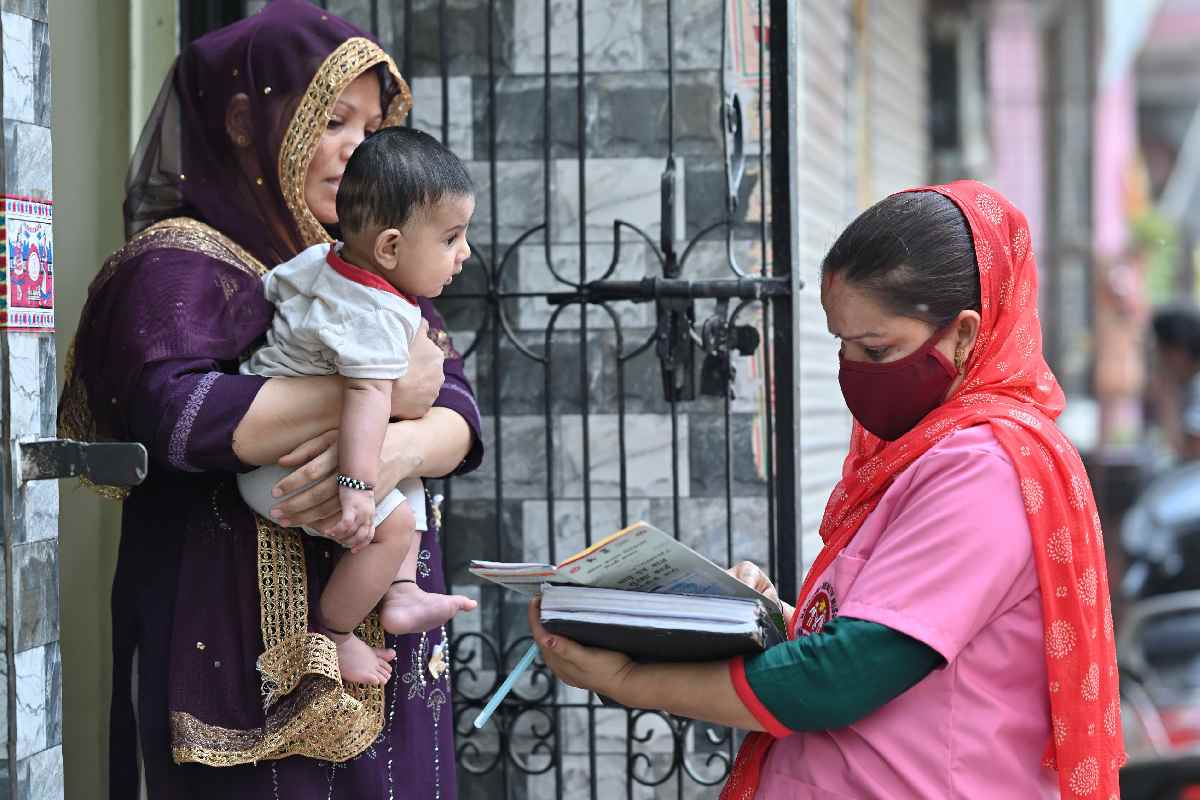
As it pours in Delhi, Accredited Social Health Activists (ASHAs) continue wading through flooded lanes, carrying medical records and survey forms through waterlogged neighbourhoods. For many, falling sick is not an option — it could mean losing a month’s incentive.
Rita Bharadwaj, who weaves through the narrow lanes of Khanpur in Sangam Vihar, South Delhi, says, “It’s hard to carry an umbrella and files, and a bag on the other hand. Sometimes we have to leave everything outside and wash our feet before we can go in. People treat us like we’re lesser beings. However, the situation is better than before. Earlier, they wouldn’t even let us wash our feet,” she said.
For the 46-year-old ASHA worker, the trouble starts before she even reaches the people she’s supposed to help. “It’s hard to carry an umbrella and files, and a bag on the other hand. Sometimes we have to leave everything outside and wash our feet before we can go in. People treat us like we’re lesser beings. However, the situation is better than before. Earlier, they wouldn’t even let us wash our feet,” she says.
The umbrella is one of the few items the government has provided her. Bharadwaj is expected to cover close to 400 houses in her area as the Booth Level Officer (BLO) for the ongoing Special Intensive Revision of voter rolls to earn her incentive.
However, the struggle does not stop there. “Even after the monsoon started, we still have to keep working. Now, because we are also working as BLOs, people shut their doors in our faces, saying they have already had their identity cards made,” she says.
Meeting targets
Everything beyond her basic incentives depends on whether she meets this target, and the goals are no longer just about health work. Alongside tracking pregnancies and immunisations, Bharadwaj and her colleagues are often roped into surveys, awareness campaigns for new government schemes, and election duty. The extra workload only adds to what she must finish on the same day, in the same lanes.
Across Delhi, ASHA workers describe the same pattern of work that expands every year, with no change in pay, safety gear, or protection when the weather turns. What Bharadwaj experiences in Khanpur’s narrow lanes is a structural issue.
Janki Sati, 38, has her own scars from the job, most of which nobody at the dispensary has ever asked about. Injuries on the field are common, but there is no system in place to acknowledge them, let alone treat them.
“It’s tough for us during the monsoon. Sometimes when we get injured, they don’t even ask or bother to help us. Occasionally, they say if you need medicine, go to the main office and take it; it’s in Malviya Nagar. Now tell me, who will go there to get medicine while injured?” Sati said.
‘Can’t afford to quit’
Her relatives and neighbours have asked her to quit, telling her the pay is too little and there is no respect for them at all. Sati says she has heard all of this before and agrees with most of the arguments, but says she cannot afford to quit.
Kiran Gupta, 41, has been an ASHA worker since 2011. In these years, she has seen more than one crisis pass through her household; during demonetisation, whatever savings she had put together over the years suddenly slipped out of her hands.
The monsoon adds its own load to an already full day. Gupta cooks for a large family, washes clothes daily, and still has to show up for work; if anything extra comes up, that too falls on her. She says neither her job nor her home really accounts for this. But even with all of it, she is not willing to give up the job. It is the one thing that has kept her from asking anyone else for money, even in the hardest years.
Working conditions
What frustrates her most is how invisible the physical conditions of the job remain to everyone else. “Especially in the monsoon, they don’t care about the working conditions. If you ever visit our village in Khanpur during peak monsoon, you will witness waterlogging. We cross these roads irrespective of everything to treat people, but no one offers us a glass of water,” she said.
For Deepa Joshi, 43, the monsoon brings a different struggle. Dengue and malaria cases rise every year during this season, and for an ASHA worker, falling sick does not just mean being unwell. It means losing the incentive tied to the month’s targets. So, Joshi stays careful through the season in a way her job does not officially require her to be, watching her own health as closely as she watches everyone else’s. There is no fixed timetable to guide her; the work is point-based, and she paces herself around it as best she can, monsoon or not.
Proper leave policy
“If we fall sick during this season, our incentive is also gone. There is always a chance of dengue and malaria, but somehow we still try to complete our work,” she said. Joshi’s demand is simple: a proper leave policy from the government and pay that reflects what the job actually demands of them.
The All India Central Council of Trade Unions (AICCTU), which has organised ASHA and health workers across several states, has repeatedly raised concerns not just about individual hardship, but about what the government hasn’t done to protect workers such as Bharadwaj during the monsoon.
‘Seen as volunteers’
Shweta Raj, an AICCTU activist who has worked with ASHA workers since 2018, points out that their struggles come down to one basic fact: they are still classified as volunteers, not government employees. “There are a total of 6,214 ASHA workers in Delhi, but since they don’t have the status of a government job and are seen as volunteers, they suffer a lot. In a city like Delhi, where everything is expensive, they can’t even afford basic things,” she said.
She points to the pandemic as proof of the gap between the work ASHA workers do and the recognition they receive. “While everyone was indoors during COVID, these are the volunteers who were out on the road, spreading awareness and helping with vaccination in their areas. The WHO recognised this work and gave India’s ASHA workers the Director-General’s Global Health Leaders Award, but their own country failed to recognise them,” Raj said.
For Bharadwaj, this isn’t just a hypothetical fear. In 2020, her 20-year-old daughter passed away, and she had to leave immediately for the funeral. Permission was not granted easily, and the delay affected her incentive during that period.
There is no fixed schedule for the job. Some days the work wraps up in two hours; other days it runs to four or five. And when headquarters calls an urgent meeting, there is no option to skip it, even if it means travelling 20 km at short notice in the middle of everything. The costs of these sudden trips are rarely covered. There is an official travel allowance, but it doesn’t reach all workers, she says.
“Sometimes they give us Rs 150 for the return travel, but that’s very rare. Earlier, the bus ticket was free; now we have to pay Rs 10 to 15 for it. And when we’re getting late, three or four of us take an Uber together, because that’s what makes sense. It costs Rs 300 to 500, and that comes from our own pocket; there’s no reimbursement. Our incentive is only Rs 3,000 a month, so it’s difficult to even use an app like that when we need to. But we still end up using it sometimes,” Bharadwaj said.
‘Recurring fear’
This fear comes up again and again in what ASHA workers say about their job. It is not the fear of the disease they are tracking, or the rain they are walking through. It is the fear of losing the job itself. There is nothing that protects them if they fall behind, even for a day. The targets do not pause for illness. They do not pause for grief. They do not pause for the weather either.
In summer, the heat does not change what they are asked to do. In the monsoon, the flooding does not change it either. And even when something as serious as a death in the family happens, the tasks stay exactly the same.
For Bharadwaj, the rain is only one more obstacle. Every morning she still shoulders her bag, steps into flooded lanes and walks from door to door, knowing that missing even a day’s work could cost her the money her family depends on.