With a digitisation rate of just 36.3%, the lowest in the Capital, South East Delhi is lagging behind in the Election Commission’s Special Intensive Revision (SIR) of electoral rolls.
Booth Level Officers (BLOs) attribute the delay to app-related problems, dense urban settlements in areas such as Okhla and Jamia Nagar, complex addresses and limited online submission of forms by residents. This has placed much of the burden of collecting and digitising forms on field workers.
As of July 27, more than half of Delhi’s electors had their enumeration forms digitised, with the number of uploaded forms crossing 72 lakh, according to official data.
The Election Commission’s latest status report showed that 72,65,605 enumeration forms had been digitised, covering 50.07% of Delhi’s 1,45,10,298 electors. A total of 1,44,91,450 forms had been distributed, covering 99.87% of the electorate.
Outer North led the 13 districts, with 62.82% of forms digitised, followed by South West at 60.42%, West at 57.16%, North West at 56.55% and Central North at 54.85%.
At the other end, South East recorded the lowest digitisation rate, followed by East at 41.60%, South at 43.07%, Old Delhi at 46.04% and Central at 46.38%.
A second shift after school
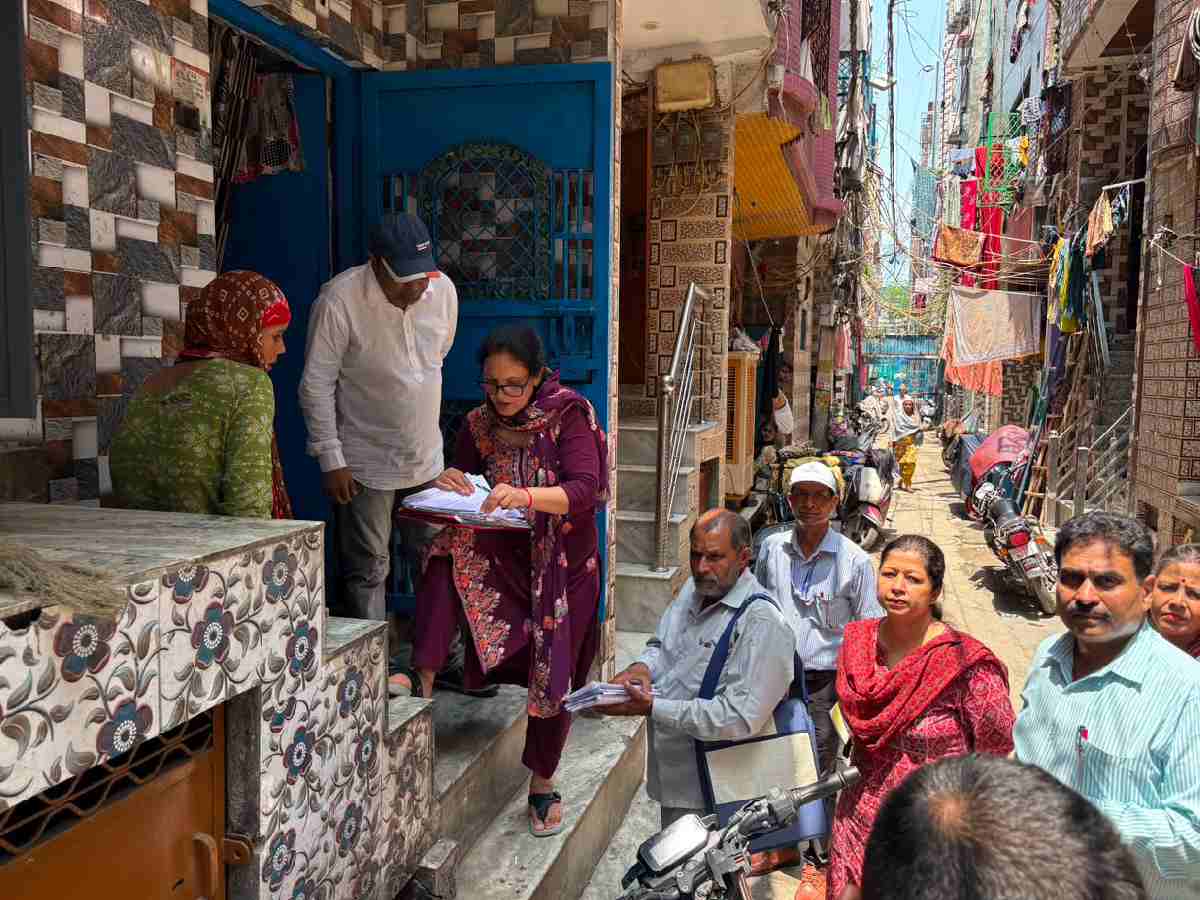
By 2 pm, as the school’s final bell rings, Booth Level Officers Aniket Ranjan and Syed Jamal Hussain begin their second shift. They carry heavy canvas bags filled with paper enumeration forms and registers, along with smartphones used to process voter information.
Ranjan works as a laboratory assistant, while Hussain teaches at a government school in Okhla. Outside their regular working hours, much of their time is spent on SIR-related work.
Their duties include verifying voter details, distributing forms and ensuring that digital records are updated on the Voter Helpline app so that every eligible citizen remains on the electoral roll. The officers said the work involved long hours, repeated visits and difficult interactions with residents.
“On paper, you are assigned a house number,” Ranjan said, pausing under a web of low-hanging electrical wires. “In reality, that plot was divided three times over the last decade. A single address now houses 10 different families across three separate structures. Finding one voter can take an hour.”
When online submissions stall
Election authorities had expected residents to use online portals and the Voter Helpline app to submit their details, easing the burden on field staff. However, the officers said few residents in their assigned areas had completed the process online.
They attributed this to limited digital access and literacy, as well as technical problems. In densely populated working-class neighbourhoods, many families lack stable internet connections or smartphones, the officers said.
Even digitally literate residents have encountered OTP failures, server timeouts and confusing address-matching requirements.
“People try to log into the portal, get stuck at the captcha or mobile-linking stage, and simply give up,” Hussain said.
He said residents tell the officers: “We couldn’t do it on our phones, so you take the paper form and figure it out.”
“Instead of assisting us, the online platform has pushed nearly 100% of the verification load right back onto our shoulders,” he added.
The officers said PIN-code information and street names for informal housing and redeveloped properties in parts of Okhla were not always accurately reflected in the central database. Consequently, entries submitted online were sometimes rejected because the addresses did not match official records.
This forces BLOs to verify the details manually and upload the documents again.
Fragmented electoral records
The confusion is compounded by fragmented records within individual households, with family members living under the same roof sometimes appearing on different pages of the electoral roll.
“Sometimes, a mother may appear on Page 18 while her son appears on Page 31. However, that is very rare,” Ranjan said.
He added that, in some instances, a wife and son are registered with one BLO, while the husband is assigned to another officer covering a neighbouring block. This can cause delays and confusion.
High residential turnover creates another challenge. Previous occupants may have moved away while their names remain registered at their former addresses, leaving officers dependent on neighbours who may not know whether the electors still live in the area.
The large number of tenants also makes the process more difficult.
“Many residents are migrant labourers who have lived in rented accommodation for decades without fixed addresses or permanent records,” Hussain said.
Requests for historical documents or links to older electoral lists, such as the 2002 roll, have caused anxiety among some residents, he added. Older residents, in particular, have asked whether they could face deportation if they lack proof of having voted in earlier elections.
Maze-like lanes and locked doors
The layout of South East Delhi’s unauthorised colonies also complicates the exercise. Sequential house numbering is often absent, while repeated subdivision of plots means that several voters share identical postal information.
Since most residents are away at work during the day, BLOs often find homes locked during daytime visits.
“If nobody is home at 11 am, we come back at 7 pm,” Hussain said. “And if they aren’t home then, we return a third or fourth time. Our shift doesn’t end when the sun goes down. It just shifts to the evening.”
Also Read: Delhi teachers say election duty as BLOs is affecting classroom teaching
Residents returning after long working days are sometimes wary of or openly hostile towards government workers knocking on their doors.
Ranjan recalled a recent encounter that became tense. After handing over an enumeration form, he asked the resident to sign the official acknowledgement copy.
“The man snapped at me immediately,” Ranjan said.
The resident shouted that he was having dinner, accused Ranjan of wasting his time and refused to sign or return the form.
“When you’re on the receiving end of that hostility after 10 hours on your feet, it tests your composure,” Ranjan said. “But as BLOs, we cannot argue. We take a breath, step back and return later.”
The officers said strict completion targets added to the pressure. Many BLOs are government school teachers, anganwadiworkers and municipal employees balancing election duties with their regular jobs.
A 45-year-old mathematics teacher engaged in the revision exercise attempted suicide at the Rani Jhansi Flyover in central Delhi. Colleagues attributed the incident to severe mental distress and pressure caused by workload and deadlines. It also prompted teachers’ associations to seek administrative relief.
Work continues after field visits
The officers’ work continues after their field visits end. Once they return home, they begin digitising the forms collected during the day.
Many field officers gather dozens of paper forms before logging into the portal. This creates a delay between the collection and digitisation of the forms.
Every paper form must be scanned, checked and uploaded manually. For older staff members and those working with poor internet connections, server crashes can keep them working past midnight.
“Fieldwork takes physical energy, but digitisation takes complete focus when you’re already running on empty,” Hussain said. “If the app crashes or a server drops, you’re stuck re-entering details late into the night.”
Ranjan and Hussain continue through the narrow lanes, registers in hand.
“It’s easy to get frustrated,” Ranjan said, adjusting his stack of forms before knocking on the next door. “But at the end of the day, an accurate electoral roll is the bedrock of democracy. If we don’t do this work meticulously, thousands of legitimate citizens in this city lose their voice.”