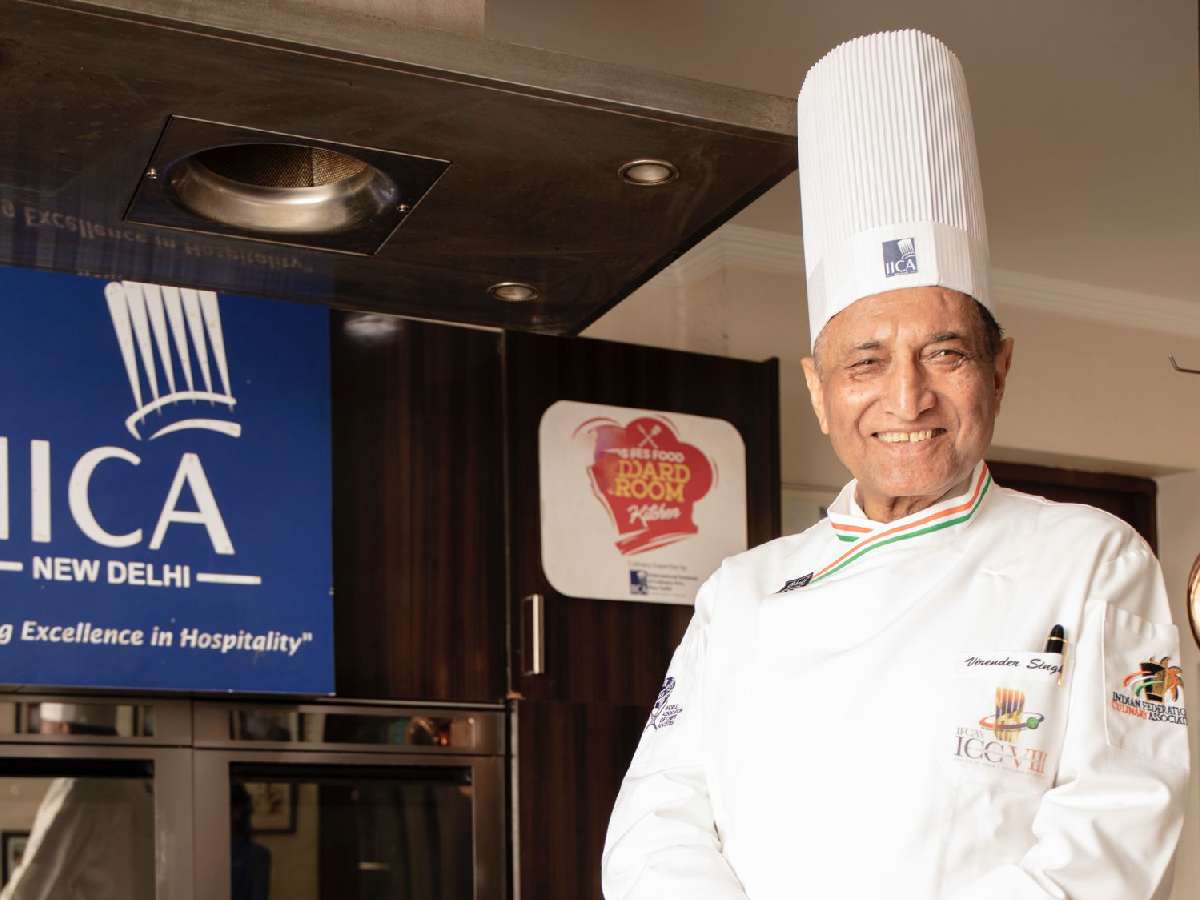
At an age when most people slow down, Virender Singh Datta still speaks about kitchens, hotels, and young chefs with the energy of a man beginning his first day at work. The founder and chairman of the International Institute of Culinary Arts continues to believe that hospitality is ultimately about humanity.
For Datta, food was never merely about recipes or luxury dining. It was survival, culture, discipline, and emotion shaped by the upheaval of Partition and the changing face of modern India. “We are Partition products,” he says quietly.
Born in Lahore, Datta was still a child when Partition uprooted his family. They had travelled to Shimla during the violence of 1947 and could not return home. “We took a train from Shimla to Delhi. It took 15 days to reach Allahabad because trains were moving criss-cross,” he recalls.
His father eventually joined the railways and rebuilt life from scratch. Scarred by the violence and uncertainty of displacement, he bought a gun with his first salary, though it later became more associated with hunting than protection. Those memories remain etched sharply in Datta’s mind. “As children, we would wake up and see deer hanging, ducks hanging, rabbits hanging,” he says.
“My mother would not touch them, so my father cleaned and cooked everything himself.” Watching his father cook shaped his earliest understanding of food and erased the idea that kitchens belonged only to women.
“So when we saw our father cooking, it felt very normal for us to cook too,” he says.
Entering hospitality
In the early 1960s, joining the hospitality industry was far from prestigious. Families wanted their children to become engineers, doctors, or civil servants, while hotels carried a social stigma. Datta’s father was no different. After studying science and pre-engineering, Datta announced that he wanted to join hotel management. “I had to go on a three-day hunger strike,” he recalls with a laugh.
Eventually, his father agreed after hearing one practical argument from acquaintances: “At least your son will never remain hungry.”
In 1962, Datta joined the first batch of the Institute of Hotel Management, Pusa, which had then been newly established by the Government of India. “We were 35 students. By the time we graduated, only 16 remained,” he says. Many students entered the institute imagining a glamorous hotel life, only to discover that the profession demanded physically exhausting work — cleaning rooms, sorting grains, handling housekeeping duties, and learning kitchen basics from scratch.
Breaking barriers
At a time when luxury hotel kitchens in India were largely dominated by European chefs, Datta belonged to the first generation of professionally trained Indian hospitality graduates who began changing the industry’s hierarchy. The institute’s faculty included British principals and European-trained professionals, many from Austria, which had then emerged as a major training destination for hospitality education.
“What we learnt here was so strong that later, when I worked in Europe, I never failed once,” he says. After completing specialised hotel management training, Datta joined the management trainee programme of The Oberoi Group. His early posting as a hotel manager in Chandigarh could have placed him on a conventional management track. Instead, a chef’s remark altered his future. “The chef told me, ‘Don’t come into the kitchen. You know nothing about it. You are disturbing us,’” Datta recalls.
Rather than feeling insulted, he decided to master the kitchen professionally.
At the time, educated Indian chefs were rare. Most luxury hotel kitchens were headed either by expatriates or chefs from communities with colonial culinary exposure in Goa and Calcutta. “I was the first Indian to move from a manager’s uniform into a white chef’s coat,” he says.
The Oberoi recognised his ambition and invested heavily in his training, sending him to Germany and France. One of his favourite memories remains arriving in Paris, leaving his bags at a railway station, walking into the Intercontinental Hotel, and asking to meet the chef.
“He asked me, ‘Do you speak French?’ I said yes,” Datta says. “He asked me some cooking questions and hired me immediately.” The experience, he says, reflected both confidence and the strength of Indian hospitality training at the time. Later, he worked as a freelance chef across Paris through a chefs’ association that supplied trained professionals to restaurants facing staff shortages.
“Every morning I would stand there with my knives and uniform waiting for assignments,” he says. “One day I would work as a sauce chef somewhere, another day in another restaurant. That became my real learning.”
Youngest executive chef
Back in India, Datta joined the opening team of the Oberoi Sheraton in Bombay. Soon, at the age of 27, he replaced a Swiss expatriate chef to become the executive chef of one of India’s biggest luxury hotels. “I had 200 cooks and seven expatriate chefs reporting to me,” he says.
The appointment was significant for the Indian hospitality industry, which still remained heavily dependent on foreign chefs in senior positions. Yet even at the peak of his culinary career, Datta began thinking beyond kitchens. “I realised I had reached the top very young,” he says. “I wanted to understand the larger business of hospitality too.”
His career would eventually span India, Europe, Oman, and the United States, including overseeing international operations and helping expand Indian hospitality brands abroad. During his years as a hotel general manager, Datta also hosted global dignitaries, politicians, and film personalities.
“Queen Elizabeth was never difficult,” he recalls. “She would simply ask, ‘Chef, what do you recommend?’ 99 % of people finally eat what the chef recommends.”
Building future chefs
After decades in luxury hospitality, Datta increasingly turned towards education. Visits to hospitality institutes in New Zealand, Australia, and the United States convinced him that India needed specialised culinary education focused on practical training rather than only theoretical hotel management. That vision led to the establishment of the International Institute of Culinary Arts in Delhi nearly two decades ago. “I was convinced there was an extreme shortage of chefs and nobody was training them properly,” he says.
Today, the institute offers international culinary qualifications and has trained thousands of students working across hotels, cruise liners, and restaurants worldwide. “This is the only profession with almost zero unemployment,” Datta says. “The world is looking for chefs, and they are not available.” For him, culinary education begins with discipline and technique before creativity. “The chef’s real job is learning how to handle a knife, fire, and ingredients,” he says. “The rest is only a recipe.”
Even now, French cuisine remains closest to his heart because of its structure, precision, and emphasis on technique. But beyond cuisine, Datta believes hospitality itself is about creating comfort and trust. “Starting a hotel is like putting life into a baby,” he says. “Buildings are made by architects, but real life comes from people, values, and training.”
Over the decades, Datta has received several honours, including Hall of Fame recognitions from hospitality and culinary institutions in India and abroad, including his alma mater IHM Pusa and the Indian Culinary Forum. Looking back, he sees his life as deeply intertwined with India’s own evolution — from a newly Partitioned nation to a global hospitality force. From Lahore to luxury hotels, from kitchens in Paris to classrooms in Delhi, Datta’s journey mirrors the rise of Indian hospitality itself. And after more than five decades in the industry, his philosophy remains surprisingly simple.
“We are a happy business,” he says with a smile.