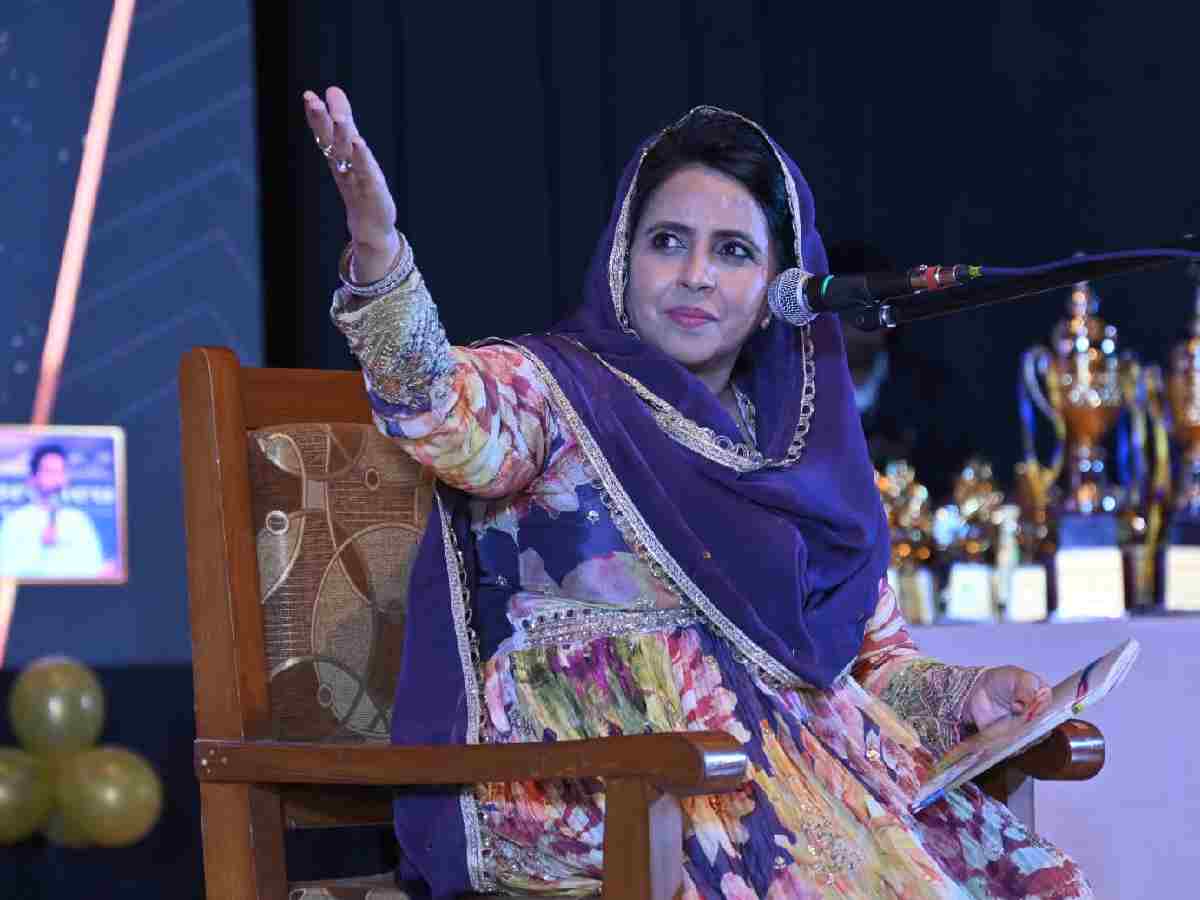
Born on December 27, 1974 in Kanpur, Uttar Pradesh, Adeeb’s inclination towards poetry emerged at the age of 15. By 16, she had begun participating in poetry gatherings, displaying remarkable confidence and flair.Her early performances caught the attention of senior poets of the era — Ghazi Azmi, Majnu Sultanpuri, Adari Neeraj, and Bekal Utsahi — who encouraged her to pursue poetry with dedication.
“My first interaction with Kaifi Azmi was memorable. I had put ‘Adib’ before my name to honour my mentor, Adib Makhanpuri. When Kaifi Azmi heard me, he said, ‘This is a very good voice. If we give her a little courage, she can go far,’” she recalled.
Her early exposure to literary luminaries provided the confidence to perform at major national gatherings.
At an International Kavish Samelan in Kanpur, poet and filmmaker Ramanand Sagar spoke to her family, urging them to allow her to move to Bombay for her art.
“He said, ‘She is talented and will write poetry and sing as well.’ Even though my family was initially hesitant, the poetic environment had always fascinated me,” she said.
Power of performance
Adeeb’s poetry is distinguished by its emotional depth and musical cadence, allowing her to connect deeply with audiences.
“A poet is a mirror of society. He or she feels what is around and puts it into poetry. I have tried to write something that everyone can relate to, and it must be my own. Maybe that is why those things connect with people quickly,” she said.
Her first poetry collection, Tum Mere Paas Raho, published in 2007, was inspired by real-life stories.
“It happened when I went to a wedding where the bride’s husband was away for work. I wrote about her feelings, and people liked it a lot,” she said.
The collection was widely appreciated and cemented her reputation as a leading voice in contemporary Urdu poetry.
Rooted yet evolving
Asked about the current state of Urdu poetry, Adeeb noted the dual influence of tradition and technology.
“Today, social media allows poetry to go viral overnight. But unless you have a teacher or sit in sessions, you don’t fully grasp the tradition. What is viral may not be perfect,” she said.
She stressed the importance of intergenerational learning, where elders guide younger poets and help refine their craft.
“Poets are doing well, but we are moving away from that culture somewhere. In the era of glamour, we are so lost that we are not able to connect with our elders,” she observed.
Despite this, she acknowledged the role of platforms like social media in spreading poetry worldwide, provided the engagement is sincere and meaningful.
Male-dominated field
As a woman in a traditionally male-dominated domain, Adeeb has faced and overcome challenges with resilience.
“Women should do as much as they can. They should write very well, organise their own gatherings, and prove to themselves that we are no less than anyone,” she said.
Her own journey serves as an inspiration to aspiring female poets worldwide, underscoring that talent and dedication transcend gender barriers.
Love and peace
At the heart of Adeeb’s work is a commitment to love and peace.
“All our poetry is only about peace. We have always tried to spread love to people through poetry. When we spread love, we will also get love,” she explained.
Her verses often advocate unity beyond religion and sect, reflecting a humanist worldview.
“God is the same. Everyone is a child of God. Everyone is a servant of God. If people understand this, then fights and disorder will end,” she added.
Adeeb believes that poetry must not only inspire love but also reflect truth.
“People should express love in their poems, ghazals, and writings, but at the same time, they should also highlight social injustices. If something has happened, show why it happened. If we don’t raise our voice against the wrong, it is an injustice to ourselves and society,” she said.
Travels and influences
Shabeena Adeeb has travelled extensively, performing in countries such as Saudi Arabia, the UAE, Qatar, Kuwait, Bahrain, Nepal, Oman, and Malaysia, bringing her message of love, unity, and cultural appreciation to international audiences.
Each performance, she says, is an opportunity to connect hearts through poetry.
Personal life and passions
“Books have always been my closest companions,” Adeeb said, reflecting on the influences that shape her life and poetry.
She draws inspiration from classical masters such as Mir Taqi Mir, Mirza Ghalib, and Josh Malihabadi, whose works continue to guide her literary sensibilities.
Adeeb also shared that she prefers simple living and traditional attire, particularly silk shalwar kameez with a full dupatta.
Among her favourite dishes are butter chicken and barbecue — small indulgences that balance her demanding travel and performance schedule.
“Literature is not just my profession but a way of life for me,” she said, adding that her love for books and poetry continues to inspire the depth and sensitivity in her writing.
Shankar-Shad Mushaira
On April 4, 2026, Adeeb will perform at the prestigious Shankar-Shad Mushaira.
She regards such events as crucial to keeping Urdu poetry alive.
“Poetry should be about love, expression, and truth. If it connects with people, it serves its purpose,” she said.
For Adeeb, mushairas are more than performances; they are spaces where poetry finds its true resonance, bridging generations, cultures, and geographies.
Adeeb also praised the quality of audiences and fellow poets at such events.
“I am very proud of Shankar-Shad Mushaira. The audience is very special — they purely listen to poetry. Poets from India and abroad participate, and the standards remain exceptionally high. This keeps the spirit of Urdu poetry alive,” she said.
Legacy and inspiration
With decades of dedication behind her, Shabeena Adeeb remains a leading voice in contemporary Urdu poetry.
She has been honoured with multiple awards for her contribution to Urdu literature, both in India and internationally. Yet her focus remains firmly on the art itself.
“Our mission is to spread love and peace through poetry. When people connect with it, when it touches hearts, that is the ultimate reward,” she said.
Now in her fifties, she continues to perform, write, and inspire.
Her journey — marked by early mentorship, global performances, social consciousness, and unwavering dedication — offers a model for aspiring poets everywhere.