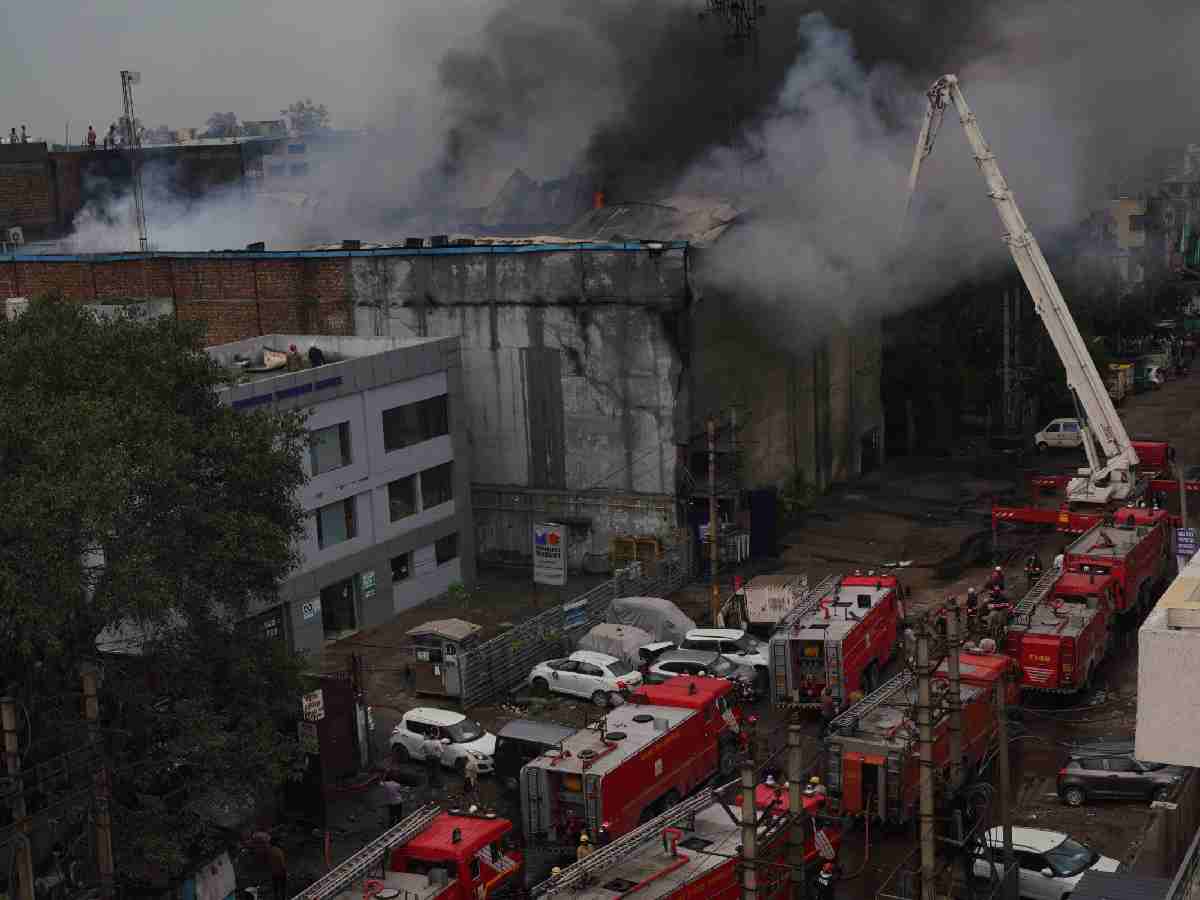
On the morning of May 3, a Sunday, a cruel fate lay in wait for families living inside a four-storey building in Vivek Vihar area of East Delhi. A blaze soon engulfed the entire building, leaving a trail of devastation in its wake. With nine people dead, the spotlight has now turned to the lack of safety precautions in residential buildings.
To prevent such incidents, the Delhi government had earlier in March issued an order directing the Delhi Fire Services (DFS) to conduct a fire safety audit in the national capital.
Yet, after about two months, it remains a pipe dream. According to the DFS, officials had moved forward with the tendering and empanelment process, but owing to the niche nature of the exercise and a lack of experts in the field, the drive is yet to get off the ground. Early on, the process stalled after a massive fire struck a residential area in South Delhi’s Palam, which claimed the lives of nine family members, including three children.
Palam inferno
Soon after it broke out around 6:30 AM, the fire in Palam trapped 12 relatives in their flat situated above a row of cosmetic and clothing shops. While emergency crews rescued three individuals, the majority of the family perished in the inferno.
The police were notified at 7:04 AM, with rescue operations commencing shortly thereafter. Following the operation, Chief Minister Rekha Gupta had directed a magisterial inquiry while announcing compensation for victims’ families and those seriously injured.
The Prime Minister’s Office also announced financial support. Senior officials from the Aam Aadmi Party visited the scene.
Local residents have raised concerns regarding the emergency response, alleging that a hydraulic lift failed to deploy correctly, which reportedly hindered evacuation while the fire continued to spread.
Witnesses also claimed that the first fire engine ran out of water during the operation. This led to a delay of around 20 minutes before a second unit arrived to tackle the flames.
Market president Mahesh Sharma told the media that he alerted the authorities immediately. He suggested that the lack of resources and technical failures prevented the family from being saved.
Following the incident, Home Minister Ashish Sood directed a fire safety audit across the capital to ascertain the number of authorised commercial spaces operating from residential areas. The presence of such buildings has effectively turned large parts of Delhi into a tinderbox.
While an audit of mixed-use buildings and fire safety measures across structures will be a welcome move, the DFS now faces a new issue: there are not enough experts in the field. “We have already floated EOIs (Expression of Interest), but for such a niche exercise, there are not enough experts. We waited for responses, but have not received any,” said AK Malik, Deputy Chief Officer, DFS.
He further added that the onus has now been shifted to the municipal body. “Recently, the onus of conducting a fire safety audit was shifted to the Municipal Corporation of Delhi (MCD), since we mostly provide clearances. They will have to arrange tenders and the necessary empanelment,” he said. Malik said the MCD has been given two weeks’ time to complete the audit.
36 distress calls daily
According to DFS data, the city continues to face significant pressure, responding to an average of 36 fire calls per day. The 2,716 calls received between January 1 and March 15 this year represent a slight dip from the same period last year, but casualties remain a major concern.
By March 2026, 13 deaths and 111 injuries had been recorded. At the same time, these incidents have increasingly involved residential areas. “Residential fires have been the most common. It is still too early to determine whether these were mixed-use buildings, which can only be confirmed following the audit. However, the pattern suggests that residential buildings have consistently been under fire,” Malik said.
Senior fire officers suggest that more than 80% of these incidents are linked to electrical faults. The increasing load on ageing wiring systems, coupled with poor maintenance and the presence of combustible materials such as furniture and fabrics, allows fires to spread rapidly. Mixed-use buildings are particularly vulnerable, as the storage of flammable cosmetics and clothing can intensify a fire within minutes.
Authorities said the upcoming audit will create a detailed database of establishments to improve enforcement. The focus has shifted towards prevention rather than response, with the government warning that strict action will follow to ensure compliance.
Lapses in Vivek Vihar
In Vivek Vihar, security features designed for protection significantly hindered evacuation. Central locking systems reportedly became difficult to operate when power failed, and thick iron grilles on balconies prevented residents from escaping through windows.
As the building’s single internal staircase filled with smoke and the lift became unusable, the structure became a bottleneck. Firefighters were forced to use power tools to cut through metal reinforcements at the rear to reach those trapped.
Also Read: Delhi: After voting, migrants return to lost jobs
On the fourth floor, three members of one family were found dead near a locked rooftop door. On the third floor, five members of another family, including a small child, also perished. The ninth victim was found on the second floor, where the fire is believed to have originated.
Desperate survival bid
A few residents survived by jumping onto mattresses laid out by neighbours or by being rescued from front-facing balconies via fire brigade ladders. Witnesses noted that while the front of the building was accessible, the rear was cramped and narrow, with overhead wiring obstructing access.