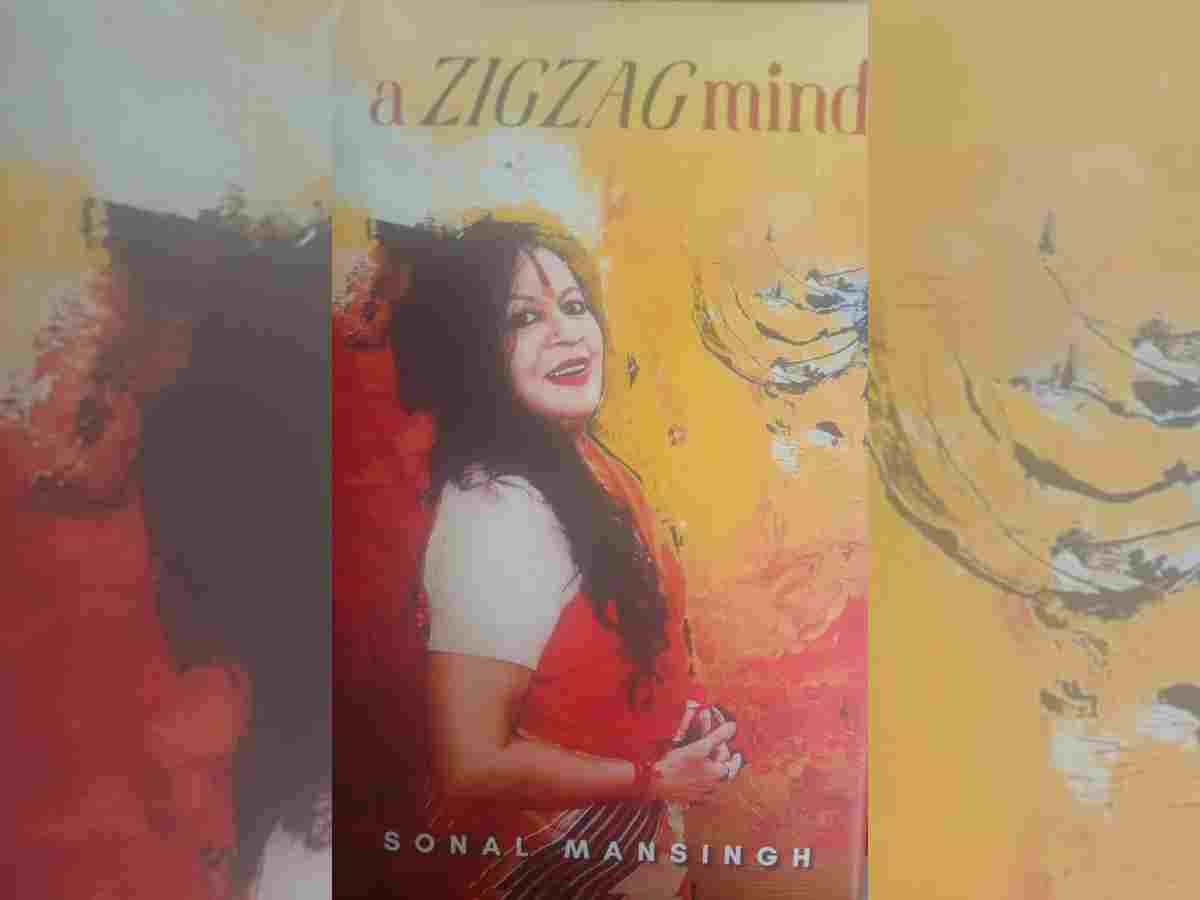
Sonal Mansingh has performed in Delhi countless times. She once lived in Defence Colony and later at Janpath. In both homes, between long hours of riyaz, she always found time to write. Her latest book, A ZigZag Mind, has just been released. It feels like one of her own Odissi performances—measured, graceful and full of unexpected turns.
First published in 2022 and now out in a revised edition from the Indira Gandhi National Centre for the Arts (IGNCA) and Vitasta Publishing, this 190-page memoir brings together five decades of her writings. It is not only a dancer’s story but also an intimate reflection on art, perseverance and the spirit of Indian culture.
From rebellion to recognition
Mansingh recounts how her life moved from being a restless teenager in Mumbai to becoming an international icon of Bharatanatyam and Odissi, marked by struggles, recoveries and quiet wisdom. At 80, she writes with humour and clarity, reminding readers that success is rarely a straight road.
Her voice is lively and honest, unafraid to show vulnerability. Born in 1944 to a family of freedom fighters—her mother, Poornima Pakvasa, was a social worker and recipient of the Padma Bhushan—Mansingh grew up with large dreams. At 18, she left home to pursue dance, turning away from her family’s wish that she study medicine. That decision led to her arangetram in 1962 and years of training under masters such as Kelucharan Mohapatra.
The turning point
In 1974, while touring Germany, Mansingh’s flourishing career was suddenly halted by a serious car accident. The crash left her with a spinal injury so severe that doctors declared her dancing days were over. For months she could neither walk nor sit upright.
“I felt like my body had betrayed me,” she writes, recalling that period in both A ZigZag Mind and her earlier biography Sonal Mansingh: A Life Like No Other. Yet she refused to give up. Confined to bed, she began composing new choreographies in her mind, using imagination as therapy. Physiotherapy became her new abhinaya—slow, deliberate movements that built strength and rhythm again. Through what she calls “foolish courage”, she returned to the stage, her comeback performance proving that a dancer’s spirit can endure even when the body falters.
The mind behind the movement
“Creativity pertains to the mind and it is imagination that moulds action,” she writes. The book moves between personal narrative and larger reflections on art, gender and society. Mansingh’s comments on working in a “man’s world” and her concern for the environment—subjects that have inspired many of her choreographies—reveal her as both artist and thinker.
A striking theme in the memoir is her view of art as inherently secular. Dance, she believes, transcends religion and speaks to all. “Art doesn’t ask your caste or creed—it asks for your surrender,” she writes.
During the 1990s, she founded Artists Against Communalism, bringing together performers from diverse faiths to counter prejudice through shared creativity. Bharatanatyam, she notes, may have temple origins but now welcomes ghazals and bhajans alike. Odissi, too, carries stories that rise above boundaries.
Also Read: The sweet artisans: the people who keep Delhi’s Diwali glowing
Mansingh recalls collaborations where Christian choirs sang with Kathak dancers or Sufi qawwalis inspired Manipuri pieces. To her, this cross-cultural dialogue represents the true genius of India—its ability to blend faiths and forms without losing integrity.
Reading the rhythm
A ZigZag Mind is not without flaws. Some episodes end abruptly, and readers may wish for more details about her international tours or photographs from her performances. Yet the revised edition, at under 200 pages, remains engaging and full of life. Mansingh hints that another book on her recovery is on the way, which will explore that phase in depth.
In his foreword, Sachchidanand Joshi, Member Secretary of IGNCA, writes, “It gives me immense pleasure to place the book A ZigZag Mind authored by Sonal Mansingh ji, a Saadhaka, dancer and scholar par excellence, as a remarkable souvenir of the Guru-Shishya Parampara.”
Why it matters
In a noisy, distracted world, Mansingh’s zigzag path reminds readers to keep moving forward. Whether you are drawn to dance, resilience or India’s cultural spirit, her memoir offers all three.
Mansingh does not merely perform—she shows how art can heal, unite and keep faith alive through movement.