The Supreme Court on September 28 directed Delhi Police to conduct comprehensive safety audits of public spaces across Delhi-NCR following reports of crimes against women and minor girls, including the alleged gang rape of a 17-year-old girl at Astha Kunj Park in south Delhi.
A Bench of Justices JB Pardiwala and K Vinod Chandran directed the Delhi Police Commissioner to constitute dedicated teams in each police district, headed by an officer not below the rank of Deputy Superintendent of Police, within four weeks. The teams will conduct immediate inspections of vulnerable locations, identify safety deficiencies and prepare district-wise vulnerability maps to help prevent crimes and improve coordination between adjoining police stations.
The audits will draw on National Crime Records Bureau (NCRB) data, local intelligence, past and present complaints, previous incidents and other objective indicators. The teams will identify locations where poor lighting, inadequate surveillance, insufficient patrolling, abandoned structures and weak access controls may increase the risk of crime.
Patrolling and infrastructure
The court also directed authorities to ensure appropriate patrolling and security arrangements at identified public parks and vulnerable areas, particularly during the evening and early morning hours. Each location must have a designated officer responsible for its security, alongside a mechanism for periodic inspections.
An immediate audit of lighting and CCTV infrastructure has been ordered across public parks and vulnerable zones, with non-functional cameras and lights to be repaired or restored promptly. Additional infrastructure must be installed wherever deficiencies are identified. Similar audits will be conducted at Metro stations, bus stops, bus terminals, railway stations and other major public transport facilities in or near vulnerable areas.
Grievance redressal
The bench also directed authorities to use existing citizen grievance-redressal mechanisms, including the CM Jan Sunwai Portal, to identify public safety deficiencies. Citizens will be able to report inadequate lighting, insufficient CCTV coverage, isolated stretches and unsafe access points. Such complaints must be location-specific wherever possible, forwarded to the competent authorities for verification and addressed within a prescribed timeframe.
The court further sought a comprehensive report from the Registrar General of the Delhi High Court within four weeks on the status and functioning of fast-track special courts and exclusive Protection of Children from Sexual Offences (POCSO) courts in Delhi.
It also sought details of the safety arrangements in public spaces frequented by women and children, including their effectiveness during peak hours, late evenings and early mornings.
Databases and schemes
The Bench asked Delhi Police to explain how the National Database on Sexual Offenders (NDSO) is being used for antecedent verification and the identification of repeat offenders. It also sought information from the Ministry of Home Affairs on the use of the Investigation Tracking System for Sexual Offences (ITSSO), including how investigations are monitored to ensure completion within statutory timelines, how frequently cases are reviewed and what remedial action is taken when investigations are delayed.
The court also directed authorities to provide details of the implementation of Mission Shakti, the umbrella programme for women’s safety, security and empowerment, in Delhi. The report must outline the programme’s components, the agencies responsible for implementation, the services available to women and children, and the mechanisms used to assess their effectiveness and accessibility.
The status and functioning of the Emergency Response Support System (112), the Women Helpline (181) and the Safe City Project, including CCTV coverage, must also be reported.
Parks audit
Earlier, Lieutenant-Governor Taranjit Singh Sandhu directed the police, the Delhi Development Authority (DDA) and the Municipal Corporation of Delhi (MCD) to conduct a comprehensive audit of parks, covering lighting, security, cleanliness and patrolling.
By September 25, the police had inspected around 1,500 parks, including approximately 300 prominent or large parks. The inspections assessed 11 parameters: previous crimes, area, maintenance agency, timings, visitors, gates, guards, lighting, CCTV coverage, dark spots and boundary walls.
The findings highlighted security gaps in several parks across the Capital, indicating that inadequate surveillance and lighting were not confined to a single location.
Swarn Jayanti Park, also known as Japanese Park, in Rohini’s Prashant Vihar, spans 170 acres and receives between 500 and 1,000 visitors during peak hours. It has four gates and 27 guards providing round-the-clock security. However, police identified insufficient lighting, inadequate CCTV coverage and several dark spots. The park has also witnessed incidents of vehicle theft and snatching.
The 100-acre District Park in Sector 1, Avantika, Rohini, attracts around 400-500 visitors during the morning and evening hours, particularly from 6 AM to 9 AM and 4 PM to 7 PM. Although the park has five gates and security guards, it lacks CCTV cameras, and police found damage to its boundary wall. Incidents involving offences under the Arms Act, Gambling Act and Narcotic Drugs and Psychotropic Substances (NDPS) Act, as well as cases of hurt, have also been reported there.
In North Delhi’s Shakti Nagar, Roshanara Bagh, spread across nearly 50 acres, has 21 CCTV cameras and 12 guards and receives around 500-700 visitors daily, mainly between 4:30 AM and 8:30 PM. Police reported no crime at the park and found its lighting, boundary and adjoining road to be in good condition.
DDU Park in Central Delhi’s IP Estate, which covers 16 acres, has security guards and receives around 150-250 visitors during peak hours, between 6 AM and 10 AM, and 4 PM and 7 PM. Police found the lighting, boundary and road conditions satisfactory while pointing out that the park does not have CCTV cameras.
Amruth Park in East Delhi’s Mandawali, spread across approximately 9 lakh square metres, has two gates and four guards but no CCTV coverage. It receives around 150-200 visitors during peak hours. Police reported no crime at the park and found its lighting, boundary and road conditions were satisfactory.
Nehru Park, under the New Delhi Municipal Council (NDMC), was found to meet all the parameters examined. The park has six gates, security guards, lighting and 12 CCTV cameras.
In Dwarka, 113 parks were audited, following which police wrote to the agencies concerned, highlighting the safety deficiencies identified during inspections. More than 200 parks in West Delhi were also audited.
The police have directed their units to prioritise safety audits of all major parks measuring one acre or more and submit reports to the Joint Commissioners of Police of the respective ranges within a week. The assessments will examine the availability of security guards, lighting arrangements, including high-mast lights, CCTV coverage, the height and condition of boundary walls, overgrown bushes and trees, and gate closure timings after sunset.
Nearly 300 large parks and more than 800 smaller parks are being audited as part of the exercise.
Police have also increased patrolling in and around major parks, with mounted patrols being used to cover areas that are difficult to access on foot or in a vehicle. The initiative aims to improve police visibility and monitor crowded stretches, isolated corners and other vulnerable locations, particularly during peak visiting hours.
Vulnerable locations
On-ground assessments of vulnerable locations have also identified surveillance and lighting deficiencies at parks and green spaces in North and South Delhi, including the Hauz Rani forest area, Bonta Park and Qudsia Bagh.
In the Hauz Rani forest area in South Delhi, there is currently no CCTV coverage. Police have written to the authorities concerned, seeking the installation of 32 cameras under the Safe City Project.
Following the recent incident, lights in the forest area have started functioning, but only around 70% are operational, according to a senior police officer. Police have also requested the pruning of trees along certain stretches, as overgrown foliage prevents existing lights from adequately illuminating parts of the area.
Concerns have also been raised over the forest area’s closing time. Although it is officially open until 8 PM, people are often found staying beyond the permitted hours despite being asked by police personnel to leave, a senior officer said.
At Hauz Rani Idgah, beside Max Hospital, the park locally known as Jamun Wala Park has neither CCTV cameras nor lighting. Police have raised the issue with the authorities concerned and sought adequate surveillance and measures to ensure the park is properly manned.
In North Delhi’s Bonta Park, three CCTV cameras are installed, and police have requested five additional cameras. The park has three lights, with six more sought to improve illumination.
At Qudsia Bagh, two CCTV cameras are currently installed, and police have sought seven additional cameras. Two lights are in place, with 10 more requested. Police have also flagged inadequate lighting along the walking track and raised the matter with the relevant agencies.
Astha Kunj incident
According to a media report, the area where the alleged incident occurred had no CCTV coverage, while several cameras at the park gates were non-functional. The report also highlighted concerns over inadequate lighting.
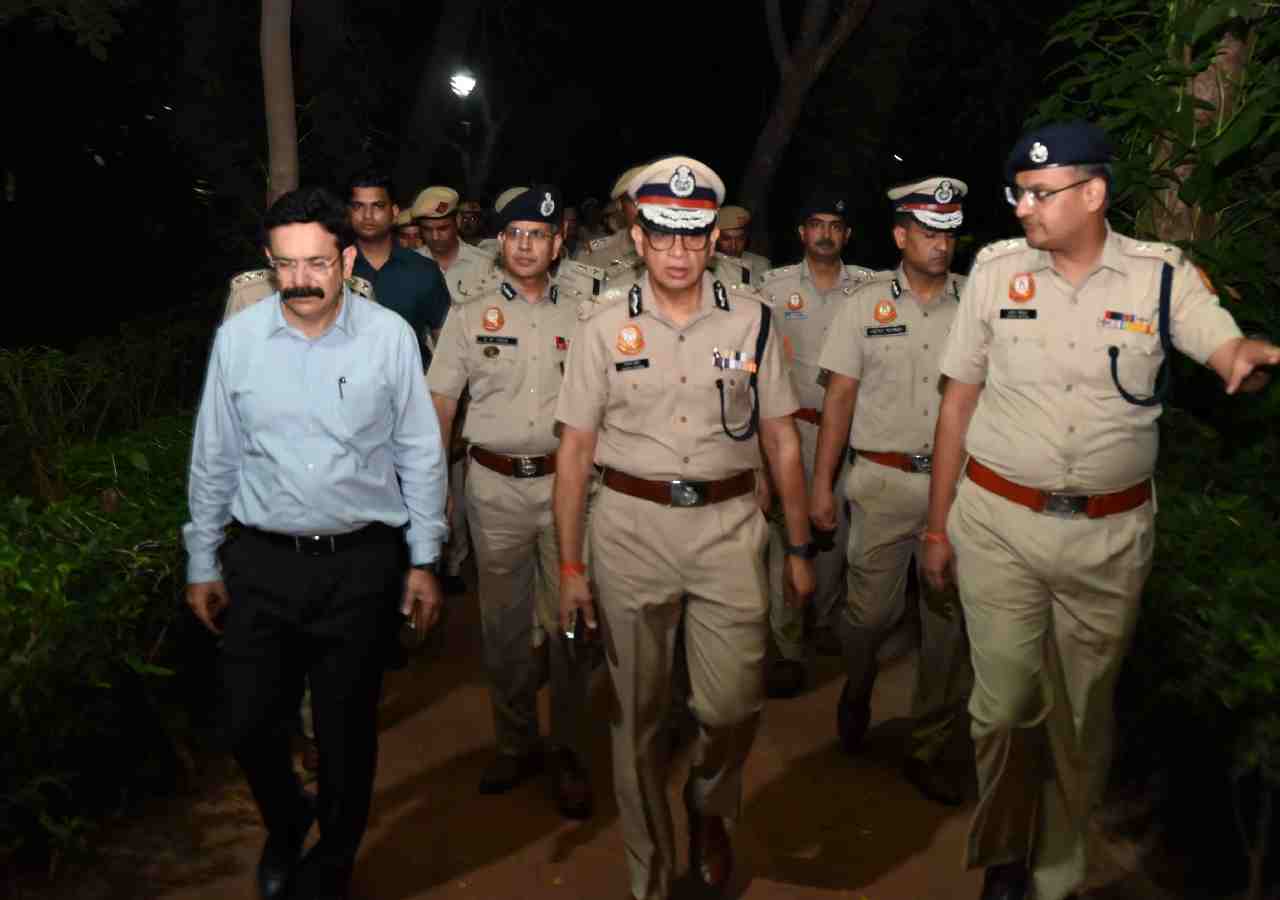
Following the incident, senior police officers have been conducting regular inspections of vulnerable parks, isolated stretches and other locations considered susceptible to crime.
Earlier, DCP (Outer North) Shobhit Saksena had said, “The police are also coordinating with civic agencies and other authorities, including the MCD, DDA and Forest Department, to address deficiencies in CCTV coverage, lighting, tree pruning and maintenance.”