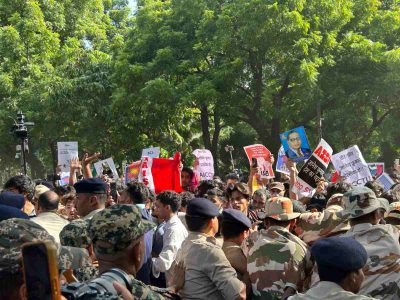
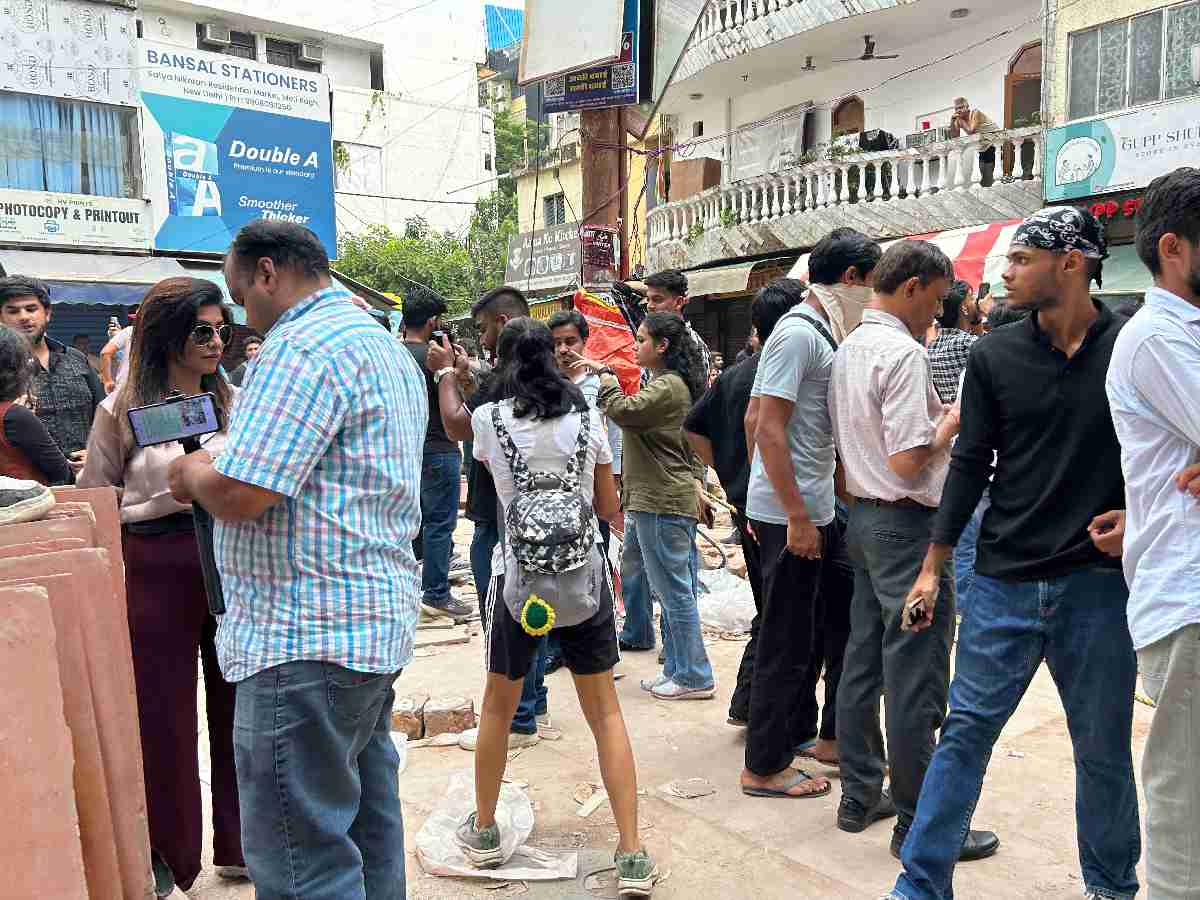
They came to Delhi to study, far from home and often at a cost their families could barely afford. After the Satya Niketan building collapse, some students have packed up and gone home. Others are asking whether they can afford to stay.
For many students from other states, getting admission to Delhi University is only the beginning. They have to pay for tuition, rent, deposits, food and transport while adjusting to life hundreds of kilometres from home. For women in particular, moving to Delhi for higher education can require families to overcome longstanding social and cultural reservations about allowing daughters to live away from home. The prospect of returning after a safety scare can therefore mean more than leaving a room: it can mean giving up a degree or the independence they worked hard to secure.
Several students told Patriot that for them, the fear extends beyond the building where they lived. If they cannot find a place that is both safe and affordable, they wonder whether they can continue their education in Delhi at all.
‘Lot of panic at home’
Nisha (name changed), 20, a journalism student from Dewas, Madhya Pradesh, left Delhi almost immediately after the incident. A student at Delhi College of Arts and Commerce, she lives in a PG.
“When I heard about the incident, there was a lot of panic at home,” she said.
She called her parents, packed her belongings and booked the earliest flight she could find. She flew to Indore and then travelled by road to Dewas.
The decision came at a cost. Nisha pays around Rs 14,000 a month for her PG, including food. She said the landlord charges around Rs 14 per unit for electricity and collects a monthly gas charge whether she cooks or not.
When she asked for her security deposit back to help pay for her flight, she said the landlord refused. She was told the deposit would not be returned and that she could leave if she wanted to.
Back home with her parents, Nisha said she felt relieved. She does not plan to return to Delhi anytime soon. The incident has changed how she views continuing her education in the city.
“If I am not alive, what will I study for?” she said.
‘Feared I’d be asked to return’
For Puja Singh (name changed), 22, leaving Delhi is not an easy decision. A BA Economics and Mathematics student at Aryabhatta College, she is from Chhattisgarh. She said students from her hometown, particularly women, do not easily get the chance to move out for higher education. That was why she hesitated before telling her parents what had happened. She feared they would ask her to come home as soon as they found out.
Her worry grew as she began noticing the condition of the buildings around her accommodation.
Now she wants to leave Delhi, but she is not sure what that would mean for her degree. Her college fee, she said, was around Rs 18,000 in her first year, Rs 22,000 in her second and around Rs 30,000 this year. She pays another Rs 12,000 a month for her PG.
For her family, sending her to the Capital had already meant a serious financial and emotional investment.
“It was a big opportunity for me,” she said. “But now I don’t know what will happen. Maybe I won’t come back.
For Puja, the difficulty is not simply finding another room. It is about deciding whether going home means giving up something that took real effort to secure in the first place.
‘Already left’
A 21-year-old Political Science student from Andhra Pradesh, who asked not to be named, has already left. She paid between Rs 17,000 and Rs 18,000 a month in rent, apart from electricity. Her annual tution fee is around Rs 37,000, she said.
Her college does not offer hostel accommodation, so she was dependent on the private rental market. She had tried to find something cheaper, but she joined the city relatively late and most affordable options were already taken.
Rent was only part of her monthly spending. Food, electricity and daily transport added to the cost of living. After paying thousands of rupees in college fees and far more for accommodation, she said students still could not be sure that the place they lived in was safe.
“After paying so much in fees and rent, there is still no safety or security,” she said.
For students like her, the problem is not simply that the national capital is expensive. It is that the cost of finding a safe place to live can itself become a barrier to continuing an education.
‘Considering returning home’
Dolly, 21, a student at Maitreyi College, said the uncertainty was spreading through her friend circle too. Students, particularly those in their first and second years, were weighing whether to go home after the incident.
“There is a lot of uncertainty among students,” Dolly said. “A lot of my friends, especially first- and second-year students, are also thinking about going back home.”
Dolly said limited hostel accommodation made the problem worse. Many girls who would prefer to live in hostels cannot get a room and end up depending on PGs or rented flats outside campus. The limited number of hostel seats means it is not a realistic option for everyone.
For students who have already paid rent and deposits on private accommodation, moving out creates another financial hit. The question, Dolly said, is where students are supposed to go if a hostel is not an option and they no longer feel safe where they are.
The worry is not limited to students who have spent years in Delhi. Sakshi Niranjan, 19, a first-semester student at Maitreyi College, has only just arrived in the city from Rajasthan. She currently lives in Satya Niketan. The incident has left her wondering whether she should stay.
Niranjan said accommodation was already a concern before the collapse. With hostel seats hard to come by, she had to rely on private housing. Now, after what happened in Satya Niketan, she is thinking of going home.
“I am scared about staying here now,” she said. “I am also thinking about going back home.”
For a first-year student, the decision comes at the very start of university life. She and her family have already spent money on college expenses and accommodation. Leaving now would mean walking away from a room they have already paid for, while returning later could mean finding and paying for another one. But for her, the money already spent is beginning to matter less than the question of safety.
For students living away from their families, the decision is rarely theirs alone. Parents who once agreed to send their children to Delhi may now be the ones calling them back.
Outstation students weigh options
For outstation students who have left Delhi or are considering returning home, the question now is how to continue their education at Delhi University, which does not offer online classes as an alternative to regular attendance. Nisha, 20, a journalism student from Dewas, Madhya Pradesh, has already returned home and does not plan to come back to Delhi anytime soon.
With her parents concerned about her safety, she is weighing other options for continuing her education, including the possibility of applying to another college next year.
A 21-year-old political science student from Andhra Pradesh, who asked not to be named, has also left the national capital and is considering similar alternatives. Puja Singh, 22, a BA Economics and Mathematics student at Aryabhatta College, and Sakshi Niranjan, 19, a first-semester student at Maitreyi College, are planning to return home while keeping all options open.
Rising costs
DU’s fee structure has not stood still. In 2022, the university raised its annual development fee from Rs 600 to Rs 900, its first such increase in 13 years, and added new heads to the fee bill, including a facilities and services charge and an economically weaker section support fund. In 2024, it raised fees for all first-year undergraduate, postgraduate and PhD students beginning that academic session, increasing BTech fees from around Rs 2.16 lakh to Rs 2.24 lakh and integrated law fees from Rs 1.90 lakh to Rs 1.99 lakh, while also revising the DUSU contribution. By 2026, the university had raised its own institutional charge again, from Rs 3,500 to Rs 4,100, a jump of over 17% in under six months, on top of whatever individual colleges charge separately.
None of these increases covers rent, electricity or deposits. They sit on top of them. For students already stretching family budgets to pay for a PG in South Campus, a rising university fee is another number added to a bill that was already difficult to manage before the Satya Niketan collapse.
Limited hostel facilities
DU draws students from across India, but its accommodation capacity has not kept pace with demand. DU has more than 2.5 lakh students, with roughly half coming from outside Delhi, while hostel seats can accommodate only a small fraction. The result is a large private rental market around campuses such as South Campus, where students negotiate directly with landlords and brokers over rent, deposits, electricity charges and basic living conditions.
Also Read: After Satya Niketan collapse, fears mount over unsafe buildings
For a student from Madhya Pradesh, Andhra Pradesh or Rajasthan, the choice is rarely between a good PG and a bad one. It is often between taking whatever is available and having nowhere to stay. The university has faced repeated demands for better hostel infrastructure, while some colleges say they lack the space to build one. Aryabhatta College has earlier said it has no room to construct a hostel, leaving its students dependent on housing outside campus.