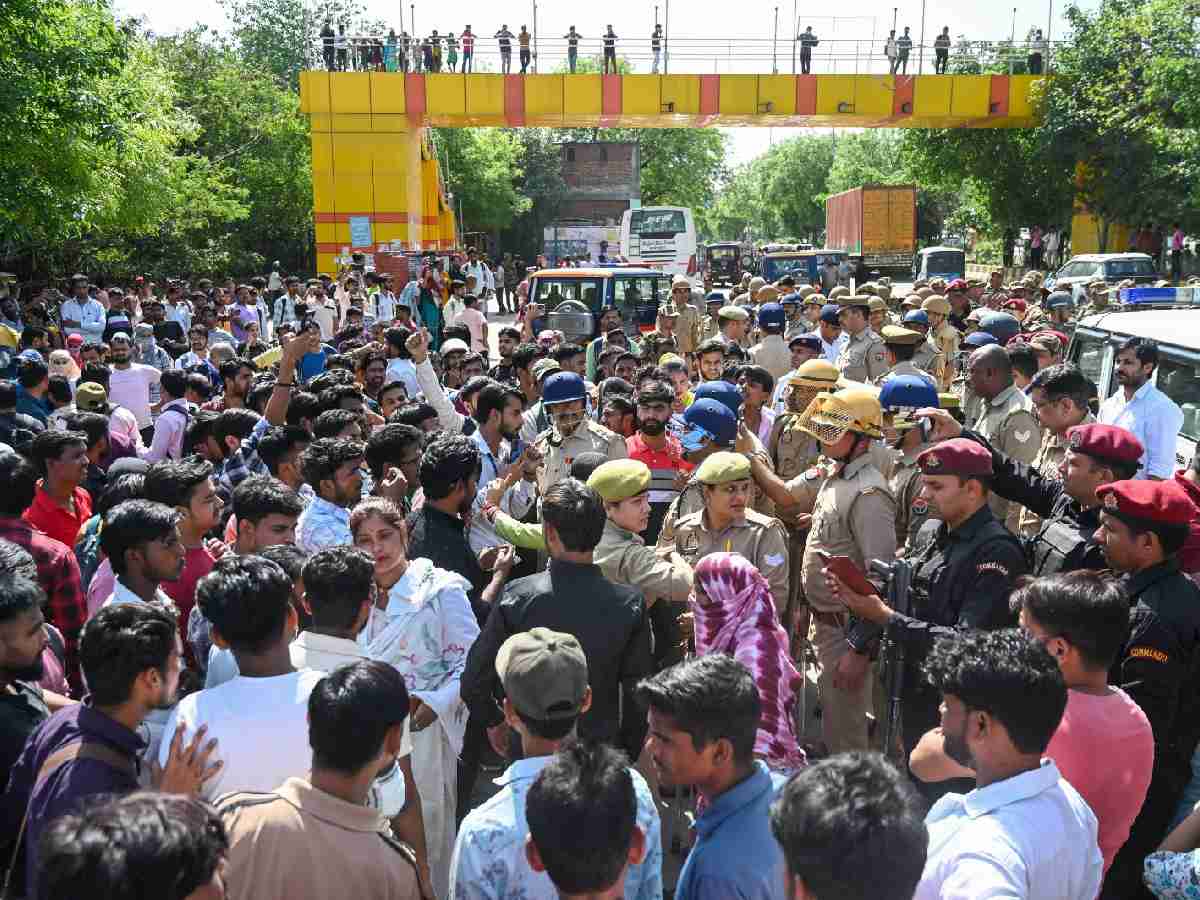
Escorted by police officers across the holding area at Surajpur court, political activists arrested in connection with the Noida workers’ protest exchange a few words before being led into court. Among them are Rupesh Rai, Manisha Chauhan, Aakriti Chaudhary, Aditya Anand, Himanshu Thakur, Satyam Verma, Yogesh Meena, and Srishti Gupta. Akash Kumar, alias Dehati, has been kept separately in the common barracks.
The walk to and from the courtroom is the only opportunity they have to speak to family members waiting outside. Even then, the conversations are brief. “No matter how much time we get, it is never enough,” says Rupesh’s niece, reflecting on the uncertainty facing the accused and their families.
The Eight are among 89 people named in three FIRs registered after the workers’ protests in Greater Noida in April. A chargesheet by Noida Police in June alleges that external organisations infiltrated the strike and incited violence. Several of the accused have also been booked under the National Security Act.
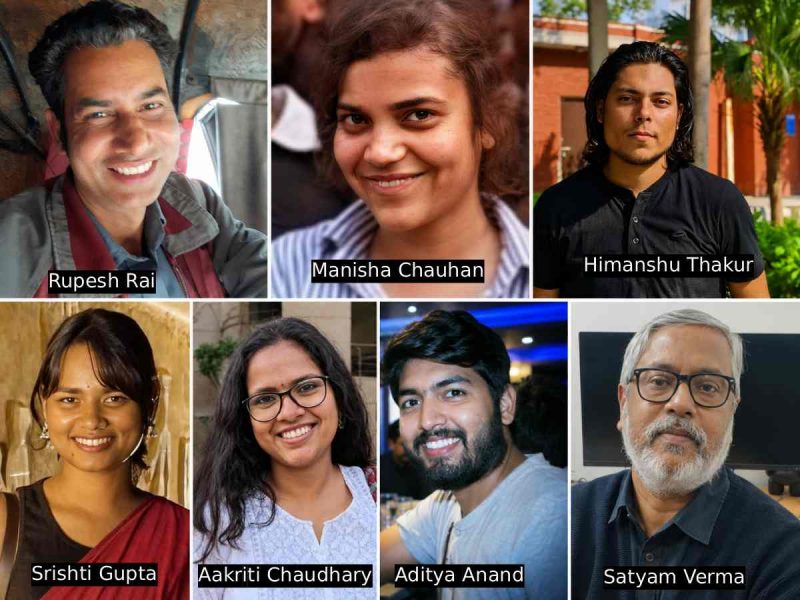
With repeated court appearances now a part of their routine, the accused have settled into a daily rhythm inside the jail. They wake early, spend about an hour walking within the prison premises, and devote much of the rest of the day to reading and studying.
Reading and studying
Inside Kasna jail, the activists spend much of their time reading and studying. Housed separately from the general prison population in semi-open barracks, they spend time together, go out for walks on some days, and have started a study circle to discuss books and current affairs. According to their family members, they have spent the past three months reading, studying and preparing for life after their release.
Also Read: Noida protests: activists allege police interference, lapses
Manisha, for instance, has been preparing for further studies in Hindi literature. She is currently reading Premchand, beginning with Kafan. “She is mostly focusing on Premchand right now. At the moment, she is reading Kafan. They have a lot of time to spend by themselves in prison, and Manisha is mostly using it to educate herself,” said a person close to the jailed activist.
The person added that the activists have also begun researching issues related to the Indian judicial and prison systems.
They have also devoted time to individual interests. While Manisha has devoted herself to Premchand and Hindi literature, Satyam has begun translating his latest book and Srishti has continued drawing and painting whenever she has the opportunity.
Family visits
Family members say they also face difficulties during prison visits. Rajesh Singh, a relative of Rupesh Rai, alleges that prison staff have repeatedly taken a portion of the money he deposits during his visits.
“I have been there almost every week since he was jailed. Initially, I would give him some money to use at the jail cafeteria because the food is unpalatable. But after the first couple of weeks, he told me not to deposit any more. When I asked why, he said that a part of the money I deposited was being taken by the guards. Sometimes they took as little as Rs 200, so they would take whatever was available,” he claimed.
Despite these concerns, the accused say they remain focused on life after prison.
“I hope to be out of here one day and continue my studies. Thankfully, the jailor where we are lodged is a good person. He does not mistreat us,” said a person quoting Manisha.
Family members and friends of those jailed allege that the activists were subjected to physical and psychological abuse while in police custody following their arrest. Santosh Singh, Rupesh Rai’s brother-in-law, said the family was relieved after he was transferred to Dasna jail.
“No matter how difficult life in Dasna jail is, it is better than being at the mercy of the police. He told me that all of the activists had been taken to an undisclosed location and beaten severely,” he said.
The prosecution’s case
Books on Maoism, works by Karl Marx, WhatsApp messages, Facebook posts, and maps of villages in Noida form the core of the evidence assembled by Noida Police in their chargesheet, submitted in the final week of June, following the factory workers’ protests.
Also Read: Echoes of Bhagat Singh in Noida protests
What began as a local industrial dispute over pay was transformed by external groups—including the Revolutionary Workers Party of India, the Bigul Mazdoor Dasta, and the Naujawan Bharat Sabha—into a vehicle for anti-government mobilisation, claim the police. Among those charged are trade union activists, industrial workers, university graduates, an engineer, a journalist and a theatre artist.
The evidence
The unrest intensified between April 11 and 13 when employees from several export and hosiery companies blocked roads. Police claim that efforts to negotiate a peaceful resolution were undermined by outside agitators, leading to rioting, property damage and stone-pelting that left multiple officers injured.
The digital trail forms a key pillar of the prosecution’s case. Investigators relied heavily on Call Data Records to establish the physical presence of the accused, alongside bulk WhatsApp messages used to coordinate the crowds and share slogans.
The police examined the Facebook page of journalist Satyam Verma, who they allege live-streamed the unrest. They also claim that the encrypted messaging app Signal was used to share location information.
According to the chargesheet, police recovered weapons, iron rods and petrol bombs from the main accused. They also seized maps of local villages that investigators believe were used to mobilise protesters.
Searches at other properties uncovered Marxist and Maoist literature, membership cards from various socialist youth organisations, personal diaries and pamphlets on the labour code.
After the protests
Earlier in June, the Haryana administration deployed special teams called ‘Labour Liaison and Industrial Coordination Teams’ across police stations in Gurugram to monitor ‘anti-social and external’ elements around industrial areas.
The move comes nearly three months after protests erupted in Manesar’s Industrial Model Township. At the time, the Manesar Crime Branch said its investigation had found that many of those arrested were not factory workers but outsiders who had allegedly infiltrated the strike to incite violence.