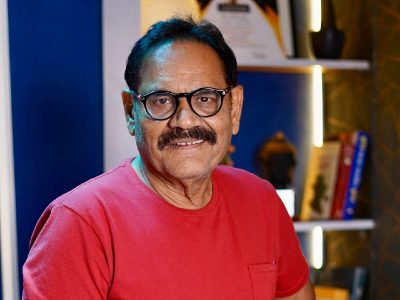

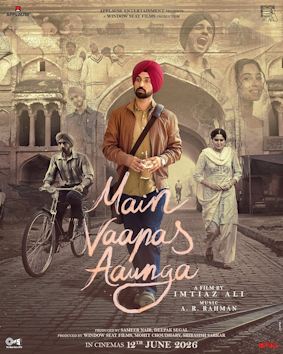
For nearly three decades, filmmaker Imtiaz Ali has explored love, identity and self-discovery through films that have resonated across generations. With ‘Main Vaapas Aaunga, he turns to a defining event in the history of the Indian subcontinent – Partition.
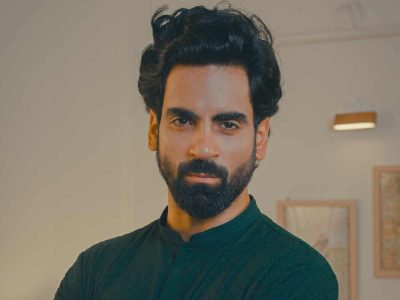
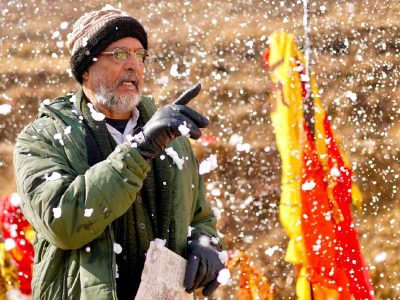
In the film, Naseeruddin Shah is a 95-year-old man haunted by memories from his youth, while characters portrayed by Diljit Dosanjh, Sharvari, and Vedang Raina become intertwined with those memories. Moving between the present day and 1947, the story follows a promise made during Partition.
To Ali, the idea of the film came from years of conversations with people who had lived through Partition. “I met a lot of people in Punjab who told me things about the time of pre-Partition India, of the Partition and how they moved across,” Ali tells Patriot. “They intrigued me, they interested me. Then I knew there was something there that younger generations could look at and perhaps learn from. That is why I started writing this story.”
Conversations around the subject gradually changed the way he thought about Partition.
‘Love in their hearts’
“When we talk about Partition, we generally talk about the violence, the bloodshed and the tragedy of it,” he says. “But I was interested in something else. I was interested in what happened afterwards. How did these people continue living? How did they survive? How did they rebuild their lives?”
Read More: Shraddha Kapoor’s ‘Eetha’ to release on August 28
The answers he found surprised him.
“When they crossed the border, they carried their trunks, jewellery, and money. But they also carried love in their hearts.”
Ali spent years speaking with people who had a first-hand experience of the Partition. Their recollections revealed to him a side of history that often remained hidden beneath larger political narratives.
“We can talk about the turbulence and the violence they saw. But it is very difficult to ascertain the despair they must have gone through. What I realised after talking to hundreds of Partition survivors is that what sustained them was love in their hearts.”
‘Personal jewel’
“This love later became memories, which then became a kind of personal jewel that they could return to, whenever they felt too down or depressed.”
The people he met continued to remember places and relationships from before Partition with affection. “They would talk about their friends, their neighbours, their childhoods. Even after so many years, those memories remained alive for them.”
Those memories became the starting point for the film.
The protagonist is Ishar Grewal, a man nearing the end of his life but unable to let go of a memory that has remained with him for decades. “Doctors are puzzled about why this man, who is battling so much pain, is not giving up. His grandson is also puzzled. He pieces together the story that is going on in the old man’s mind. And that’s how we go to 1947.”
The film moves between generations, connecting contemporary India with pre-Partition Punjab through one man’s memories. The title of the film, explains Ali, reflects an experience shared by countless people who crossed the border in 1947.
“I feel that this is the personal story of thousands of people. They had to move from their natural habitat, leave their loved ones, move away from their homes against their wishes and cross a defining line with the promise that Main Vaapas Aaunga.”
For many families, the move did not initially feel permanent. The title of the film emerged from that sentiment. “They thought they would go back. There was always a feeling that the separation was temporary, that one day they would return.”
Although the film is rooted in history, Ali hasn’t approached it as a political story. “I was interested in the human story. I was interested in the people.”
‘Something magical’
The release of Main Vaapas Aaunga coincides with the 25th anniversary of Lagaan and Gadar, two films that drew from significant moments in Indian history. Ali sees a connection.
“There’s something magical in it,” he says.
“In a way, Main Vaapas Aaunga is the child of Gadar and Lagaan. It has the same period and history as those two films.”
The filmmaker remembers the excitement surrounding those releases. “We were in trouble deciding which film to watch first. I wanted to watch both on the same day — and I did.”
Power of love
Long before becoming a filmmaker, Ali was a keen movie-goer. For him, the excitement about cinema has never disappeared.
Although his latest film is set against the backdrop of Partition, Ali believes its emotional core remains similar to stories he has told before. His films are frequently described as love stories, though it was never a conscious objective.
He sees love as something that naturally finds its way into storytelling.
“It is perhaps not possible to make a film which has no love,” he says. “It might not be for a girl or a boy. It might be for something else. But it is love that drives everything.”
That idea extends beyond romance.
“I feel ultimately the story is about your relationship with your own self. A love story connects you with your own self.”
Asked what constitutes the perfect love story, Ali laughs and says he does not have an answer. “If I had any idea, I wouldn’t be making stories in which these love stories keep popping up all the time.”
The uncertainty itself is part of the attraction. “I feel that it is the lack of clarity that leads me into this kind of cinema.”
‘No strategy’
Ali has never approached filmmaking with rigid formulas. “I don’t know everything before I start. There are things that I discover while writing and making a film.”
The same approach informs his view of the film industry, and he remains sceptical of attempts to predict what viewers want.
“I’m not looking at it very strategically, honestly. I’m just looking at it very individually. Thinking about the stories that grip me and the ones that begin inside me already.”
He believes audiences remain open to different kinds of stories and therefore does not spend much time thinking about trends. Instead, he focuses on stories that genuinely interest him. “You have to be excited by what you are making. Otherwise, there is no point.”
Learning from setbacks
Ali also spoke about failure, a subject he approaches with unusual honesty. “Failure can be a very, very good teacher,” he says. “Much better than success.”
The lessons are not always pleasant.
“You feel bad. You try to roll with the punches and learn something from it.”
Some of his most important growth as a filmmaker has stemmed from setbacks. “I personally have learnt a lot from failure. And I can see that in my films.”
Rather than view disappointment as something to avoid, he sees it as an inevitable part of the creative process. “You learn things that you otherwise would not learn,” he says.
That willingness to embrace uncertainty, whether in storytelling or in life, appears throughout the conversation. It is visible in the way he speaks about love, memory and history. It shows in his refusal to reduce Partition to a single narrative. And it is reflected in the questions that continue to interest him decades into his career.
For Ali, Main Vaapas Aaunga ultimately began with listening.
It began with people recounting lives interrupted by history, with stories carried across borders and with memories preserved over generations. When he thinks about the survivors whose stories inspired the film, one detail continues to stay with him.
“They only have beautiful memories. They don’t talk about hatred.”
Also Read: ‘First deserve, then desire’: Parvin Dabas on films, success and lifev